Self-Defense Exceptionalism and the Immunization of Private Violence

After the high-profile trial of Kyle Rittenhouse, the parameters of lawful self-defense are a subject of intense public and scholarly attention. In recent years, most commentary about self-defense has focused on “Stand Your Ground” policies that remove the duty to retreat before using lethal force. But the reaction to Rittenhouse’s case reflects a different, more extreme way that the law governing defensive force is changing. In particular, advocates and legislators say that private citizens like Rittenhouse who exercise self-defense should be entitled to immunity—an exemption from prosecution—giving them an extraordinary procedural benefit not attaching to other defenses that are adjudicated at trial. As this Article reveals, this effort to transform self-defense into something exceptional within criminal law began more than a decade ago in the shadows of Stand Your Ground. One-quarter of U.S. states have already enacted laws providing for self-defense immunity.

This Article examines this fundamental yet understudied shift in self-defense law. It shows how the concept of immunizing defensive force is foreign to the Anglo-American legal tradition as well as settled principles of modern criminal law and procedure, including the exceedingly narrow role of immunities. It tells the story of how self-defense immunity arose not as part of the broader criminal justice reform movement, but rather at the behest of the movement to insulate defensive gun use from liability. And it demonstrates the costs of treating self-defense as an immunity, such as increasing violence, diminishing the institution of the jury, delegitimizing criminal law outcomes, and undermining judicial economy. After exposing the unreasoned rise and inevitable costs of self-defense immunity, this Article concludes that self-defense should remain an affirmative defense to criminal charges rather than immunize a defendant from being prosecuted at all. Self-defense reform should move in lockstep with other criminal law defenses so as to avoid the societal harms that result from immunizing defensive violence.

INTRODUCTION

On August 25, 2020, seventeen-year-old Kyle Rittenhouse traveled to Kenosha, Wisconsin, with an illegally obtained AR-15–style rifle in the wake of the shooting of Jacob Blake by a police officer.1Kim Bellware, What to Know About the Contentious Trial of Kyle Rittenhouse, Wash. Post (Nov. 10, 2021, 8:03 AM), https://www.washingtonpost.com/nation/2021/11/10/rittenhouse-trial-faq [https://perma.cc/ED9L-K3MG]. Rittenhouse said he went heavily armed to provide medical aid and protect property, albeit strangers’ property, during racial justice protests and unrest following yet another police shooting of a Black man.2Id. Instead, he shot three men during altercations, killing two of them.3Id. Rittenhouse was charged with crimes including murder,4See Crim. Complaint, State v. Rittenhouse, 2020 CF 000983 (Aug. 27, 2020). Wisconsin does not have a crime called “murder”; instead, it proscribes “first-degree intentional homicide” when a person “causes the death of another human being with intent to kill that person.” Wisc. Stat. § 940.01 (2022). and in his defense he asserted self-defense: he feared that the men would disarm him and use his own rifle against him unless he shot them first.5Shaila Dewan, Can Self-Defense Laws Stand Up to a Country Awash in Guns?, N.Y. Times (Nov. 13, 2021), https://www.nytimes.com/2021/11/13/us/rittenhouse-arbery-self-defense.html [https://
perma.cc/YC5U-XKFD].

Rittenhouse’s case was closely watched and controversial, splitting the nation into diametrically opposed camps regarding the appropriateness of his conduct. It also raised difficult factual and legal questions, including whether he provoked the confrontations and thereby negated the lawfulness of his defensive force.6Cynthia Lee, How a Vaguely Worded Wisconsin Law Could Let Rittenhouse Walk, Politico (Nov. 17, 2021), https://www.politico.com/news/magazine/2021/11/17/wisconsin-self-defense-law-rittenhouse-522814 [https://perma.cc/7C86-Y292] (describing Wisconsin’s initial aggressor doctrine in relation to the Rittenhouse case). At the end of a two-week trial at which dozens of witnesses testified, a jury deliberated for three days and returned a verdict of not guilty.7Julie Bosman, Kyle Rittenhouse Was Found Not Guilty of Intentional Homicide and Four Other Charges, N.Y. Times (Nov. 19, 2021), https://www.nytimes.com/live/2021/11/19/us/kyle-rittenhouse-trial [https://perma.cc/6A5R-6XEW]. The outcome should have pleased those who supported Rittenhouse’s conduct that summer night. Instead, a common reaction was, as former President Donald Trump put it, that Rittenhouse “shouldn’t have been prosecuted in the first place.”8Fox News, Trump on Rittenhouse Verdict, YouTube (Nov. 19, 2021), https://
http://www.youtube.com/watch?v=b0lReIesfZE&t=6s [https://perma.cc/39J9-D7PW]; see also Bosman, supra note 7 (quoting Republican candidate for Wisconsin governor, Rebecca Kleefisch, as asserting that the prosecution of Rittenhouse was a “complete disgrace”).

If that sentiment were simply a feature of modern political rhetoric, it might be undeserving of close scrutiny. Indeed, the politics of self-defense shone brightly after the Rittenhouse trial. U.S. Representative Marjorie Taylor Greene even introduced a bill to award Rittenhouse a civilian’s highest congressional tribute, a Congressional Gold Medal, for his “courageous actions.”9Kyle H. Rittenhouse Congressional Gold Medal Act, H.R. 6070, 117th Cong. (Nov. 23, 2021); Mariana Alfaro, Rep. Greene Introduces Bill to Award Congress’s Highest Honor to Kyle Rittenhouse, Who Fatally Shot Two Men, Wash. Post (Nov. 24, 2021, 7:35 PM), https://www.washingtonpost.com/
politics/greene-rittenhouse-congressional-gold-medal/2021/11/24/c09980d2-4d49-11ec-a1b9-9f12bd39
487a_story.html [https://perma.cc/6XEN-XCX7]. Greene voted not to grant the same award to the police officers who defended the Capitol during the riots of January 6, 2021. Annie Grayer & Kristin Wilson, 21 Republicans Vote No on Bill to Award Congressional Gold Medal for January 6 Police Officers, CNN: Politics (June 16, 2021, 12:19 PM), https://www.cnn.com/2021/06/15/politics/congressional-gold-medal-house-vote/index.html [https://perma.cc/82HH-EDCN].
Several Republican politicians invited Rittenhouse to intern in their offices.10Jon Skolnik, Lauren Boebert Challenges Madison Cawthorn to “Sprint” for Rittenhouse Internship, Salon (Nov. 24, 2021, 5:25 PM), https://www.salon.com/2021/11/24/lauren-boebert-challenges-madison-cawthorn-is-in-a-wheelchair-to-sprint [https://perma.cc/H96Z-X8JF]. Just days after the verdict, he was welcomed at Trump’s Mar-a-Lago Club in Florida.11Jennifer Hassan, Donald Trump Meets with Kyle Rittenhouse After Verdict, Calls Him “A Nice Young Man,” Wash. Post (Nov. 24, 2021, 6:28 AM), https://www.washingtonpost.com/nation/
2021/11/24/trump-meets-kyle-rittenhouse [https://perma.cc/MU3U-99SP].

But this Article shows how the notion that people “should not fear exposure to criminal prosecution when they use firearms to defend themselves and their homes” is more than rhetoric.12Amicus Brief of Attorney General Eric Schmitt Supporting Dismissal of the Case, State v. McCloskey, No. 2022-CR01300, at *1 (Cir. Ct. Mo. July 20, 2020). Rather, it is the foundation for an effort to grant an exemption from prosecution to those who, like Rittenhouse, claim self-defense in defending against criminal charges. After Rittenhouse’s acquittal, one advocate penned “Kyle’s Law” to cement the exalted status of self-defense.13Kyle’s Law: Stopping Politically Motivated Prosecutions of Self-Defense, Law of Self Defense [hereinafter Kyle’s Law], https://losd.ubpages.com/kyleslaw/ [https://perma.cc/DV72-N9UN]. The proposed statute would alter the law in various ways, including effectively immunizing lawful defensive force from prosecution altogether.14See id. (“Let’s make ALL probable cause hearings in self-defense cases into something akin to self-defense immunity hearings—if the prosecution can’t disprove self-defense by a preponderance of the evidence at this pre-trial hearing, the matter is dismissed with prejudice . . . .”). The measure also proposes exposing prosecutors to personal liability in self-defense cases. Id. As it turns out, more than one-fourth of U.S. states have already done just that,15See Ala. Code § 13A-3-23(d) (2016); Colo. Rev. Stat. § 18-1-704.5(3) (1985); Fla. Stat. § 776.032 (2005); Ga. Code Ann. § 16-3-24.2 (2014); Kan. Stat. Ann. § 21-5231 (2011); Ky. Rev. Stat. Ann. § 503.085 (West 2006); Okla. Stat. tit. 21 § 1289.25(F) (2018); S.C. Code Ann. § 16-11-450 (2006); Mich. Comp. Laws § 780.961(1) (2006); Idaho Code § 19-202A(1) (2018); Utah Code Ann. § 76-2-309 (2021); S.D. Codified Laws § 22-18-4.8 (2021); Iowa Code § 704.13 (2017); N.C. Gen. Stat. § 14-51.3 (2011). and the trend is likely to continue.16See, e.g., S. 1120, Reg. Sess. 2023–2024 (N.Y. 2023); S. 666, 101st Gen. Assemb., 2d. Reg. Sess. (Mo. 2022); see also S. 215, 134th Gen. Assemb., Reg. Sess. (Ohio 2021); S. 71, 64th Leg., Budget Sess. (Wyo. 2018).

In the past decade, legal scholarship has explored “Stand Your Ground,” or the removal of the common law duty to retreat before using lethal defensive force in public.17See, e.g., Megan Miller & John Pepper, Assessing the Effect of Firearms Regulations Using Partial Identification Methods: A Case Study of the Impact of Stand Your Ground Laws on Violent Crime, 83 Law & Contemp. Probs. 213 (2020); Tamara Rice Lave, Shoot to Kill: A Critical Look at Stand Your Ground Laws, 67 U. Mia. L. Rev. 827 (2013); Jeannie Suk, The True Woman: Scenes from the Law of Self-Defense, 31 Harv. J.L. & Gender 237 (2008). Civic groups, including the American Bar Association, have also evaluated and critiqued Stand Your Ground. See, e.g., Am. Bar Ass’n, National Task Force on Stand Your Ground Laws: Final Report and Recommendations (Sept. 2015) [hereinafter ABA Task Force], https://www.americanbar.org/content/dam/aba/administrative/
diversity/SYG_Report_Book.pdf [https://perma.cc/SM5C-4BPU]; Giffords Law Ctr., “Stand Your Ground Kills”: How These NRA-Backed Laws Promote Racist Violence (May 2021), https://giffords.org/lawcenter/report/stand-your-ground-kills-how-these-nra-backed-laws-promote-racist-
violence [https://perma.cc/9YYG-RANF]; Rand Corp., The Effects of Stand Your Ground Laws (Apr. 2020), https://www.rand.org/research/gun-policy/analysis/stand-your-ground.html [https://perma.
cc/8JVJ-N384].
That literature shows how Stand Your Ground interacts with an expansion of gun rights in a way that can lead to more violence and exacerbate existing patterns of discrimination in the criminal justice system.18See infra notes 234–38 and accompanying text (discussing literature). Articles have likewise explored additional features of the intersection of criminal law, self-defense, and gun rights.19In earlier work, I considered how increased gun carry can dilute the ways self-defense law traditionally has operated to steer conflicts away from unnecessary lethal violence. Eric Ruben, An Unstable Core: Self-Defense and the Second Amendment, 108 Cal. L. Rev. 63, 100–01 (2020) (“If the Second Amendment protects a broad right to carry handguns virtually everywhere and at all times, and most Americans choose to exercise that right, conflicts would regularly present a threat of lethal violence, and lethal force would regularly be perceived as a reasonably proportional and necessary response. In such a world, necessity and proportionality mean less, no longer moderating between lethal and nonlethal defensive force.” (citations omitted)). Others have observed how the criminal law provides “thin and blurry” answers to the question of when brandishing a gun is lawful self-defense or a crime, Joseph Blocher, Samuel W. Buell, Jacob D. Charles & Darrell A.H. Miller, Pointing Guns, 99 Tex. L. Rev. 1173, 1190 (2021), and how citizen arrest provisions, when combined with gun rights, can lead to deadly outcomes, Kimberly Kessler Ferzan, Taking Aim at Pointing Guns? Start with Citizen’s Arrest, Not Stand Your Ground, 100 Tex. L. Rev. Online 1, 7–12 (2021). And legal scholars are starting to explore whether self-defense law might be bolstered in light of changed circumstances—especially the proliferation of gun carry—to limit the unnecessary loss of life.20Cynthia Lee recently has proposed that policymakers adjust the initial aggressor doctrine to place more of a burden on those who carry guns and then claim self-defense after using them in confrontations. Cynthia Lee, Firearms and Initial Aggressors, 101 N.C. L. Rev. 1 (2022). Rafi Reznik has argued that self-defense should be conceived as an excuse, not a justification, for otherwise unlawful violence. Rafi Reznik, Taking a Break from Self-Defense, 32 S. Cal. Interdisc. L.J. 19 (2022); see also infra notes 207–09 and accompanying text (discussing the justification/excuse distinction and Reznik’s argument). Meanwhile, Guha Krishnamurthi and Peter N. Salib explain how the confluence of expansive self-defense laws and firearm possession creates dangers of violence for even well-intentioned, rational actors. See Guha Krishnamurthi & Peter N. Salib, Small Arms Races, U. Chi. L. Rev. Online (June 3, 2022), https://lawreviewblog.uchicago.edu/2022/06/03/krishnamurthi-salib-small-arms-races [https://
perma.cc/6TGF-CQXY]. After the Supreme Court established a broad Second Amendment right to carry handguns in New York State Rifle & Pistol Association v. Bruen, 142 S. Ct. 2111 (2022), the focus on how self-defense law—as well as the criminal law more generally—might be adjusted to achieve optimal outcomes will only increase. See generally Eric Ruben, Public Carry and Criminal Law After Bruen, 135 Harv. L. Rev. F. 505 (2022) (highlighting intersections between criminal law and public carry beyond licensing that could attract policymaking attention after Bruen).

Yet the notion that self-defense is exceptional and “deserves” to be immunized, as one legislative witness put it,21Self-Defense Amendments: Hearing on H.B. 227 Before the H. Judiciary Comm., 64th Leg., 2021 Gen. Sess. (Utah 2021), https://le.utah.gov/av/committeeArchive.jsp?timelineID=180423 [https://perma.cc/C63Q-C36R] (statement of Mitch Vilos). has evaded close scrutiny. Articles about Stand Your Ground have acknowledged what Cynthia Ward termed the “curious beast” of self-defense immunity as well as the “confusion” it invites.22Cynthia V. Ward, Three Questions About “Stand Your Ground” Laws, 95 Notre Dame L. Rev. Reflection 119 (2021); see also Benjamin M. Boylston, Immune Disorder: Uncertainty Regarding the Application of “Stand Your Ground” Laws, 20 Barry L. Rev. 25 (2014) (discussing vagueness in how states are to implement self-defense immunity); Jennifer Randolph, Comment, How to Get Away with Murder: Criminal and Civil Immunity Provisions in “Stand Your Ground” Legislation, 44 Seton Hall L. Rev. 599, 618 (2014) (observing how self-defense immunity provisions are unclear, which could lead to inconsistent application). In an earlier article, Jonathan Markovitz critiqued how self-defense immunity can “increase opportunities for racial stereotypes to cloud the reasonableness component of the self-defense determination.” Jonathan Markovitz, “A Spectacle of Slavery Unwilling to Die”: Curbing Reliance on Racial Stereotyping in Self-Defense Cases, 5 U.C. Irvine L. Rev. 873, 877 (2015). Mary Anne Franks, in an article about the asymmetrical distribution of violence between genders, observed how “immunity, by decreasing the likelihood of arrest or prosecution of a person using deadly force, lowers the transaction costs of using such force, which arguably makes the use of violence more appealing.” Mary Anne Franks, Men, Women, and Optimal Violence, 2016 U. Ill. L. Rev. 929, 936 (2016). I build on this observation in Section III.A. However, self-defense immunity warrants a sustained analysis in terms of how it began as an adjunct to the gun rights movement and how it fits within the criminal justice system today. That, in turn, calls for an examination of a more general topic that similarly has received little attention: the procedural treatment of criminal law defenses and why prosecutorial immunities are so few in number. To exempt a category of defendants from the ordinary criminal process is profound, bestowing “a far greater right than any encompassed by an affirmative defense, which may be asserted during trial but cannot stop a trial altogether.”23Bunn v. State, 667 S.E.2d 605, 608 (Ga. 2008). Examining why the criminal law is generally opposed to granting an exemption from prosecution is an important, understudied part of the inquiry.24See infra notes 94–105 and accompanying text (discussing immunity in the context of criminal law’s distinctive function of expressing a community’s moral condemnation).

This Article proceeds in three parts. Part I shows how justifications for otherwise criminal conduct, like self-defense, have traditionally been adjudicated: as affirmative defenses to criminal charges. Some have argued that immunizing self-defense is simply a return to past protections that have been lost in recent times.25See infra notes 174–78 and accompanying text (discussing reliance on historical arguments in advocacy for self-defense immunity). But those engaging in private violence have always been exposed to criminal prosecution and trial. The argument that self-defense exceptionalism is rooted in tradition is unsupported.

Part I also shows how modern pretrial criminal procedure is consistent with the historical antecedents. The formal process is overwhelmingly structured to bring cases forward to trial, even if few cases get that far.26See Carissa Byrne Hessick, Punishment Without Trial: Why Plea Bargaining Is a Bad Deal 32–33 (2021) (noting that guilty plea rates have been above 90% since the 1990s). Pretrial screening is largely geared toward questioning the basis for the charged offense, not adjudicating potential defenses.27See infra Section I.B (discussing pretrial screening mechanisms). The criminal law makes exceptions for a narrow set of pretrial matters—narrower than in the civil context. The scant prosecutorial immunities and their narrow justifications can be linked to the criminal law’s aims and distinctive character, which are especially protective of public prosecutions. The exceptions that receive prosecutorial immunity tend to be fundamentally different than self-defense in both their scope and purpose. In particular, other criminal law immunities benefit narrow classes of defendants and must be addressed ahead of trial to protect distinctive public interests like maintaining foreign relations or preserving the balance of powers.28See infra Section I.C (discussing immunities and other pretrial matters). Self-defense, in contrast, can be invoked by any defendant and, like a multitude of other defenses,29“Current law recognizes a surprising variety of . . . possible bars to conviction, from amnesia to withdrawal.” Paul H. Robinson, Criminal Law Defenses: A Systemic Analysis, 82 Colum. L. Rev. 199, 203 (1982). Paul Robinson identifies fifty-four such bars to conviction. Id. at 203 n.7. can be adjudicated at trial without undermining its role as justifying otherwise unlawful conduct. Moreover, interests served by self-defense law—like maintaining the legitimacy of the legal order—are actually undermined by immunity.

Part II then turns to the next logical question: Why are states now diverging from American legal tradition and standard practices to treat self-defense as something exceptional? The Article traces self-defense immunity from a barely debated and misunderstood change to Colorado law in the 1980s to a primary ambition of gun rights advocates in the 2000s. The resulting legal changes are often characterized as “Stand Your Ground laws,” but that understates the transformation that is afoot. Stand Your Ground relates to just one of many ways that legislators are remaking the law governing defensive force. Indeed, one possible reason why self-defense immunity has escaped close scrutiny is that the typical focus is on the substantive elements establishing what lawful self-defense is, and especially the duty to retreat, while glossing over changes to how self-defense is adjudicated.30Cf. Ward, supra note 22, at 138 (“Clarifying the issues is a necessary step toward a rational conversation not only about Stand Your Ground, but also about other controversial elements of self-defense.”).

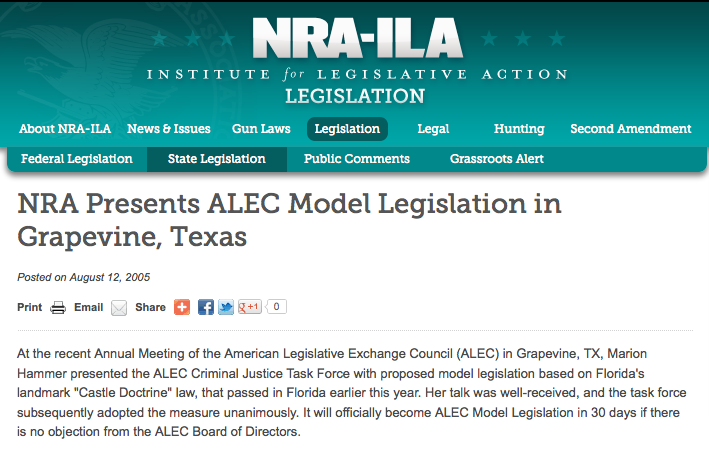
Yet while Stand Your Ground has garnered the most attention, advocates—and especially gun rights advocates—have pursued a deeper goal: insulating defensive gun use from legal oversight to the greatest extent possible. It is hard to overstate the degree to which the quick rise of self-defense immunity is due to lobbying by advocates for one deadly weapon (the gun) that is used in a minuscule percentage of self-defense confrontations.31See Eric Ruben, Law of the Gun: Unrepresentative Cases and Distorted Doctrine, 107 Iowa L. Rev. 173, 202 (2021) (“According to the [National Crime Victimization Survey], fewer than 1 percent of crime victims report using a gun in self-defense . . . .” (citing David Hemenway & Sara J. Solnick, The Epidemiology of Self-Defense Gun Use: Evidence from the National Crime Victimization Surveys 2007–2011, 79 Preventative Med. 22, 22 (2015))). The loudest voices advocating for immunizing self-defense tend not to be those seeking criminal justice reform generally but rather those seeking to expand gun rights. A National Rifle Association (“NRA”) lobbyist, for example, drafted and led the campaign to institute self-defense immunity in Florida, which then became a model for states across the nation.32See infra notes 162–64 and accompanying text (discussing the involvement of the National Rifle Association in the spread of self-defense immunity laws). The playbook for transforming self-defense into an immunity mirrors the one used to expand gun rights.33See infra notes 149–54 and accompanying text (describing similarities in arguments raised for gun rights and self-defense immunity). The overlap between gun rights and self-defense rights advocacy begs the question of whether any principle other than bestowing a benefit on gun users is guiding self-defense’s transformation from an affirmative defense into an immunity. Part II raises several possibilities, but it finds each too thin to justify such an immense procedural departure.

Part III then explores functional and institutional costs of immunizing private violence. Self-defense immunity sends a signal that people can judge for themselves when to deploy violence in the name of self-protection without exposure to prosecution, thereby encouraging unnecessary violence.34See infra Section III.A. Meanwhile, by preventing the community, through the jury, from evaluating the lawfulness of defensive force, immunity jettisons the institution best suited for adjudicating self-defense.35See infra Section III.B. In addition, immunizing self-defense creates an inefficient process by which courts consider the same witnesses and arguments that will be presented at trial during a separate pretrial hearing, setting up the sort of mini-trial that criminal procedure generally disfavors.36See infra Section III.C.

Trials like Rittenhouse’s spark intense disagreement and debate. But such trials are a feature—not a bug—of the American justice system. The Article concludes that policymakers should keep self-defense in its traditional place as an ordinary affirmative defense to criminal charges. Criminal justice reform is desperately needed, but treating private violence as privileged at the behest of gun rights advocates is a perilous path.

I.  SELF-DEFENSE AND PRETRIAL CRIMINAL PROCEDURE

       As Carl Sagan famously put it: “You have to know the past to understand the present.”37Carl Sagan, Cosmos 41 (1980). That maxim applies equally well for modern criminal law. This Part thus explores how self-defense was historically implemented in criminal procedure. It shows how the criminal justice system that the United States adopted from England was “trial-centered, in the sense that the legal system sought to resolve most criminal business at trial,”38John H. Langbein, The Origins of Adversary Criminal Trial 7 (2003). including claims of self-defense. This Part then shows how that treatment continued in modern times until the recent effort to grant pretrial prosecutorial immunity for self-defense. The effort to recharacterize self-defense as an immunity invites a question about how immunities fit within the criminal justice system. This Part closes by addressing that question, showing how and why prosecutorial immunities are few in number and narrowly construed, and how and why their typical rationale does not apply to self-defense.

A.  Historical Procedure

In 1841, in People v. McLeod, a New York court considered a habeas corpus petition for a defendant charged with murder.39People v. McLeod, 1 Hill 377 (N.Y. Sup. Ct. 1841). The defendant sought his “unqualified discharge” on the basis of pretrial evidence that, among other things, he acted in lawful self-defense.40Id. at 392–93. The court emphatically rejected the “extraordinary” request,41Id. at 406. noting the “absurdity of such a proposition in practice, and its consequent repudiation by the English criminal courts” whose law and procedure the United States inherited.42Id. at 404. Among other things, granting the defendant’s request “would be to trench on the office of the jury.”43Id. at 397. As the court explained, “[a]n innocent man may be, and sometimes unfortunately is[,] imprisoned. Yet his imprisonment is no less lawful than if he were guilty. He must await his trial before a jury.”44Id. at 404. That early American understanding of the appropriate time—and the appropriate entity—to adjudicate self-defense was firmly rooted in the English common law tradition.

During the seventeenth and eighteenth centuries in England, after a felony was charged, judges lacked authority to discharge defendants “without further trial.”45Michael Dalton, The Country Justice 407 (1618) (“[I]t is not fit that a [m]an once arrested and charged with Felony (or suspicion thereof) should be delivered upon any [m]an’s discretion, without [further] [t]rial.”). Justices of the peace played the central role in administering the criminal law. See generally Larry M. Boyer, The Justice of the Peace in England and America from 1506 to 1776: A Bibliographic History, 34 Q.J. Libr. Cong. 315 (1977) (discussing the power and reach of justices of the peace in criminal matters); see also Saul Cornell, The Right to Keep and Carry Arms in Anglo-American Law: Preserving Liberty and Keeping the Peace, 80 Law & Contemp. Probs. 11 (2017) (discussing justice of the peace manuals used by English and American officials between 1688 and 1835). This was true regardless of whether the defendant was believed to be justified in engaging in the alleged offense conduct.46See Richard Burn, The Justice of the Peace and Parish Officer 207 (1756) (“If a felony is committed, and one is brought before a justice upon suspicion thereof, and the justice finds upon examination that the prisoner is not guilty, yet the justice shall not discharge him, but he must either be bailed or committed; for it is not fit that a man once arrested and charged with felony, or suspicion thereof, should be delivered upon any man’s discretion, without further trial.”); see also Langbein, supra note 38, at 46–47 (“[T]he JPs had no power to dismiss felony charges for insufficiency of the evidence.”); id. at 47 (“What passed for truth in English criminal procedure would have to emerge at trial, from the altercation of citizen accusers and citizen accused.”). Some justices of the peace pressured prosecutors to discharge cases, while recognizing their own limited ability to discharge cases before trial. Id. at 47 n.184. In the 1700s, judges began conducting a “pretrial inquiry” that “increasingly took on the trappings of a public hearing, which would ultimately come to be known as the preliminary hearing.”47Langbein, supra note 38, at 274. At such hearings, however, the defense attorney was limited to challenging the prosecution’s case and was not entitled to present the defense’s case.48Id. at 274–75; see also id. (“As late as 1787 an experienced Old Bailey barrister serving as defense counsel remarked in response to a question from the bench that ‘[t]he Magistrates at Bow Street never receive evidence for prisoners, only for prosecutors.’ ” (citing Darcy Wentworth & Mary Wilkerson, Old Bailey Sessions Papers (“OBSP”) 15, 19 (Dec. 1787, #8) (quoting Newman Knowlys))).

Classic common law treatises demonstrate how self-defense was just like other defenses in that it was a trial issue, not a pretrial issue. For example, Michael Foster, a judge on the King’s Bench and the author of a widely read treatise published in 1762, observed that the defendant raising self-defense “standeth upon just the same foot that every other Defendant doth: the Matters tending to Justify, Excuse, or Alleviate, must appear in Evidence before He can avail himself of them.”49Michael Foster, A Report of Some Proceedings on the Commission of Oyer and Terminer and Goal Delivery for the Trial of the Rebels in the Year 1746 in the County of Surry, and of Other Crown Cases 255 (1762). And the opportunity to introduce that evidence was not until trial: “[W]hether the Facts alledged by way of Justification, Excuse, or Alleviation are True, is the proper and only Province of the Jury.”50Id.; see also id. (“In every Charge of Murder, the Fact of Killing being first proved, all the Circumstances of Accident, Necessity, or Infirmity are to be satisfactorily proved by the Prisoner.”).

Several years after Foster’s publication, William Blackstone completed “the preeminent authority on English law for the founding generation,”51Alden v. Maine, 527 U.S. 706, 715 (1999); see also District of Columbia v. Heller, 554 U.S. 570, 593–94 (2008). in which he explained that “it is incumbent upon the prisoner to make out, to the satisfaction of the criminal court and jury,” any “circumstances of justification, excuse, or alleviation.”52See 4 William Blackstone, Commentary on the Laws of England *201 (1769). The jury, Blackstone wrote, is “to decide whether the circumstances alleged [regarding self-defense or other affirmative defenses] be proved to have actually existed”; the judge then decides “how far [the proved circumstances] extend to take away or mitigate the guilt.”53Id.

Edward Hyde East, in his influential 1803 treatise, built on Blackstone’s and Foster’s accounts and elaborated on the lack of a pretrial process for asserting self-defense.541 Edward Hyde East, Treatise of the Pleas of the Crown 340 (1803). He wrote that “the jury alone [is] to decide” on “the truth” of the defendant’s allegations of “justification, excuse, or alleviation,” though the judge could consider such defenses when deciding on bail.55Id.; see also id. (“And where a party is committed upon such a charge [of homicide], he may be brought up by habeas corpus before the court of [the King’s Bench], and if a clear case be laid before the court, whereby the homicide appears to be either justifiable or excusable, they will upon view of the depositions and commitment admit the party accused to bail, as in Mrs. Barney’s case . . . where the charge clearly appeared to be groundless.”). The McLeod case demonstrates that this current continued in the United States into the nineteenth century.56See supra notes 39–44 and accompanying text. In his 1872 Commentaries on the Law of Criminal Procedure, Joel Prentiss Bishop described how a defendant entering a plea of not guilty at arraignment formally “puts himself upon the country,” or submits to a trial by jury.57Joel Prentiss Bishop, Commentaries on the Law of Criminal Procedure; or, Pleading, Evidence, and Practice in Criminal Cases 487 (2d ed. 1872); see also Going to the Country, Black’s Law Dictionary (11th ed. 2019) (“The act of requesting a jury trial. A defendant was said to be ‘going to the country’ by concluding a pleading with the phrase ‘and of this he puts himself upon the country.’ ”); see also Francis Wharton, A Treatise on the Criminal Law of the United States § 530 (1874) (“In all cases of felony the prisoner shall be arraigned, and where any person on being so arraigned shall plead not guilty, every such person shall be deemed and taken to put himself upon the inquest or country for trial . . . .” (quoting criminal procedure rules in Pennsylvania)). The jury therefore remained the primary entity to decide disputed fact issues in criminal cases, including regarding self-defense.58Joel Prentiss Bishop, Commentaries on the Criminal Law § 735 (1868) (discussing how “inquiries concerning facts . . . must be passed upon by the jury”); Wharton, supra note 57, § 488 (describing how in a self-defense case, “[t]he jury must judge whether the danger was apparent”).

Pretrial processes, like the preliminary hearing and the grand jury, generally did not provide a defendant an opportunity to introduce evidence of any particular defense.59See James Manford Kerr & Francis Wharton, A Treatise on Criminal Procedure § 112 (10th ed. 1918) (“[N]or has the practice of taking the prisoner’s examination [at the preliminary magistrate’s review] been generally adopted.”); id. § 1288 (“The question before the grand jury being whether a bill is to be found, the general rule is that they should hear no other evidence but that adduced by the prosecution.”). Kerr and Wharton recognize limited exceptions “to avoid circuity and oppression,” such as if “the defendant, in a liquor prosecution, tenders a license.” Id. § 113. As the 1918 edition of Francis Wharton’s treatise on criminal procedure observed, “the better opinion is that on a preliminary hearing the magistrate is to hold the defendant for trial” when “there is made out a probable case of guilt.”60Id. § 114. Similarly, in a proceeding before the grand jury, “it is not the usage to introduce, in matters of confession and avoidance, witnesses for the defense, unless their testimony becomes incidentally necessary to the prosecution.”61Id. § 1288; see also id. § 1290 (“[A] grand jury has no authority by law to ignore a bill for murder on the ground of insanity, though it appear plainly from the testimony of witnesses, as examined by them on the part of the prosecution, that the accused was in fact insane . . . .”); see also Confession and Avoidance, Black’s Law Dictionary, supra note 57 (defining “confession and avoidance” to be “[a] plea in which a defendant admits allegations but pleads additional facts that deprive the admitted facts of an adverse legal effect”); Brooks v. Haslam, 4 P. 399, 399 (1884) (noting that self-defense “amounts simply to a plea in confession and avoidance”); Jordan v. State, 593 S.W.3d 340, 343 (Tex. Crim. App. 2020) (“Self-defense is a confession-and-avoidance defense requiring the defendant to admit to his otherwise illegal conduct.”).

The notion that self-defense could be adjudicated by a judge before trial thus has no basis in the common law tradition imported from England and implemented in America. The next Section shows how that basic understanding carried forward to modern times.

B.  Modern Procedure

In 1971, Indiana passed a statute providing that “[n]o person . . . shall be placed in legal jeopardy of any kind whatsoever” after exercising lawful self-defense.62Loza v. State, 325 N.E.2d 173, 176 (Ind. 1975) (quoting and discussing Ind. Code § 35-13-10-1 (repealed 1976)). Armed with that broad statutory language, one defendant sought a pretrial determination of the lawfulness of his claimed self-defense.63Id. In Loza v. State, Indiana’s highest court recognized the novelty of the proposition before reacting much like the New York court did more than a century earlier in McLeod.64See id. (“This statute has not been previously interpreted by our courts, and our research discloses no interpretation of any similar statute by any sister state.”); supra notes 39–44 and accompanying text (discussing People v. McLeod, 1 Hill 377 (N.Y. Sup. Ct. 1841)). In particular, in order “to prevent absurdity,” the court held that the new law “neither creates a new remedy nor does it alter our procedure in any respect.”65Loza, 325 N.E.2d at 176; see also Myers v. State, 137 N.E. 547, 548 (Ind. 1922) (noting that alleged facts surrounding claims of self-defense are “proper matters for the jury alone to consider and weigh”); Landreth v. State, 171 N.E. 192, 194 (Ind. 1930), overruled in part on other grounds by Burris v. State, 34 N.E.2d 928 (Ind. 1941) (“[T]he defense of self-defense is an ultimate fact solely for the determination of the jury from the evidence.”). In other words, self-defense remained a trial issue. The Loza court’s understanding was consistent with modern pretrial procedure.

Modern criminal procedure is heavily constitutional,66See William J. Stuntz, Substance, Process, and the Civil-Criminal Line, 7 J. Contemp. Legal Issues 1, 7 (1996) (“Only in criminal procedure does constitutional law dominate the field.”). and an overview of the minimalist pretrial constitutional requirements for defenses (like self-defense) is therefore instructive. Under the Fourth Amendment, police officers must have probable cause before making an arrest,67See generally Terry v. Ohio, 392 U.S. 1 (1968) (discussing when the probable cause requirement applies in police-citizen interactions). The probable cause standard is expressly referenced in the Fourth Amendment. U.S. Const. amend. IV (“The right of the people to be secure in their persons, houses, papers, and effects, against unreasonable searches and seizures, shall not be violated, and no Warrants shall issue, but upon probable cause, supported by Oath or affirmation, and particularly describing the place to be searched, and the persons or things to be seized.” (emphasis added)). and an impartial magistrate must review whether probable cause exists if the arrestee is to remain in custody.68See Gerstein v. Pugh, 420 U.S. 103, 114 (1975) (“[W]e hold that the Fourth Amendment requires a judicial determination of probable cause as a prerequisite to extended restraint of liberty following arrest.”). The Supreme Court has described probable cause as “a fluid concept” that “requires only a probability or substantial chance of criminal activity, not an actual showing of such activity.”69Illinois v. Gates, 462 U.S. 213, 232, 243–44 n.13 (1983). Admittedly, probable cause is “not a high bar.”70Kaley v. United States, 571 U.S. 320, 338 (2014).

Importantly, moreover, probable cause does not require robust consideration of self-defense, if it requires any at all. The Third Circuit has held that “affirmative legal defenses”—like self-defense—“are not a relevant consideration in [a police] officer’s determination of probable cause.”71Holman v. City of York, 564 F.3d 225, 229 (3d Cir. 2009). In contrast, the Second Circuit has held that “a police officer’s awareness of the facts supporting a defense can eliminate probable cause.”72Jocks v. Tavernier, 316 F.3d 128, 135 (2d Cir. 2003). That said, such evidence must be “conclusive” or first-hand,73See Ryan P. Sullivan, Revitalizing Fourth Amendment Protections: A True Totality of the Circumstances Test in § 1983 Probable Cause Determinations, 105 Iowa L. Rev. 687, 708–09 (2020) (discussing Jocks, 316 F.3d 128, and other relevant case law). and once an officer has probable cause to make an arrest, the officer does not constitutionally have “to investigate exculpatory defenses offered by the person being arrested or to assess the credibility of unverified claims of justification.”74Jocks, 316 F.3d at 135–36; see also Baker v. McCollan, 443 U.S. 137, 145–46 (1979) (observing that police officers do not have “to investigate independently every claim of innocence”); District of Columbia v. Wesby, 138 S. Ct. 577, 588 (2018) (“[P]robable cause does not require officers to rule out a suspect’s innocent explanation for suspicious facts.”). Self-defense is not singled out for special treatment, but rather is treated like any other defense.75Jocks, 316 F.3d at 135.

Subsequently, once a prosecutor makes a charging decision, there is “no federal constitutional right to any review” of that decision before trial “apart from the grand jury clause of the Fifth Amendment.”76Ronald Jay Allen, Joseph L. Hoffmann, Andrew D. Leipold, Debra Livingston & William J. Stuntz, Criminal Procedure: Adjudication and Right to Counsel 1037 (2011) (citing Gerstein v. Pugh, 420 U.S. 103, 119 (1975)). The grand jury, meanwhile, is also guided by the standard of whether there is “probable cause necessary to initiate a prosecution for a serious crime.”77Kaley v. United States, 571 U.S. 320, 328 (2014). In United States v. Williams,78United States v. Williams, 504 U.S. 36, 51 (1992). the Supreme Court held that, notwithstanding the constitutional obligation to disclose material exculpatory evidence to a defendant before trial,79Brady v. Maryland, 373 U.S. 83, 87 (1963) (“[T]he suppression by the prosecution of evidence favorable to an accused upon request violates due process where the evidence is material either to guilt or to punishment.”). the Constitution does not require prosecutors to disclose substantial exculpatory evidence to the grand jury, including regarding a potential claim of self-defense.80Williams, 504 U.S. at 51. Looking back to the common law history, the Court explained that the grand jury is “an accusatory [body],” not “an adjudicatory body,” and its task is “to assess whether there is adequate basis for bringing a criminal charge.”81Id. Historically, “it has always been thought sufficient for the grand jury to hear only the prosecutor’s side.”82Id. at 37.

In some jurisdictions, by either law or internal policy, prosecutors are held to a higher standard than the federal constitutional baseline with respect to grand juries.83Sara Sun Beale, William C. Bryson, James E. Felman & Katherine Earle Yanes, Prosecutor’s Duty to Present Exculpatory Evidence, in Grand Jury Law and Practice § 4:17 (2d ed. 2021) (“In approximately a quarter of the states, there are statutes or judicial decisions that require prosecutors to inform the grand jury of exculpatory evidence in some circumstances.”). However, most such departures only require presenting “evidence that is clearly exculpatory” or “that would exonerate the accused or lead the grand jury to refuse to indict.”84Id. The United States Justice Manual, for example, provides that “when a prosecutor conducting a grand jury inquiry is personally aware of substantial evidence that directly negates the guilt of a subject of the investigation, the prosecutor must present or otherwise disclose such evidence to the grand jury before seeking an indictment against such a person.” U.S. Dep’t of Just., Presentation of Exculpatory Evidence, in Department of Justice Manual § 9-11.233 (2021). That is a hard standard for a defendant to satisfy. Beale et al., supra note 83, § 4:17 (characterizing this “test” as “very difficult . . . to satisfy”). The Manual provides that “failure to follow the Department’s policy should not result in dismissal of an indictment,” but that “appellate courts may refer violations of the policy to the Office of Professional Responsibility for review.” U.S. Dep’t of Just., supra. Given the low bar for indictment—again, probable cause85Kaley v. United States, 571 U.S. 320, 328 (2014).—even these jurisdictions stop far short of adjudicating self-defense before trial.

The Federal Rules of Criminal Procedure, which “almost always reflect the basic position adopted in a substantial number of states,”86Wayne R. LaFave, Jerold H. Israel & Nancy J. King, Principles of Criminal Procedure: Post-Investigation 4 (2004). provide other pretrial procedural steps apart from the grand jury, most notably a preliminary hearing.87Fed. R. Crim. P. 5.1(e). Yet the preliminary hearing—consistent with historical practices88See supra notes 47, 58–60 and accompanying text (discussing the historical focus on prosecution evidence at preliminary hearings).—focuses on the prosecution’s evidence for the charged offense, and not evidence of self-defense or any other affirmative defense. Again, the standard is probable cause: the prosecutor need only show “probable cause to believe an offense has been committed and the defendant committed it.”89Fed. R. Crim. P. 5.1(e). Moreover, the prosecutor gets to decide whether to have a preliminary hearing at all: if the prosecutor secures an indictment before a grand jury, then the defendant has no right to demand a pretrial hearing.90The same is true in “most states and for most charges.” Marc L. Miller, Ronald F. Wright, Jenia I. Turner & Kay L. Levine, Criminal Procedures: Prosecution and Adjudication 188 (6th ed. 2019) (discussing preliminary hearings).

It thus has remained true under conventional criminal procedure that “[i]f a defendant claims innocence or has a defense,” including self-defense, “the proper body to decide the issue is the petit jury.”91Beale et al., supra note 83. Recent reform efforts, however, characterize self-defense not as a “defense” but as an “immunity,” calling to mind exceptions to the general rule—a category of traditional immunities and other matters that are adjudicated pretrial. The next Section addresses such pretrial issues in relation to self-defense.

C.  Immunities from Prosecution

Recent legislation declaring that self-defense is an immunity from prosecution has led judges and commentators to treat self-defense as a “true immunity” comparable to others.92Rogers v. Commonwealth, 285 S.W.3d 740, 753 (Ky. 2009) (“[T]he General Assembly has made unmistakably clear its intent to create a true immunity, not simply a defense to criminal charges.”). This classification invites questions about how other prosecutorial immunities operate, why they exist, and whether they share anything in common with self-defense.93In considering these questions, I build on Cynthia Ward’s observation that self-defense immunity “seems quite different” from traditional immunities. See Ward, supra note 22, at 134–35 (“Traditionally, immunity from prosecution is offered to certain government officials, or to citizens performing important roles in the legal process (such as witness in a criminal case), where it might reasonably be argued that society’s interests in protecting such roles and functions outweighs its interest in prosecuting the individual. That seems quite different from the immunity procedure outlined in Florida’s self-defense law.” (citation omitted)).

Common immunities from prosecution include diplomatic immunity, judicial immunity, legislative immunity, executive immunity, immunity after compelled testimony, and immunity bestowed on the basis of a plea agreement.94Since my focus is on immunities from criminal prosecution, I do not address the operation of immunities geared toward civil suits and liability such as sovereign and qualified immunity. See, e.g., State v. Velky, 821 A.2d 752, 759 (Conn. 2003) (“Sovereign immunity is not applicable in criminal cases, because, at least ordinarily, the charges are not brought ‘in effect’ against the government.”); Kipps v. Caillier, 197 F.3d 765, 768 (5th Cir. 1999) (“Public officials acting within the scope of their official duties are shielded from civil liability by the qualified immunity doctrine.” (emphasis added)); Temich v. Cossette, No. 11CV958, 2015 U.S. Dist. LEXIS 76064, at *6 (D. Conn. June 12, 2015) (“The defense of qualified immunity is not germane to a criminal proceeding.”). These are “defenses” in the sense that they are asserted by a defendant as a way to avoid a conviction. But their essence goes beyond ordinary defenses because immunities operate to exempt a person from the mandate of the criminal law, not to justify otherwise criminal conduct because of the circumstances surrounding that conduct.95Immunity, Black’s Law Dictionary supra note 57 (“Any exemption from a duty, liability, or service of process; esp., such an exemption granted to a public official or governmental unit. Cf. IMPUNITY.”). Black’s Law Dictionary cross-references “impunity” in its definition of “immunity,” which similarly denotes an “[e]xemption from punishment.”96Impunity, Black’s Law Dictionary, supra note 57. The example that Black’s uses to describe impunity relates to diplomatic immunity: “because she was a foreign diplomat, she was able to park illegally with impunity.”97Id. Immunity gets asserted early in the criminal process to head off the prosecution of someone possessing such an exemption.

As such, prosecutorial immunities are a remarkable departure from the ordinary criminal process described above; moreover, they are in tension with a basic, distinctive function of criminal law. Criminal law is traditionally viewed as a means to declare “a formal and solemn pronouncement of the moral condemnation of the community.”98Henry M. Hart, Jr., The Aims of the Criminal Law, 23 Law & Contemp. Probs. 401, 405 (1958) (describing distinctions between criminal and civil wrongs); see also Paul Robinson, Criminal Law 21 (1997) (discussing the criminal law’s role in “creating and maintaining the social consensus on morality necessary to sustain norms”). The community’s role in implementing the criminal law—through a public prosecution and jury trial—is intertwined with that function. It is no coincidence that the prosecutor in a criminal case is called “The People” in many jurisdictions.99See, e.g., Law Reporting Bureau of the State of N.Y., New York Law Reports Style Manual § 8.1(a) (2012), http://www.courts.state.ny.us/reporter/new_styman.htm [perma.cc/62GF-KVATJ] (“In criminal actions, the prosecuting authority is usually described as ‘The People of the State of New York.’ ”).

Prosecutorial immunity dilutes the formal power of the public in assessing an alleged crime, and it thus raises special concerns in criminal law that might exist only to a lesser extent in the civil context, where immunity is sometimes granted, for example, primarily to avoid costs.100See generally Alexandra B. Klass, Tort Experiments in the Laboratories of Democracy, 50 Wm. & Mary L. Rev. 1501 (2009) (describing a growing conferral of tort immunity without accompanying compensatory schemes); John C.P. Goldberg, The Constitutional Status of Tort Law: Due Process and the Right to a Law for the Redress of Wrongs, 115 Yale L.J. 524 (2005) (describing and critiquing widespread tort reform); see also Protection of Lawful Commerce in Arms Act, Pub. L. No. 109-92, 119 Stat. 2095 (codified at 15 U.S.C. § 7901 et seq. (2005)) (shielding federally licensed firearm manufacturers, dealers, and sellers from civil, but not criminal, actions “resulting from the criminal or unlawful misuse” of firearms). In the criminal context, immunities tend to be justified by a narrower, more compelling rationale. As a general matter, only when avoiding the criminal justice process is a defense’s entire raison d’être is it exempted from prosecution as an “immunity.” Put differently, the public policies underlying the above-mentioned criminal law immunities necessarily require the avoidance of prosecution and trial.

Consider diplomatic immunity. A key reason why we immunize conduct by foreign diplomats in the United States is to protect American diplomats outside the United States from exposure to foreign court systems.101See U.S. Dep’t of State Off. of Foreign Missions, Diplomatic and Consular Immunity: Guidance for Law Enforcement and Judicial Authorities 5 (2018) [hereinafter Diplomatic and Consular Immunity] (“On a practical level, a failure of the authorities of the United States to fully respect the immunities of foreign diplomatic and consular personnel may complicate diplomatic relations between the United States and the other country concerned. It may also lead to harsher treatment of U.S. personnel abroad, since the principle of reciprocity has, from the most ancient times, been integral to diplomatic and consular relations.”); William F. Marmon, Jr., Note, The Diplomatic Relations Act of 1978 and Its Consequences, 19 Va. J. Int’l L. 131, 134, 142 n.64 (1978) (“[I]t is to our advantage not to expose our personnel to [foreign] court systems.” (quoting the testimony of Hampton Davis during a Senate Foreign Relations Hearing)). There is no way to satisfy that goal through an affirmative defense at trial. Consistent with the purpose of diplomatic immunity, it also does not protect diplomats from sanction upon return to their home countries.102See Vienna Convention on Diplomatic Relations, Apr. 18, 1961, 23 U.S.T. 3227, 500 U.N.T.S. 95, at art. 31(4) (“The immunity of a diplomatic agent from the jurisdiction of the receiving State does not exempt him from the jurisdiction of the sending State.”). Judicial, legislative, and executive immunities are similarly geared to specific policy rationales necessitating avoidance of a trial. Each protects “governmental officials from personal liability arising from their official duties” because of the strong interest in facilitating their ability to serve the public.103Robinson, supra note 29, at 231. The Supreme Court has explained how legislative immunity enables “representatives to execute the functions of their office without fear of prosecutions.”104Tenney v. Brandhove, 341 U.S. 367, 374 (1951). An added component of legislative and judicial immunity is to preserve the balance of power between the three branches of government by insulating legislative and judicial officers from prosecutions by the executive branch.105James Walton McPhillips, Note, “Saturday Night’s Alright for Fighting”: Congressman William Jefferson, the Saturday Night Raid, and the Speech or Debate Clause, 42 Ga. L. Rev. 1085, 1093 (2008) (observing how legislative immunity insulates legislators from an “unfriendly executive”). Again, interests that these governmental immunities serve cannot be furthered—and indeed would be undermined—if they were treated as defenses to be proved at trial. The remarkable benefit of immunity is thus granted because of strong public policy arguments that inherently entail a bar to prosecution.

How does self-defense relate to immunities? Self-defense is not about trial avoidance but exculpation.106Robinson, supra note 29, at 220 (observing that justification defenses exculpate because “by the infliction of the intermediate harm or evil, a greater societal harm is avoided or benefit gained”). Like other justification defenses and unlike immunities, it can be adjudicated in the traditional way—through trial—without undermining its rationale.107Id. at 220. “The societal benefit underlying [immunities] arises not from [the defendant’s] conduct, but from foregoing his conviction.” Id. at 232. Moreover, unlike typical immunities, self-defense furthers interests that are in fact undermined by short-circuiting a prosecution and trial.

T. Markus Funk has identified seven values served by self-defense law: protecting the state’s monopoly on force, protecting the individual attacker’s right to life, maintaining the equal standing between people, protecting the defender’s autonomy, ensuring the primacy of the legal process, maintaining the legitimacy of the legal order, and deterring attackers.108T. Markus Funk, Rethinking Self-Defence: The ‘Ancient Right’s’ Rationale Disentangled 18 (2021). Immunity arguably advances the interests in protecting a defender’s autonomy or deterring attackers. But it runs roughshod over other values, especially self-defense law’s dual roles of ensuring the primacy of the legal process and maintaining the legitimacy of the legal order. Both roles underlie the idea that “the authority to punish and condemn” remain with “the liberal state,” not with individual citizens.109Id. at 44. In his discussion of ensuring the primacy of the legal process, Funk notes that “[t]o the extent possible, . . . the justice system must promote the resolution of disputes in the courts.”110Id. at 43. Immunity, however, dilutes the state’s oversight of defensive violence and, perhaps worse still, undermines the community’s role through the jury to assess the lawfulness of violence—a point addressed in greater depth in Part III. In other words, in contrast to typical immunities, whose purposes areoverall advanced by providing an exemption from prosecution, key values underlying self-defense law are undercut by providing such an exemption.

Immunities, of course, are not the only matters that receive pretrial resolution. Some defenses—like those based on statutes of limitations, double jeopardy, and speedy trial requirements—are also adjudicated in advance of trial. Other issues, like competency to stand trial, also receive pretrial determination. In the effort to implement self-defense immunity, some have analogized self-defense to those other pretrial issues even though they are not technically “immunities.”111See, e.g., People v. Guenther, 740 P.2d 971, 977 (Colo. 1987) (en banc) (analogizing self-defense immunity to prosecutorial bars based on the statute of limitations, double jeopardy, and speedy trial requirements); Rogers v. Commonwealth, 285 S.W.3d 740, 755 (Ky. 2009) (comparing self-defense immunity hearings to competency hearings). Yet these issues, like traditional immunities, protect interests that necessarily call for avoiding trial and thus are dissimilar to self-defense. Statutes of limitations affirm the belief that “[a]fter a period of time, a person ought to be allowed to live without fear of prosecution.”112Model Penal Code § 1.07, cmt. at 16–17 (Tentative Draft No. 5, 1956); see also Toussie v. United States, 397 U.S. 112, 114–15 (1970) (observing that a limitations period “is designed to protect individuals from having to defend themselves against charges when the basic facts may have become obscured by the passage of time and to minimize the danger of official punishment because of acts in the far-distant past”). Double jeopardy protections are “designed to protect an individual from being subjected to the hazards of trial and possible conviction more than once for an alleged offense.”113Green v. United States, 355 U.S. 184, 187 (1957). Speedy trial guarantees mandate “the Government [to] move with the dispatch that is appropriate to assure [the defendant] an early and proper disposition of the charges against him.”114United States v. Marion, 404 U.S. 307, 313 (1971). And resolving competency questions must also happen before a trial since the entire point is to determine the defendant’s “ability to participate meaningfully in the trial.”115Rogers, 285 S.W.3d at 755.

In connection with competency hearings, one exception to the general rule of limiting pretrial criminal matters to those that inherently require pretrial determination involves the insanity defense. Courts tend to draw a clear line between the question of competency to stand trial, which is adjudicated in advance of trial, and insanity at the time of the offense, which is a trial issue.116See, e.g., Bishop v. Superior Court ex rel. County of Pima, 724 P.2d 23, 25–26 (Ariz. 1986) (en banc) (stating that competency and the insanity defense “are distinctly different inquiries, one leading to a determination of whether the trial can proceed at all, and the other to the trial defense of insanity”); Ricks v. State, 242 S.E.2d 604, 606 (Ga. 1978) (“The issue of the accused’s insanity at the time of the alleged crime is a question for the trial jury. The issue of the accused’s competency to stand trial is a question for a special jury upon a special plea of insanity.”). As a general matter, therefore, an insanity defense is submitted to the fact finder at trial and is not decided at a pretrial hearing.117See, e.g., Tenn. Code. Ann. § 39-11-501 (2014) (providing the defense of insanity is “a matter for the trier of fact alone”); Wis. Stat. § 971.165 (2008) (requiring a continuous, bifurcated trial for the insanity defense); State v. Fichera, 903 A.2d 1030, 1035 (N.H. 2006) (“[S]anity is a question of fact to be determined by the jury . . . .” (quoting State v. Hall, 808 A.2d 55 (N.H. 2002))); State ex rel. Smith v. Scott, 280 S.E.2d 811, 814 (W. Va. 1981) (“Consequently, we hold that a trial court judge is not under any duty to hold a hearing on the issue of criminal responsibility in advance of trial regardless of how compelling the pretrial reports may be. Criminal responsibility is a jury question . . . unless both prosecutor and judge concur that the outcome of the proceedings would be a foregone conclusion.”); Bonner v. State, 520 S.W.2d 901, 906 n.2 (Tex. Crim. App. 1975) (“The issue of insanity at the time of the commission of an offense is a defensive one, and therefore is properly raised during the course of the trial on the merits.”); People v. Ford, 235 N.E.2d 576, 578 (Ill. 1968) (“The defense of insanity at the time of the crime, like any other defense, must be raised at the time of trial and submitted to the jury who are hearing the case, and no special jury is called or pretrial hearing conducted to determine this question.”). However, such bifurcation is not universally followed. Pennsylvania law, for example, grants a judge the discretion to “hear evidence on whether the person was criminally responsible for the commission of the crime charged” so long as the judge is already conducting a competency hearing.11850 Pa. Cons. Stat. § 7404(a) (2014); see also Commonwealth v. Scott, 578 A.2d 933, 936–37 (Pa. Super. Ct. 1990) (describing procedure).

In that context, judicial economy might weigh in favor of considering evidence of both competency and insanity at a pretrial hearing. At least one other state—North Carolina—gives courts discretion to hold a pretrial insanity hearing so long as the state consents.119N.C. Gen. Stat. § 15A-959 (1973) (“Upon motion of the defendant and with the consent of the State the court may conduct a hearing prior to the trial with regard to the defense of insanity at the time of the offense.”). That exception is highly limited in that courts and prosecutors can override a defendant’s request for a hearing, making it quite different from self-defense immunity.120See infra Part II. And in Washington, a defendant may request a pretrial insanity determination, but the statute notes that any acquittal under the statute cannot be used to contest mental health detention—a possibility that distinguishes insanity and self-defense.121Wash. Rev. Code § 10.77.080 (1998) (“The defendant may move the court for a judgment of acquittal on the grounds of insanity: PROVIDED, That a defendant so acquitted may not later contest the validity of his or her detention on the grounds that he or she did not commit the acts charged.”); see also Christopher Slobogin, The Guilty but Mentally Ill Verdict: An Idea Whose Time Should Not Have Come, 53 Geo. Wash. L. Rev. 494 (1985) (discussing “not guilty but mentally ill” verdicts, by which a defendant is still incarcerated for treatment despite being found not guilty by reason of insanity).

This Section has set out the limited nature of criminal law immunities and other pretrial matters and offered a normative explanation, rooted in the criminal law’s distinctive role, for that narrow scope. Below, the Article considers additional arguments for and against expanding immunities to include self-defense.122See infra Section II.C, Part III. First, however, the Article turns to the story of how self-defense immunity arose in the first place.

II.  THE PUSH TO MAKE SELF-DEFENSE EXCEPTIONAL

In light of the American criminal law tradition of adjudicating self-defense at trial, how did self-defense immunity arise? This Part shows how self-defense immunity emerged out of Colorado in 1986, laid dormant for almost two decades, and then became a central component of gun rights advocacy in the 2000s. The Part then analyzes the thin rationales put forward for treating self-defense as deserving of exceptional treatment through prosecutorial immunity.

A.  Inauspicious Beginning in Colorado

Accounts of recent self-defense reforms tend to begin with Florida’s 2005 Stand Your Ground legislation.123See, e.g., Elizabeth Chuck, Florida Had First Stand Your Ground Law, Other States Followed in “Rapid Succession,” NBC News (July 18, 2013, 7:03 AM), https://www.nbcnews.com/news/us-news/forida-had-first-stand-your-ground-law-other-states-followed-flna6c10672364 [perma.cc/QX22-DB36]. Indeed, Florida’s law served as a model that influenced legal changes across the country.124See infra notes 162–69 and accompanying text (describing the influence of Florida’s self-defense reform). But the first example of a self-defense immunity statute was not Florida’s but rather a last-minute compromise bill from Colorado twenty years earlier.125See Colo. Rev. Stat. § 18-1-704.5 (1986); Dirk Johnson, “Make My Day”: More Than a Threat, N.Y. Times (June 1, 1990) (noting that “[n]o other state [was] believed to have such a law” providing immunity from criminal prosecution for lawful self-defense).

The Colorado law did not, at first, provide for prosecutorial immunity. Rather, the bill initially added a legal presumption to self-defense law to enhance the scope of lawful self-defense against home intruders.126William Wilbanks, The Make My Day Law: Colorado’s Experiment in Home Protection 31 (1990). To be sure, homeowners already had an expanded right to self-defense through the “Castle Doctrine,” which generally removed a person’s duty to retreat before using lethal defensive force in the home.127See Blackstone, supra note 52, at *223 (“[T]he law of England has so particular and tender a regard to the immunity of a man’s house, that it stiles it his castle, and will never suffer it to be violated with impunity.”); 1 Matthew Hale, The History of the Pleas of the Crown 486 (1680) (writing that when a man is assailed in his own house he “need not fl[y] as far as he can, as in other cases of se defendendo, for he hath the protection of his house to excuse him from flying, for that would be to give up the protection of his house to his adversary by flight”). All American jurisdictions accept some version of the Castle Doctrine. Sanford H. Kadish, Stephen J. Schulhofer & Rachel E. Barkow, Criminal Law and Its Processes: Cases and Materials 924 (2017); see also People v. Tomlins, 107 N.E 496 (N.Y. 1914) (“It is not now and never has been the law that a man assailed in his own dwelling is bound to retreat. If assailed there, he may stand his ground and resist the attack.”). However, Colorado policymakers wanted to do more, so they borrowed from a California statute that a person confronting a home intruder is legally “presumed” to fear for their life.128See Cal. Penal Code § 198.5 (1984) (“Any person using force intended or likely to cause death or great bodily injury within his or her residence shall be presumed to have held a reasonable fear of imminent peril of death or great bodily injury to self, family, or a member of the household when that force is used against another person, not a member of the family or household, who unlawfully and forcibly enters or has unlawfully and forcibly entered the residence and the person using the force knew or had reason to believe that an unlawful and forcible entry occurred.”). That presumption would satisfy one requirement of lethal defensive force—that the defender reasonably perceives a threat of death or serious bodily injury129See Colo. Rev. Stat. § 18-1-704(2)(a) (“Deadly physical force may be used only if a person reasonably believes a lesser degree of force is inadequate and . . . [t]he actor has reasonable ground to believe, and does believe, that he or another person is in imminent danger of being killed or of receiving great bodily injury.”).—thereby relieving the defendant of the need to produce evidence of such heightened fear.

Prosecutors objected because they “believed that it would be very difficult, if not impossible, to rebut the presumption in favor of the homeowner.”130Wilbanks, supra note 126, at 42. The presumption would result in a helpful jury instruction for the defendant and could help a defendant avoid taking the stand to demonstrate a fear of death or great bodily injury. The presumption would not shift the burden of proof, however, since the prosecution already had to disprove self-defense beyond a reasonable doubt. See Martin v. Ohio, 480 U.S. 228, 236 (1987) (“[A]ll but two of the States, Ohio and South Carolina, have abandoned the common-law rule and require the prosecution to prove the absence of self-defense when it is properly raised by the defendant.”). There was little public debate regarding the subsequent compromise that became the nation’s first law providing immunity from prosecution for self-defense.131Wilbanks, supra note 126, at 38 (noting the compromise negotiations were “held behind closed doors” and “were unannounced . . . and lacked formality”). Yet the law appears to have imported a civil immunity provision enacted in Colorado in 1982 into the criminal law.132See infra notes 133–35 and accompanying text (describing Colorado’s civil immunity law).

By way of background, in 1981, a Colorado jury awarded a plaintiff more than $300,000 in damages from a defendant for gunshot injuries incurred while the plaintiff was burglarizing the defendant’s shop.133Wilbanks, supra note 126, at 21–23. The public outcry was swift and the shop owner’s lawyer helped to draft a bill immunizing people like his client from civil damages.134Id. at 23. The resulting law barred payouts for personal injuries “sustained during the commission of or during immediate flight from” a felony if the person inflicting the injury reasonably believed that physical force was “reasonable and appropriate” to prevent both injury and the commission of the felony.135Id. at 24. The wisdom of such civil immunity is beyond the scope of this Article; more important for present purposes is that it did not address immunity from criminal liability. As discussed above, criminal liability is geared toward vindicating public harms in a way that civil liability is not.136See supra notes 92–98 and accompanying text. The Colorado shop owner case demonstrates another distinction between civil and criminal cases in that the prosecutor declined to prosecute. Wilbanks, supra note 126, at 22. In criminal cases, a prosecutor with legal experience weighs the viability of a case before pressing charges and then must prove the case beyond a reasonable doubt. In re Winship, 397 U.S. 358, 364 (1970) (“[T]he Due Process Clause protects the accused against conviction except upon proof beyond a reasonable doubt of every fact necessary to constitute the crime with which he is charged.”). In contrast, civil plaintiffs are frequently not lawyers (even if they have representation by one) and face a lesser burden of proof: they have to prove their case by a preponderance of the evidence, not beyond a reasonable doubt. See Addington v. Texas, 441 U.S. 418, 423–24 (1979) (observing that in “the typical civil case involving a monetary dispute between private parties[, s]ince society has a minimal concern with the outcome of such private suits, plaintiff’s burden of proof is a mere preponderance of the evidence,” whereas “[i]n a criminal case, on the other hand, the interests of the defendant are of such magnitude that . . . the state [must] prove the guilt of an accused beyond a reasonable doubt”). This presents a risk of over-litigation in the civil context that is generally absent from the criminal context. Nonetheless, the criminal immunity bill that later passed in Colorado in 1986 mirrored the earlier civil immunity law. The law provided that a person “shall be immune from criminal prosecution” if the person used defensive force and four conditions were met relating to an unlawful home intrusion.137Colo. Rev. Code § 18-1-704.5(3) (1986) (emphasis added). The four conditions were that (1) the defendant was an “occupant of a dwelling”; (2) another person “made an unlawful entry into the dwelling”; (3) “the occupant ha[d] a reasonable belief that such other person . . . committed a crime in the dwelling in addition to the uninvited entry, or [wa]s committing or intend[ed] to commit a crime against a person or property in addition to the uninvited entry”; and (4) “the occupant reasonably believe[d] that such other person might use any physical force, no matter how slight, against any occupant.” Id.

The 1986 law’s legislative sponsors and the negotiating prosecutors appeared to have different beliefs about what the new law actually accomplished. The sponsors appreciated that they had achieved “greater protection [for defendants] than a presumption for the homeowner as part of an affirmative defense at trial.”138Wilbanks, supra note 126, at 46. The negotiating prosecutors, in contrast, believed that they gave up nothing. Denver’s district attorney, for example, publicly commented that the “compromise is just a clarification of existing law.”139Id. at 45 (quoting Norman Early).

In that vein, some prosecutors tried to argue in subsequent litigation that the new provision could not possibly grant true immunity for self-defense.140People v. Guenther, 740 P.2d 971, 975 (Colo. 1987). Among other things, they pointed out that the provision appears alongside other affirmative defenses in Colorado’s criminal code.141Id. When the issue reached the Colorado Supreme Court, however, the justices rejected the prosecutors’ interpretation that self-defense remained an ordinary defense to be proved at trial, noting that “[i]t must be presumed that the legislature has knowledge of the legal import of the words it uses.”142Id. at 976. The plain meaning of “shall be immune from criminal prosecution” in the statute, they concluded, was “to bar criminal proceedings against a person for the use of force under the circumstances set forth” in the law.143Id. at 975. In the course of reaching that holding, the justices acknowledged what went unsaid during the legislative hearings: that “the immunity created by [the law] is an extraordinary protection which, so far as we know, has no analogue in Colorado statutory or decisional law.”144Id. at 980. In fact, immunity for self-defense in criminal cases does not appear to have existed anywhere else in the country.145See Johnson, supra note 125 (“No other state is believed to have such a law.”).

Perhaps because of its unusualness, or because it was an eleventh-hour deal seemingly unrooted in any principle other than compromise, Colorado’s self-defense immunity law was not immediately enacted elsewhere. In 1987, for example, Oklahoma’s governor vetoed legislation similar to Colorado’s, which subsequently passed after the immunity provision was removed.146Wilbanks, supra note 126, at 50–51. Nonetheless, Colorado’s immunity provision was on the books, providing a template for future efforts.

B.  Auspicious Effort by Gun Rights Advocates

The Colorado self-defense immunity law was not instituted at the behest of gun rights advocates or other lobbyists, but rather, it arose as a compromise with prosecutors after a locally elected leader perceived a need for expanding self-defense protections against home intruders.147Id. at 31 (“Rep. Armstrong says that the idea and initiative for the original bill was her own as she did not contact any lobbyists (the Colorado District Attorneys Council, the National Rifle Association, homeowners associations) to seek help in drafting the initial bill.”). In more recent times, however, gun rights advocates and the NRA in particular have led a campaign to expand not only the right to have and carry guns but also to brandish and shoot them when gun owners feel threatened.148For accounts of the NRA’s recent focus on self-defense law, and especially Stand Your Ground, see Mary Anne Franks, The Cult of the Constitution 85 (2019) and Caroline E. Light, Stand Your Ground: A History of America’s Love Affair with Lethal Self-Defense 161–62 (2017). Most public attention to this campaign has centered around Stand Your Ground, but looking closely at testimony and commentary reveals a deeper ambition: immunizing defensive gun use from prosecution.

The parallels between the NRA’s lobbying for gun rights and its lobbying for self-defense immunity is striking. Gun rights advocates frequently claim that the right to keep and bear arms is being disrespected in the courts and therefore that the Second Amendment needs more protection.149Joseph Blocher and I explore that rhetorical move in Eric Ruben & Joseph Blocher, “Second-Class” Rhetoric, Ideology, and Doctrinal Change, 110 Geo. L.J. 613, 613 (2022); see also Joseph Blocher & Eric Ruben, No, Courts Don’t Treat the Second Amendment as a ‘Second-Class Right,’ Wash. Post (Nov. 17, 2021, 6:00 AM), https://www.washingtonpost.com/outlook/2021/11/17/no-courts-dont-treat-second-amendment-second-class-right [https://perma.cc/S9QU-UHDD] (discussing “allegations of widespread mistreatment” of the right to keep and bear arms). The claim with self-defense is similar: as one gun rights advocate put it, self-defenders are “victimized . . . in court.”150Self-Defense Amendments: Hearing on H.B. 227 Before the Senate Natural Resources, Agriculture, and Environment Comm., 2021 Gen. Sess., at 35:30 (Utah 2021), https://le.utah.gov/
av/committeeArchive.jsp?timelineID=182900 [https://perma.cc/8K2K-MH86] (statement of Clark Aposhian).
The executive director of the NRA’s Institute for Legislative Action lamented that “people who defend themselves are more likely to be charged with crimes and, as the old sayings go, be forced to ‘tell it to the judge’ and ‘let the jury sort it out.’ ”151Chris W. Cox, “Castle Doctrine” Legislation: Protecting Your Right to Protect
Yourself, NRA-ILA (Apr. 1, 2012), https://www.nraila.org/articles/20120401/castle-doctrine-legislation-protecting-your-right-to-protect-yourself [https://perma.cc/7M2Q-PW9V].
That creates a problem, he explained, because “a murder trial puts the defendant at risk of a long prison sentence—or worse.”152Id. The NRA lobbyist most directly involved with Florida’s landmark Stand Your Ground bill in 2005 was likewise moved by this notion.153Mike Spies, The N.R.A. Lobbyist Behind Florida’s Pro-Gun Policies, New Yorker (Feb.
23, 2018), https://www.newyorker.com/magazine/2018/03/05/the-nra-lobbyist-behind-floridas-pro-gun-policies [https://perma.cc/ND4Z-RRE2] (describing Marion Hammer’s role in the enactment of Florida’s 2005 law and subsequent amendments).
A basic problem, in her view, was that people were “being arrested” and “prosecuted . . . for exercising self-defense that was lawful.”154Id. (quoting Marion Hammer).

An answer to that feeling of disregard for self-defense was to transform it from an affirmative defense to an immunity. The NRA devised a self-defense immunity law155Id. and found legislative sponsors in Florida who agreed with the complaint that, as one put it, “law-abiding citizens” who “protect themselves [are] in a posture that they have to defend themselves from their own government.”156Talk of the Nation, Opinion, Why I Wrote “Stand Your Ground” Law, NPR (Mar. 26, 2012, 1:00 PM), https://www.npr.org/2012/03/26/149404276/op-ed-why-i-wrote-stand-your-ground-law [https://
perma.cc/AKP6-KD45] (interview of State Rep. Dennis Baxley (R-Fla.)).
The measure passed in 2005 and went even further than Colorado’s, extending prosecutorial immunity to all self-defense—not just self-defense in the context of home invasions.157See id. In particular, the law provided that someone using lawful self-defense is “immune from criminal prosecution,” with “criminal prosecution” defined to “include[] arresting, detaining in custody, and charging or prosecuting the defendant.”158See Fla. Stat. § 776.032 (2005). The self-defense immunity provision adopted in Florida in 2005 is as follows:

Immunity from criminal prosecution and civil action for justifiable use of force.—

(1) A person who uses force as permitted in s. 776.012, s. 776.013, or s. 776.031 is justified in using such force and is immune from criminal prosecution and civil action for the use of such force, unless the person against whom force was used is a law enforcement officer, as defined in s. 943.10(14), who was acting in the performance of his or her official duties and the officer identified himself or herself in accordance with any applicable law or the person using force knew or reasonably should have known that the person was a law enforcement officer. As used in this subsection, the term “criminal prosecution” includes arresting, detaining in custody, and charging or prosecuting the defendant.

(2) A law enforcement agency may use standard procedures for investigating the use of force as described in subsection (1), but the agency may not arrest the person for using force unless it determines that there is probable cause that the force that was used was unlawful.

(3) The court shall award reasonable attorney’s fees, court costs, compensation for loss of income, and all expenses incurred by the defendant in defense of any civil action brought by a plaintiff if the court finds that the defendant is immune from prosecution as provided in subsection (1).

Id. The law, formally called, “An act relating to the protection of persons and property,” 2005 Fla. Laws 199, also enacted Stand Your Ground, 2005 Fla. Laws 202, and two presumptions making it easier to defend deadly defensive force in a person’s home and cars, see id. (creating Fla. Stat. § 776.013(1), (4)).

After some Florida judges placed the burden on the defendant to prove self-defense at a pretrial hearing, legislators stepped in to strengthen the immunity provision by clarifying that the burden of proof is on the prosecutor to disprove self-defense before trial by clear and convincing evidence.159See Love v. State, 286 So. 3d 177, 180 (Fla. 2019) (recounting the history of the burden shift for self-defense immunity in Florida). That standard is much higher than the probable cause standard that prosecutors must satisfy to indict, which, as discussed above, is the primary focus of traditional and modern pretrial screening.160See supra Section I.B (discussing pretrial screening and the probable cause standard). And there have been efforts to increase the burden even more, such as by requiring the prosecutor to disprove self-defense beyond a reasonable doubt—the same burden borne by the prosecutor at trial.161See Lizette Alvarez, Florida Poised to Strengthen ‘Stand Your Ground’ Defense, N.Y. Times (Mar. 15, 2017), https://www.nytimes.com/2017/03/15/us/stand-your-ground-florida.html [https://
perma.cc/HF98-Z8EM] (describing effort to increase the burden for disproving self-defense at immunity hearings to the beyond-a-reasonable-doubt standard).

Unlike Colorado’s law, which failed to attract buy-in elsewhere, Florida’s law was aggressively promoted by the NRA and the conservative American Legislative Exchange Council (“ALEC”),162See NRA Presents ALEC Model Legislation in Grapevine, Texas, NRA Inst. Legis. Action (Aug. 12, 2005), https://www.prwatch.org/files/NRA_2005.png [https://perma.cc/MK8P-8AAY] (“At the recent Annual Meeting of the American Legislative Exchange Council (ALEC) in Grapevine, TX, Marion Hammer presented the ALEC Criminal Justice Task Force with proposed model legislation based on Florida’s landmark “Castle Doctrine” law, that passed in Florida earlier this year.”); Press Release, ALEC Statement on “Stand Your Ground” Legislation (Mar. 26, 2012), https://www.alec.org/
press-release/alec-statement-on-stand-your-ground-legislation-32612 [https://perma.cc/T8Q2-8X58] (“Florida’s ‘Stand Your Ground’ law was the basis for the American Legislative Exchange Council’s model legislation, not the other way around.”)
which described the need to “[p]rotect[] citizens from prosecution or liability if they use a firearm in self defense [sic] inside or outside their homes.”163See, e.g., ALEC, 2007 Legislative Scorecard, http://www.alec.org/am/pdf/2007
alecscorecard.pdf [https://web.archive.org/web/20081106044025/http://www.alec.org/am/pdf/2007
alecscorecard.pdf].
Similar laws were introduced in states across the country,164Id. (tracking where ALEC model legislation had been successfully introduced or enacted); see also Adam Weinstein, How the NRA and Its Allies Helped Spread a Radical Gun Law Nationwide, Mother Jones (June 7, 2012), https://www.motherjones.com/politics/2012/06/nra-alec-stand-your-ground [https://perma.cc/34DP-N7NG]. and the NRA-promoted sentiment that civilians asserting self-defense should have a path to immunity was frequently invoked. When legislators debated Iowa’s self-defense law, one objected that a person must “spend eternity in prison trying to defend themselves” after being put “in that untenable situation where they have to make that snap decision and defend themselves or another from an aggressor.”165Iowa House of Representatives Floor Debate on HF 517 During the 87th General Assembly, Iowa Legislature, at 1:15:45 PM (Mar. 7, 2017), https://www.legis.iowa.gov/perma/093020194217 [https://web.archive.org/web/20230421065522/https://www.legis.iowa.gov/dashboard?view=video&chamber=H&clip=H20170307124009459&dt=2017-03-07&offset=1793&bill=HF%20517] (statement of Rep. Matt Windschitl); see also id. at 1:52:00 PM (“We want to make absolutely certain that, if someone ever does find themselves in that situation where they’ve used Stand Your Ground or not retreated, that we provide to them the protections from criminal and civil actions against them.”). In Ohio, a legislative witness inveighed that “[t]he mere fact of acting justly in self-defense should not result in dragging folks who used defensive force in accordance with Ohio law through the mud, costing them valuable time and resources.”166Memorandum of Support for Senate Bill 215 from Ohio Gun Owners to the Ohio Senate Veterans and Public Safety Committee (Oct. 5, 2021) (statement of Rob Knisley, Ohio Gun Owners). In South Carolina, a self-defense bill’s sponsor argued that “the State should have to prove you did something wrong before they can send you to jail” to await trial in homicide cases.167WCBD News 2, Stand Your Ground in South Carolina, YouTube (May 19, 2016), https://www.youtube.com/watch?v=RptJ8dKVWJg [https://perma.cc/HQ7R-2MCQ] (interviewing House Rep. Greg Delleney, Jr., regarding H. 4703). And in Utah, an advocate complained that people should not have to “go through the crucible of a self-defense trial.”168Self-Defense Amendments: Hearing on H.B. 227 Before the Senate Natural Resources, Agriculture, and Environment Comm., 2021 Gen. Sess. (Utah 2021) [hereinafter Hearing on H.B.
227], https://le.utah.gov/av/committeeArchive.jsp?timelineID=182900 [https://perma.cc/8K2K-MH86] (statement of Mitch Vilos).
Ultimately, after the passage of Florida’s law, more than twenty other states passed some sort of self-defense reform, such as Stand Your Ground,169See The Effects of Stand Your Ground Laws, Rand Corp. (Apr. 22, 2020), https://
http://www.rand.org/research/gun-policy/analysis/stand-your-ground.html#fn3 [https://perma.cc/TA4X-5R64] (counting twenty-four states that passed self-defense reform in the decade after Florida’s 2005 enactment).
with at least thirteen enacting self-defense immunity.170See Ala. Code § 13A-3-23(d) (2016), Colo. Rev. Stat. § 18-1-704.5(3) (1985), Fla. Stat. § 776.032 (2005), Ga. Code Ann. § 16-3-24.2 (2014), Kan. Stat. Ann. § 21-5231 (2011), Ky. Rev. Stat. Ann. § 503.085 (West 2006), Okla. Stat. tit. 21 § 1289.25(F) (2018), S.C. Code Ann. § 16-11-450 (2006), Mich. Comp. Laws § 780.961(1) (2006), Idaho Code § 19-202A(1) (2018); Utah Code Ann. § 76-2-309 (2021), S.D. Codified Laws § 22-18-4.8 (2021), Iowa Code § 704.13 (2017), N.C. Gen. Stat. § 14-51.3 (2011).

But the fact that people who lawfully defend themselves are sometimes prosecuted and forced to argue self-defense is unexceptional. It is a truism that self-defense sometimes exculpates—that is precisely why it is an available defense to criminal charges. Singling out self-defense for special treatment as an immunity should have a compelling rationale similar to the ones that justify other prosecutorial immunities. The next Section searches for such a rationale in the legislative debates and commentary.

C.  Searching for a Rationale

A common assertion among advocates for self-defense immunity is that awaiting trial is “not giving the right to self-defense the consideration it deserves.”171Hearing on H.B. 227, supra note 168, at 8:40 (statement of Mitch Vilos). But why not? After all, awaiting trial is the traditional process and the one afforded other defenses. In his systematic analysis, Paul Robinson identifies dozens of other affirmative defenses that bar conviction.172Robinson, supra note 29, at 203 n.7. What is the basis for treating self-defense differently than these other defenses? Though legislative debates offer no consistent rationale, four can be teased out: restoring procedural protections for self-defense lost to history, stopping politically motivated prosecutions of self-defenders, vindicating the notion that self-defense is a “natural right,” and reducing defense costs for gun owners. None of these is as strong as the rationale for traditional immunities—an inherent need for pretrial adjudication.173See supra Section I.C (discussing traditional prosecutorial immunities). Moreover, each is unpersuasive on its own terms.

Some advocates argue that prosecutorial immunity restores self-defense to an exalted place from a bygone era. In Florida, for example, a witness testified that making the prosecutor disprove self-defense before trial “recover[s] a right that we as citizens lost to defend ourselves from criminals.”174Mark Obbie, The Politician Who Brought America ‘Stand Your Ground’ Is Pushing to Make Self-Defense Claims More Bulletproof, Trace (Sept. 27, 2015), https://www.thetrace.org/2015/09/stand-your-ground-florida-bill-baxley [https://perma.cc/2HEH-HTVM] (quoting testimony of Eric Friday). In Utah, a witness testified that “Utah used to have a robust preliminary hearing procedure” as it relates to self-defense, and that immunity “restores some much-needed balance.”175Self-Defense Amendments: Hearing on H.B. 227 Before the Senate Natural Resources, Agriculture, and Environment Comm., 2021 Gen. Sess., at 2:37 (Utah 2021) (testimony of Mark Moffatt), https://le.utah.gov/av/committeeArchive.jsp?timelineID=182900 [https://perma.cc/8K2K-MH86].

A related move has been to couple self-defense immunity with Stand Your Ground and then defend both on the basis of Stand Your Ground history. For example, the NRA has said that Stand Your Ground laws, such as Florida’s (which includes an immunity provision), “focus on the narrow issue of whether and to what extent a person who would otherwise have a right to self-defense forfeits that right by not first attempting to flee the confrontation.”176Stand Your Ground, NRA Inst. Legis. Action (Feb. 1, 2014), https://www.nraila.org/
articles/20140201/stand-your-ground [https://perma.cc/WKE5-VCKB].
With omnibus bills like Florida’s so purportedly reduced, the NRA then asserted that removing the duty to retreat has “a pedigree in American law dating back over 150 years.”177Id. Other advocates have similarly ignored everything in recent self-defense legislation other than Stand Your Ground and then defended the entirety on the basis of Stand Your Ground history.178A legal scholar with the Cato Institute, which also supports Florida-style self-defense laws, similarly downplayed their ambition. As he put it, “[Stand Your Ground] laws are a tremendously misunderstood aspect of the debate over firearms regulation and criminal-justice reform” because “[a]ll they do is allow people to assert their right to self-defense in certain circumstances without having a so-called ‘duty to retreat.’ ” Ilya Shapiro, Testimony Before the U.S. Senate Judiciary Committee’s Subcommittee on the Constitution, Civil Rights, and Human Rights: Hearing on “‘Stand Your Ground’ Laws: Civil Rights and Public Safety Implications of the Expanded Use of Deadly Force” 1 (Oct. 29, 2013), https://www.cato.org/sites/cato.org/files/pubs/pdf/syg_senate_
testimony_-_shapiro_with_attachments.pdf [https://perma.cc/NVT7-T2Y7]; see also id. (arguing that “there’s nothing particularly novel” about Stand Your Ground laws). The misdirection might be unwittingly assisted by opponents of immunity legislation who adopt a similar Stand Your Ground framing. See, e.g., ABA Task Force, supra note 17.

Nostalgia is a staple of gun rights advocacy,179See Ruben & Blocher, supra note 149, at 632 (describing rhetorical appeals to an imagined past in gun rights advocacy). so it is unsurprising to see appeals to history when it comes to self-defense immunity. Yet, as shown in Section I.A, there is no basis in Anglo-American legal tradition for immunizing private defensive violence. Treating self-defense as exceptional through immunity is a thoroughly modern innovation.

An alternative rationale is that people exercising lawful self-defense are targeted for “political” prosecutions.180See, e.g., Tucker Carlson, Kyle Rittenhouse’s Trial Is the Most Bizarre Court Proceeding Ever Caught on Camera, Fox News (Nov. 10, 2021), https://www.foxnews.com/opinion/tucker-carlson-kyle-rittenhouse-trial [https://perma.cc/9N8K-GCRX] (saying Kyle Rittenhouse’s prosecutor “didn’t want to know what happened that night” and was “under enormous political pressure” to “declare Kyle Rittenhouse a murderer”). Indeed, it has become an article of faith on the political right that people exercising self-defense with firearms are targeted for political prosecutions. See, e.g., Kyle’s Law, supra note 13 (“Too often, rogue prosecutors bring felony criminal charges against people who were clearly doing nothing more than defending themselves, their families, or others from violent criminal attack.”). Prosecutors have vigorously rejected that narrative, and advocates for immunizing self-defense have failed to offer convincing evidence of political prosecutions, let alone the sort of systemic abuses that would justify a radical change to self-defense law. Advocates for both of the first immunity statutes—in Colorado (1986) and Florida (2005)—could not point to a single example of an improper prosecution.181See Wilbanks, supra note 126, at 54 (“[T]he sponsors of the bill were not able to point to any case in the past where they viewed the prosecutor to have incorrectly (in their view of the homeowner’s right of self-defense) charged a homeowner.”); Spies, supra note 153 (“Hammer and the Republican sponsors of Stand Your Ground could not point to a single instance in which a person had been wrongfully charged, tried, or convicted after invoking Florida’s traditional self-defense law.”). Rather, the chief NRA lobbyist for the Florida law ultimately contended that whether bad prosecutions have been brought is “not relevant.”182Spies, supra note 153; see also Daniella Rivera, ‘It’s Not Working’: KSL Investigates Unintended Consequences of New Utah Self-Defense Law, KSL.com (Nov. 16, 2021, 12:17 PM), https://www.ksl.com/article/50284891/its-not-working-ksl-investigates-unintended-consequences-of-new-utah-self-defense-law [https://perma.cc/R34W-ZCRG] (“Lisonbee said the [Utah immunity] law was intended to address politically motivated prosecutions but could not provide examples of that happening in Utah.”).

In subsequent efforts to immunize self-defense, advocates have invoked the prosecutions of George Zimmerman for the shooting death of Trayvon Martin and Rittenhouse for the Kenosha incident as exemplars of political prosecutions justifying self-defense immunity.183See, e.g., Kyle’s Law, supra note 13 (naming the Zimmerman and Rittenhouse prosecutions as evidence of political prosecutions that rationalize the adoption of self-defense immunity). Looking to Zimmerman’s prosecution is somewhat ironic given that it took place in Florida after Florida adopted its 2005 immunity provision and Zimmerman opted not to have a pretrial immunity hearing.184See Lizette Alvarez & Cara Buckley, Zimmerman Is Acquitted in Trayvon Martin Killing, N.Y. Times (July 13, 2013), https://www.nytimes.com/2013/07/14/us/george-zimmerman-verdict-trayvon-martin.html [https://perma.cc/LWH5-H78G] (noting that the shooting occurred on February 26, 2012, and the trial took place in 2013). Furthermore, in both cases the juries reached verdicts only after extensive deliberation. The lead homicide investigator in the Zimmerman case recommended charges but was initially overruled.185Matt Gutman, Trayvon Martin Investigator Wanted Manslaughter Charge, ABC News (Mar. 27, 2012, 8:18 AM), https://abcnews.go.com/US/trayvon-martin-investigator-wanted-charge-george-zimmerman-manslaughter/story?id=16011674 [https://perma.cc/8TGG-8BQJ]. Many perceived the declination of charges as reflecting racial bias, as Martin was an unarmed Black teenager.186See Markovitz, supra note 22, at 879–80 n.32 (recounting how many thought “the criminal justice system was indifferent to Trayvon Martin’s death, and was disinclined to try to provide justice”). A special prosecutor ultimately brought charges and a trial was held.187See Alvarez & Buckley, supra note 184. The law considered by Zimmerman’s jury did not include how initial aggressors have a limited right to self-defense, since the judge declined to instruct the jury on the initial aggressor doctrine;188See Alafair Burke, What You May Not Know About the Zimmerman Verdict: The Evolution of a Jury Instruction, HuffPost (July 15, 2013), https://www.huffpost.com/entry/george-zimmerman-jury-instructions_b_3596685 [https://perma.cc/BDD9-7TGS]. perhaps that would have made a difference in the verdict. Others have argued that prosecutors in both cases made strategic errors that may have affected the outcomes.189Some legal scholars have asserted that the Zimmerman prosecution made a tactical error by pursuing a murder theory rather than solely a manslaughter theory. David G. Savage & Michael Muskal, Zimmerman Verdict: Legal Experts Say Prosecutors Overreached, L.A. Times (July 14, 2013,
12:00 AM), https://www.latimes.com/nation/la-xpm-2013-jul-14-la-na-zimmerman-legal-20130715-story.html [https://perma.cc/8BM3-XDAN]. That, of course, is different than saying Zimmerman should not have been prosecuted at all. Various commentators have also critiqued the strategy and tactics deployed in the Rittenhouse prosecution. See, e.g., Ashley Collman, Did Prosecutors Bungle the Kyle Rittenhouse Case? Legal Experts’ Reviews Are Mixed, Insider (Nov. 16, 2021, 12:29 PM), https://www.insider.com/legal-experts-say-kyle-rittenhouse-prosecution-made-some-mistakes-2021-11 [https://perma.cc/T6T7-97DW].
In the Zimmerman trial, half of the jurors reportedly wanted to convict but changed their minds.190Richard Luscombe, George Zimmerman: Half of Jurors ‘Initially Favored Conviction,’ Guardian (July 16, 2013, 7:22), https://www.theguardian.com/world/2013/jul/16/george-zimmerman-jurors-trayvon-martin [https://perma.cc/S4E7-4GY3].Deliberations in both cases extended over multiple days before the jurors returned not guilty verdicts.191Id.; see Bosman, supra note 7 (noting that the Rittenhouse jury deliberated for three days before reaching its verdict).

Of course, in an ideal world, prosecutors would have perfect clarity into guilt and innocence, and prosecutions that result in acquittals after trial would never be brought. That, of course, is not realistic and is the reason why affirmative defenses and trials exist.192Cf. Ward, supra note 22, at 136 (“The adjudication process itself is a recognition of human imperfection—because we can never have perfect knowledge, we subject our suspicions to the test of a criminal trial (or at least the prospect of a criminal trial) before punishing someone suspected of a crime.”). Moreover, in light of the radical nature of the change wrought by singling out self-defense for immunity, if political prosecutions are the justification, then advocates should put forth more and better examples.

Another rationale that advocates raise is that self-defense is philosophically or morally distinct as a natural or human right.193See, e.g., Self-Defense Amendments: Hearing on H.B. 227 Before the H. Judiciary Comm., 64th Leg., 2021 Gen. Sess. (Utah 2021), https://le.utah.gov/av/committeeArchive.jsp?timelineID=
180423 [https://perma.cc/XB2Y-GLUD] (testimony of Clark Aposhian, Utah Shooting Sports Council, noting “[s]elf-defense is a basic human right”).
The Republican Party platform refers to the right of self-defense as “God-given.”194See Republican Nat’l Convention, Republican Party Platform of 2016, at 12 (2016), https://prod-cdn-static.gop.com/static/home/data/platform.pdf [https://perma.cc/S4TQ-NA62]. And the argument that self-defense is a justification and not an excuse is often explained by referencing moral philosophy.195See Reznik, supra note 20, at 26–27. But these understandings of self-defense as a natural, divine, or human right have long existed in harmony with adjudication at trial. Blackstone, for example, referred to self-defense as a natural right,1961 William Blackstone, Commentary on the Laws of England *139–40 (1765). but he believed, as described above, that self-defense is squarely a jury question.197See supra notes 52–53 and accompanying text (discussing Blackstone’s account of the process for raising affirmative defenses). Saying that self-defense is a natural right does not rationalize treating it as an immunity any more than it rationalizes erasing the common law elements of necessity and proportionality that have long guided self-defense decision-making.198See, e.g., Isaacs v. State, 25 Tex. 174, 177 (1860) (stating that the right to self-defense “is founded on the . . . law of nature” but that the common law requirement of “necessity of the case, and that only . . . justifies a killing”).

That leaves the fourth explanation, which perhaps arises most often: that gun owners should not have to pay typical criminal defense costs if they have a claim of self-defense. The NRA’s former executive director noted that “the legal fees . . . can easily top $50,000.”199Cox, supra note 151. A representative of a gun rights advocacy group in Wyoming expressed a similar view: “We don’t want to have a gun owner bankrupted by the criminal process just because he had to use a firearm in self-defense.”200Arno Rosenfeld, Senate Removes Immunity from ‘Stand Your Ground’ Law, Cody Enter. (Feb. 28, 2018), https://www.codyenterprise.com/news/local/article_d303bdba-1cc8-11e8-8673-776a19213ae2.html [https://perma.cc/6TPX-XS8P] (quoting Aaron Dorr of Wyoming Gun Owners discussing Senate File 71). And in Utah, an advocate said, “I have people calling me all the time [and saying] I’m afraid it will ruin me if I have to defend myself.”201Self-Defense Amendments: Hearing on H.B. 227 Before the H. Judiciary Comm., 64th Leg., 2021 Gen. Sess. (Utah 2021), https://le.utah.gov/av/committeeArchive.jsp?timelineID=180423 [https://perma.cc/EGF2-RRLM] (statement of Mitch Vilos). The legislative sponsor of the Utah bill recounted how a person leaving a gun carry class remarked, “I would rather die than financially ruin my family” by using a gun in self-defense.202House of Representatives Floor Debate on H.B. 227 During the 2021 General Session, Utah State Legislature, at 1:00:11 (Feb. 22, 2021), https://le.utah.gov/av/floorArchive.jsp?
markerID=114533 [https://perma.cc/YF2H-3WSJ] (statement of State Rep. Karianne Lisonbee).

The cost of criminal defense is a concern for all defendants, not just those asserting that violent conduct was justified as self-defense, and cost typically is not a sufficient rationale for prosecutorial—as opposed to civil—immunity.203See supra notes 100–01 and accompanying text (comparing rationales for civil and prosecutorial immunities); cf. Ward, supra note 22, at 135–36 (questioning the trial hardship rationale for self-defense immunity procedures). If self-defense, alone among affirmative criminal law defenses, is to be immunized, it warrants a much stronger rationale than cost saving for gun owners. This is especially true in light of the costs incurred as a result of self-defense immunity that are discussed in the next Part.

III.  THE COSTS OF IMMUNIZING PRIVATE VIOLENCE

The previous Section showed how the usual arguments put forth to support self-defense immunity are thin. It also is important to consider whether immunizing private violence has costs that further undercut exceptional treatment of defensive force. This Part contends that it does: immunizing self-defense can lead to more unlawful violence with less legal oversight; diminish the jury, thereby inviting less accurate and less legitimate outcomes; and introduce inefficiency into the criminal justice process.

A.  More Unlawful Violence (and Increased Impunity)

The message that self-defense immunity sends is troubling: that people can engage in defensive violence that they believe is lawful with less legal oversight. Both logic and data suggest that this message could bring about more assaults and homicides because of the impunity it signals—and in fact provides. Frederick Schauer has observed that “[q]uite often, officials who are immune for one reason or another from formal legal sanctions violate the law with some frequency.”204Frederick F. Schauer, The Force of Law 90 (2015). One can expect the same result from self-defense immunity, except for a much larger swath of the population; relatively few people receive official immunity, but everyone is entitled to assert self-defense when defending against criminal charges.205Moreover, officials often are constrained by other forms of oversight that could compensate for the negative effects of granting immunity. See id. at 86 (discussing internal punishment that can play a role “in ensuring official obedience to law”).

Rafi Reznik has recently argued that the modern understanding of self-defense as a justification, not an excuse, can signal societal acceptance of the alleged offense conduct in a way that promotes more violence;206See Reznik, supra note 20, at 68 (“[W]e should not want to tell self-defenders that they have done the right thing, nor provide them with the powers that justification confers, vindicate the values that justificatory self-defense stands for, or accept the socio-political conditions that self-defense laws create or perpetuate.”). immunity sends an even more powerful signal. As Reznik describes, in the dominant view, a justification indicates that “the wrongfulness of the act is negated.”207Id. at 26. Excuses, on the other hand, do not negate the wrongfulness of the conduct but “negate the blameworthiness of the actor.”208Id. at 27. The upshot is that “[j]ustifying self-defense,” as opposed to excusing it, “can . . . amount to an encouragement and it can even amount to an imperative.”209Id. at 33; see also Markovitz, supra note 22, at 875–76 (observing how “legal determinations of self-defense are, in effect, reflective of policy determinations about socially acceptable forms of violence”). Reznik argues that self-defense should be considered an excuse, which it was under English common law.210See Reznik, supra note 20, at 65; see also Darrell A. H. Miller, Self-Defense, Defense of Others, and the State, 80 Law & Contemp. Probs. 85, 87–95 (2017) (tracing the intellectual history of self-defense from an excuse to a justification). On the ground, however, the trend is going in the opposite direction: jurisdictions are granting immunity to self-defenders, which goes even further down the path toward encouraging the use of violence than considering self-defense a justification.211Cf. Schauer, supra note 204, at 7 (noting that “[s]ometimes the law” creates positive incentives “by granting immunity from otherwise applicable and legally enforced obligations”).

This trend is especially problematic because people are often wrong about the lawfulness of defensive force. One study found, for example, that a majority of self-reported defensive gun uses are likely illegal.212David Hemenway, Debra Azrael & Matthew Miller, Gun Use in the United States: Results From Two National Surveys, 6 Inj. Prevention 263, 266 (2000). People “view [a] hostile encounter from their own perspective; in any mutual combat both participants may believe that the other side is the aggressor and that they themselves are acting in self-defense.”213Id. A particular incident from the summer of the Rittenhouse shooting is exemplary.

Two months before the Rittenhouse shooting, Mark and Patricia McCloskey stood outside their St. Louis, Missouri, mansion as racial justice protesters marched nearby.214Tom Jackman, St. Louis Couple Who Aimed Guns at Protesters Charged with Felony Weapons Count, Wash. Post (July 20, 2020, 8:33 PM), https://www.washingtonpost.com/nation/2020/07/20/st-louis-couple-who-aimed-guns-protesters-charged-with-felony-weapons-count [https://perma.cc/5PW7-6PG3]. The protestors do not appear to have entered the McCloskeys’ property, though they marched on the sidewalk in a gated community in which the McCloskeys lived. See Jessica Lussenhop, Mark and Patricia McCloskey: What Really Went on in St Louis that Day?, BBC (Aug. 25, 2020), https://www.bbc.com/news/election-us-2020-53891184 [https://perma.cc/C53B-FGL2] (reporting that, while protestors walked into the private neighborhood, video from the event “does not show the protestors cross[ed] onto the McCloskeys’ property, remaining instead on the sidewalks and in the roadway”). Both were captured on video screaming angrily and wielding firearms: Mr. McCloskey, an AR-15–style rifle, and Ms. McCloskey, a handgun that she pointed at one protester after another.215See Jackman, supra note 214; see also KMOV St. Louis, Charges Filed Against Mark and Patricia McCloskey, YouTube (Jul. 20, 2020), https://www.youtube.com/watch?v=sUMfKFLGDcE [https://perma.cc/QP6H-CH8Q]. In Missouri, it is a crime to “exhibit[], in the presence of one or more persons, any weapon readily capable of lethal use in an angry or threatening manner.”216Mo. Rev. Stat. § 571.030 (2022). A local prosecutor charged the couple with violating that statute.217See Jackman, supra note 214. In their defense, the couple asserted that their conduct was justified to protect themselves and their property.218Id.

Speaking at the 2020 Republican National Convention (the McCloskeys, like Rittenhouse, became celebrities on the political right for their gun use),219Caitlin O’Kane, St. Louis Couple Who Pointed Guns at Black Lives Matter Protesters to Speak at Republican National Convention, CBS News (Aug. 18, 2020, 2:06 PM), https://www.cbsnews.com/news/republican-national-convention-mark-patricia-mccloskey-to-speak [https://perma.cc/ATS7-DQH7]. Mr. McCloskey subsequently announced his candidacy for a
U.S. Senate seat, prominently displaying on his campaign website a photograph of himself and
Ms. McCloskey holding their guns during the racial justice protest. McCloskey for
Senate, https://www.mccloskeyforsenate.com [https://web.archive.org/web/20211106143557/https://
http://www.mccloskeyforsenate.com].
Mr. McCloskey, a lawyer, expressed outrage that the prosecutor “actually charged [them] with felonies for daring to protect [their] home.”220CNBC, Couple Who Pointed Guns at BLM Protesters Speaks at RNC, YouTube (Aug. 24, 2020), https://www.youtube.com/watch?v=gK8P0vUQ4lg [https://perma.cc/AU64-926A]. Then, in a remarkable move, Missouri’s attorney general urged dismissal of the local charges on the basis of the sentiment underlying immunity: “Missourians should not fear exposure to criminal prosecution when they use firearms to defend themselves and their homes from threatening intruders.”221Amicus Brief of Attorney General Eric Schmitt Supporting Dismissal of the Case, State v. McCloskey, No. 2022-CR01300, at *1 (Cir. Ct. Mo. Jul. 20, 2020). In the end, however, the couple effectively conceded that they were not lawfully defending themselves when they pled guilty to the crimes of assault and harassment, thereby waiving any claim for self-defense.222Meryl Kornfield, St. Louis Couple Who Pointed Guns at Protesters Plead Guilty, Will Give Up Firearms, Wash. Post (June 17, 2021, 7:07 PM), https://www.washingtonpost.com/nation/
2021/06/17/st-louis-couple-guns [https://perma.cc/EFL6-859X]; see Hagan v. State, 836 S.W.2d 459, 461 (Mo.1992), overruled on other grounds by State v. Heslop, 842 S.W.2d 72 (Mo. 1992) (“The general rule in Missouri is that a plea of guilty voluntarily and understandably made waives all non-jurisdictional defects and defenses.” (citation and quotation marks omitted)). Mr. McCloskey nonetheless showed no remorse, saying of the criminal conduct, “I did it, and I’d do it again.” Joel Currier, St. Louis
Gun-Waving Couple Plead Guilty to Misdemeanor Charges, St. Louis Post-Dispatch (June
17, 2021), https://www.stltoday.com/news/local/crime-and-courts/st-louis-gun-waving-couple-plead-guilty-to-misdemeanor-charges/article_5b02e25b-0034-58a3-8181-f0a724ffa323.html [https://perma.
cc/J5NN-A3MY]. The Supreme Court of Missouri suspended both Mark and Patricia McCloskeys’ law licenses because of their convictions for offenses involving moral turpitude. See In re Mark T. McCloskey, Order, No. SC99301 (Mo. Feb. 8, 2022); In re Patricia McCloskey, Order, No. SC99302 (Mo. Feb. 8, 2022).
In other words, despite their confident assertions that they were legally justified in their actions, they ultimately admitted that they had no legal justification for their conduct.223The case did not end there. The Missouri governor, who asserted that the prosecution was “political” and “out of control,” pardoned the couple. Meryl Kornfield, Missouri Governor Pardons
Mark and Patricia McCloskey, Who Pointed Guns at Protestors, Wash. Post (Aug. 3, 2021, 10:25
PM) https://www.washingtonpost.com/nation/2021/08/03/mccloskey-pardon [https://perma.cc/UP68-AY2Q]; Marc Cox Show, Interview of Governor Mike Parson, Facebook (July 17, 2020), https://www.facebook.com/watch/?v=273414383946013 [https://perma.cc/L63N-AUWR].

Unlawful defensive force imposes an especially troubling risk to Black men and women, like many of those marching in front of the McCloskey house, who are mistaken as threats all too frequently. Data has consistently shown that Black people are more likely to be misperceived as a threat than white people.224L. Song Richardson & Phillip Atiba Goff, Self-Defense and the Suspicion Heuristic, 98 Iowa L. Rev. 293, 307–14 (2012) (discussing data). According to L. Song Richardson and Phillip Atiba Goff, this is in part because Black people “serve as our mental prototype (i.e., stereotype) for the violent street criminal.”225Id. at 310. A prosecution and trial can separate out biased and unreasonable threat perceptions from unbiased and reasonable ones better than any individual can in the moment.226To be sure, I am not saying that juries are never biased. The point, rather, is that a jury with representation from a cross-section of the community as required by law should reflect more diverse voices than a lone defendant (or judge), which would make it better suited to discern biased and unreasonable threat assessments. I discuss virtues of the jury in greater detail below. See infra Section III.B. And getting it right is important for ensuring a fair and just implementation of criminal law.

Well-intentioned people can have flawed perceptions of lawfulness, but encouraging restraint for defensive violence through the threat of prosecution and punishment is even more important for those who are ill-intentioned. For some people, “genuine and sanction-independent obedience [to the law] is rare.”227Schauer, supra note 204, at 75; see id. at 59 (noting how law serves to “constrain[] moral outliers”). In that circumstance, “coercion through the threat of sanctions emerges as the principal mechanism for securing the obedience that turns out to be so often necessary.”228Id. at 75. Immunity lessens the law’s constraining force and risks that someone prone to violence will construe immunity as a license to commit violence.229See generally Dan M. Kahan, Gentle Nudges vs. Hard Shoves: Solving the Sticky Norms Problem, 67 U. Chi. L. Rev. 607 (2000) (discussing the criminal law’s ability to shape norms and behavior).

In this regard, it is notable that a study of the effects of Colorado’s 1986 immunity law found that those invoking immunity “used force (sometimes deadly force) as much out of anger as self-defense.”230Wilbanks, supra note 126, at 322. Moreover, the legal change primarily benefited defendants other than the intended beneficiaries—homeowners confronting stranger intruders.231Id. In the years immediately following the enactment, the only “strangers” who intruded into homes and faced defensive force triggering immunity were police officers.232Id. at 321.

Unfortunately, more recent empirical studies on the impact of changes to self-defense law do not distinguish between the effect of various simultaneous changes, such as Stand Your Ground, presumptions, and immunity. Several such studies have shown that self-defense reforms that include an immunity provision correlate with more violent crime.233See, e.g., Alexa R. Yakubovich, Michelle Degli Esposti, Brittany C. L. Lange, G. J. Melendez-Torres, Alpa Parmar, Douglas J. Wiebe & David K. Humphreys, Effects of Laws Expanding Civilian Rights to Use Deadly Force in Self-Defense on Violence and Crime: A Systematic Review, Am. J. Pub. Health (Mar. 10, 2021) (reviewing the literature). One study found that in the decade following Florida’s 2005 legislation, “monthly rates of homicide increased by 24.4% and monthly rates of homicide by firearm by 31.6%.”234David K. Humphreys, Antonio Gasparrini & Douglas J. Wiebe, Evaluating the Impact of Florida’s “Stand Your Ground” Self-Defense Law on Homicide and Suicide by Firearm: An Interrupted Time Series Study, 177 JAMA Internal Med. 44, 49 (2017). Another found that the law was associated with a 44.6% increase in adolescent firearm homicides.235Michelle Degli Esposti, Douglas J. Wiebe, Jason Gravel & David K. Humphreys, Increasing Adolescent Firearm Homicides and Racial Disparities Following Florida’s ‘Stand Your Ground’ Self-Defence Law, 26 Inj. Prevention 187 (2020). In February 2020, the U.S. Commission on Civil Rights released a report finding no evidence of crime deterrence and an increase in homicide rates in states that adopted such laws.236U.S. Comm’n on C.R., Examining the Race Effects of Stand Your Ground Laws and Related Issues 6 (2020). A commissioner recommended rejecting self-defense immunity because it “remove[s] incentives to mitigate or reduce the use of deadly force by protecting the claimant regardless of the collateral consequences.”237Id. at 26 (statement of Michael Yaki). Yet, as noted, the power of these studies as regards the impact of self-defense immunity is limited and, hopefully, future empirical studies will seek to isolate the effect of self-defense immunity.

A corollary to the signals sent by self-defense immunity is that sometimes immunity can in fact hinder or prevent a conviction of someone who engages in unlawful violence. The analysis of cases soon after Colorado passed its self-defense immunity law in 1986 found that the statute likely led to an acquittal in one case that would otherwise have been a probable conviction, as well as decisions not to prosecute in others.238Wilbanks, supra note 126, at 321–24. The district attorney for a single county in Kansas has reported “declin[ing] to file charges against thirty-three people based on self-defense immunity,” thirty of which were deemed homicides by the coroner.239Report of District Attorney Marc Bennett 18th Judicial District of Kansas
43 (Jan. 18, 2022), https://www.sedgwickcounty.org/media/60604/final-c-lofton-january-18-2022.pdf [https://perma.cc/6N6Y-5KC2].
Three additional cases were charged by the district attorney but dismissed on self-defense immunity grounds by a judge.240Id. at 45.

Those arguing in support of self-defense immunity do not contest, and implicitly concede, much of this analysis. They acknowledge that the risk of having to defend against a prosecution causes gun owners to hesitate before deploying lethal force, and they seek to reduce such hesitation.241See, e.g., supra notes 202–03 and accompanying text (expressing gun owner concerns about the cost of defending against a prosecution). However, a cost of immunizing self-defense is to transform the signals sent by conventional self-defense law in a way that likely leads to more unlawful, and at times discriminatory, violence. Furthermore, immunizing self-defense erects an obstacle to achieving a basic goal of the criminal justice system: punishing those who commit crimes of violence.

B.  Fewer Juries in Matters of Community Importance

Another consequence of granting a defendant immunity is to disempower a jury from deciding facts surrounding a properly charged crime. The institution of the jury has long played a central role in self-defense cases. The jury is well-equipped to resolve disputes about the lawfulness of violence. Moreover, and importantly in the context of self-defense, the community’s involvement through the jury legitimates the law and promotes acceptance of outcomes as well as community healing.

Today, the jury is most often discussed solely in the context of defendants’ rights,242See U.S. Const. amend. VI (granting defendants the right to “an impartial jury”); Duncan v. Louisiana, 391 U.S. 145, 155 (1968) (“A right to jury trial is granted to criminal defendants in order to prevent oppression by the Government.”). but the jury’s importance to society is actually far deeper. At the nation’s founding, Anti-Federalists were adamant about protecting the institution of the jury because, even more than protecting the defendant, the jury integrated “the people in the administration of government.”243Herbert J. Storing, What the Anti-Federalists Were For, in 1 The Complete Antifederalist 19 (Herbert J. Storing ed. 1981). As Laura I. Appleman has put it, “the right of the jury trial” is about “the participation of the citizenry in [the] rule of law.”244See Laura I. Appleman, The Lost Meaning of the Jury Trial Right, 84 Ind. L.J. 397, 413 (2009); see also id. (noting that juries play an invaluable role for “the local community and to the people at large”); accord Stephen A. Siegel, The Constitution on Trial: Article III’s Jury Trial Provision, Originalism, and the Problem of Motivated Reasoning, 52 Santa Clara L. Rev. 373 (2012); Meghan J. Ryan, Juries and the Criminal Constitution, 65 Ala. L. Rev. 849, 882 (2014); George C. Harris, The Communitarian Function of the Criminal Jury Trial and the Rights of the Accused, 74 Neb. L. Rev. 804 (1995). This feature of the jury—as a key means of community involvement in the law’s implementation—is reflected in the fact that a defendant has no federal constitutional right to waive a jury trial, even if a defendant can demand one.245U.S. Const. amend. VI (“In all criminal prosecutions, the accused shall enjoy the right to a speedy and public trial, by an impartial jury of the State and district wherein the crime shall have been committed . . . .”); Singer v. United States, 380 U.S. 24, 34 (1965) (“[T]here is no federally recognized right to a criminal trial before a judge sitting alone.”). Some states do grant defendants a right to demand a bench trial as a matter of state law. See, e.g., Md. Code Ann., Crim. § 4-246 (West 2023) (“A defendant may waive the right to a trial by jury at any time before the commencement of trial . . . .”). Prosecutors and courts generally can demand jury trials even over the defendant’s objection.246See, e.g., Singer, 380 U.S. at 24–26 (upholding Rule 23(a) of the Federal Rules of Criminal Procedure, which requires the government to consent to and the court to approve a defendant’s waiver of a jury trial); Fla. R. Crim. P. 3.260 (“A defendant may in writing waive a jury trial with the consent of the state.”); Ky. R. Crim. P. 9.26 (“Cases required to be tried by jury shall be so tried unless the defendant waives a jury trial in writing with the approval of the court and the consent of the Commonwealth.”); State v. Greenwood, 297 P.3d 556, 558–59 (Utah 2012) (holding that a trial court erred when granting a defendant’s request for a bench trial over the prosecution’s objection); State v. Burks, 674 N.W.2d 640, 647 (Wis. Ct. App. 2003) (permitting the trial judge to insist on a jury trial even when both the defense and prosecution prefer a non-jury trial). Today, as in the past, there is a “strong preference for jury trials on all elements of a criminal case.”247Rodgers v. Commonwealth, 285 S.W.3d 740, 755 (Ky. 2009) (emphasis added).

Accuracy is one important interest served by this longstanding commitment to juries, because “[j]uries . . . are considered the best deciders of fact.”248See Ryan, supra note 244, at 872; see also Paul F. Kirgis, The Right to a Jury Decision on Sentencing Facts After Booker: What the Seventh Amendment Can Teach the Sixth, 39 Ga. L. Rev. 895, 905 (2005) (“As our system has implicitly recognized for centuries, juries are simply the best actors to decide fact questions.”); Jenia Iontcheva, Jury Sentencing as Democratic Practice, 89 Va. L. Rev. 311, 339–343 (2003) (discussing the virtues of the jury as a deliberative democratic body); Colleen P. Murphy, Integrating the Constitutional Authority of Civil and Criminal Juries, 61 Geo. Wash. L. Rev. 723, 745 (1993) (“The Founders considered the jury to be superior to a single judge in finding facts because it embodied the common sense of twelve individuals with a variety of experiences and knowledge.”). This is in no small part because juries “are more representative of their communities than judges . . . . They better represent various races, socio-economic classes, various levels of formal education, differing religions, and a broader spectrum of political engagement than do judges.”249Ryan, supra note 244, at 878; see also Laura Gaston Dooley, Our Juries, Our Selves: The Power, Perception, and Politics of the Civil Jury, 80 Cornell L. Rev. 325, 325 (1995) (“[T]he modern jury is the most diverse of our democratic bodies.”). This is especially true when the task is assessing “matters reflecting their communities’ values,”250Ryan, supra note 244, at 878. See generally Andrew Guthrie Ferguson, Why Jury Duty Matters (2012) (discussing the value of juries and jury duty in the American democracy). like self-defense.

Self-defense is inherently fact-based, calling for answering difficult questions about the reasonableness of a defendant’s perception of—and violent response to—a threat. Evaluating the lawfulness of self-defense calls for an assessment of whether defensive force was reasonably necessary and proportionate to a reasonably perceived threat.251See Ruben, supra note 19, at 81–89 (discussing elements of necessity and proportionality in self-defense law); United States v. Peterson, 483 F.2d 1222, 1229 (D.C. Cir. 1973) (“ ‘[T]he law of self-defense is a law of necessity’; the right of self-defense arises only when the necessity begins, and equally ends with the necessity . . . .”). A counterargument to the claim that a jury is best placed to decide on self-defense reasonableness might be that judges already decide questions of reasonableness for other purposes, especially determining the lawfulness of searches and seizures under the Fourth Amendment, so why not do so for self-defense, too? However, judicial determination of reasonableness in the Fourth Amendment context is itself heavily criticized, not least because “judges are not representative of the societal standards upon which [such] questions are based, thus likely skewing judges’ conclusions.” Ryan, supra note 244, at 874; see also id. at 877 n.177 (collecting scholarship critical of judicial determinations of reasonableness in the Fourth Amendment context). Criminal law scholars devise complex classifications in an attempt to capture the permutations of defensive confrontations and how they intersect with the law of self-defense,252See, e.g., Larry Alexander, Recipe for a Theory of Self-Defense: The Ingredients, and Some Cooking Suggestions, in The Ethics of Self-Defense 20, at 21–28 (Christian Coons & Michael Weber eds., 2016) (categorizing those who might be involved in self-defense situations and affect the application of law to facts as the victim, a nonthreatened third party, a culpable aggressor, a culpable person, a culpable faker, an innocent aggressor, an anticipated innocent aggressor, and an innocent bystander). but it is impossible to resolve self-defense claims through any sort of rote analysis. It is necessary to apply community values and experiences to assess reasonableness, and judges, unlike juries, are often removed from both.253See Ryan, supra note 244, at 874 (noting that judges “are not representative of society, nor are they usually representative of the individual communities that they serve”); id. at 874–77 (surveying literature on judicial diversity). Simply because a jury is comprised of a cross-section of the community, the jury will incorporate perspectives and experiences that lead to a fair resolution of disputed facts more so than a single judge who is likely insulated from the circumstances that gave rise to the violence.

Moreover, importantly, community resolution of the difficult factual questions that go into self-defense can legitimate the law and promote acceptance of outcomes.254See Funk, supra note 108, at 49 (“[W]idely rejected self-defence decisions can adversely impact the broader public’s view of the legitimacy of the legal order.”); id. (“Self-defence outcomes that are broadly rejected as immoral threaten to incrementally erode the justice system’s moral credibility, undermine compliance with the law, and reduce cooperation with legal authorities.”). Precisely because “juries have the power to incorporate societal norms and values into their decisions . . . citizens can view these determinations as legitimate and as not influenced by the political leanings of government-employed judges.”255Ryan, supra note 244, at 881. That sense of legitimacy, in turn, can help a community accept a case’s outcome and move past the trauma of community violence.

For example, after the killing of Trayvon Martin, the quick decision not to prosecute George Zimmerman led to mass protests across the country.256Patrik Jonsson, George Zimmerman Charged in Trayvon Martin Case: Why Now, and What Next?, Christian Sci. Monitor (Apr. 11, 2012), https://www.csmonitor.com/USA/Justice/2012/0411/
George-Zimmerman-charged-in-Trayvon-Martin-case-Why-now-and-what-next [https://perma.cc/
VZ8T-7P28] (describing protests).
Many thought that the declination of charges suggested that “the criminal justice system was indifferent to Trayvon Martin’s death and was disinclined to try to provide justice.”257Markovitz, supra note 22, at 879–80 n.32. The fact that Martin was a Black teenager triggered speculation that race was part of the reason for not immediately prosecuting Zimmerman.258Id. This speculation is consistent with data: as one researcher found, “[w]ith respect to race, controlling for all other case attributes, the odds a white-on-black homicide is found justified is 281 percent greater than the odds a white-on-white homicide is found justified.” John K. Roman, Race, Justifiable Homicide, and Stand Your Ground Laws: Analysis of FBI Supplementary Homicide Report Data 9 (2013). If the homicide occurred in a state with a Stand Your Ground law, like Florida, that “increases the odds of a justifiable finding by 65 percent.” Id. at 9–10; see also Nicole Ackermann, Melody S. Goodman, Keon Gilbert, Cassandra Arroyo-Johnson & Marcello Pagano, Race, Law, and Health: Examination of “Stand Your Ground” and Defendant Convictions in Florida, 142 Soc. Sci. & Med. 194 (2015) (finding a defendant was two times as likely to be convicted for killing a white victim as a non-white victim under Florida’s 2005 self-defense law). When a special prosecutor subsequently charged Zimmerman, the move brought great relief. Martin’s mother commented that “[w]e simply wanted arrest, nothing more, nothing less, and we got it.”259Jonsson, supra note 256 (quoting Trayvon’s mother, Sybrina Fulton). Although many people who wanted a prosecution may have been disappointed by the jury verdict of not guilty, that the process was followed, and that the decision was rendered by a jury certainly lowered the temperature of the earlier protests.

Conversely, a prosecution’s dismissal because of immunity sends a very different signal to the community. Victims and family members can never know how a jury of their peers would decide on the legality of defensive force. Indeed, a homicide case in Utah elicited the opposite reaction after the defendant was discharged because of self-defense immunity.260See Rivera, supra note 182 (describing the discharge of Troy James Pexton). A family member of the victim of the alleged homicide exclaimed in court: “We all feel the justice system has no doubt failed us.”261Id. (quoting from court audio recordings). Another said: “This has forever changed my outlook on the system and the faith that I once had that justice would prevail.”262Id. Similarly, in Kansas, after a prosecutor declined to bring homicide charges against juvenile detention officers citing a self-defense immunity law, the victim’s family viewed the decision as “yet another instance of an unarmed Black teenager killed by law enforcement with impunity” and without “even an ounce of accountability.”263Ryan Newton, Laura McMillan & Stephanie Nutt, Sedgwick County Prosecutor: No Charges in Cedric Lofton’s Death, KSN.com (Jan. 18, 2022), https://www.ksn.com/news/local/watch-live-da-holds-news-conference-unknown-subject [https://perma.cc/LP62-X55D] (quoting statement from Cedric Lofton’s family). Likewise, a community partnership expressed “outrage[]” at the declination of charges, viewing it as a “blatant disregard for the life” of the victim.264Id. (quoting statement by the Progeny youth/adult partnership).

The denouncements above demonstrate that self-defense immunity can not only prevent a community from healing, but can also undermine the rule of law and faith in the judiciary. In this regard, it is notable that the criticism in such cases is not at the legislature for passing a self-defense immunity bill, or at the governor for signing it, but rather at the “justice system” that “no doubt failed.”265Rivera, supra note 182. Moreover, under the law of self-defense, the harm caused by defensive violence is supposed to “remain[] a legally recognized harm which is to be avoided whenever possible,”266Robinson, supra note 29, at 213. and the conduct underlying self-defense is supposed to “remain[] generally condemned and prohibited.”267Id. at 220. Immunity dilutes the force of such legal values and erodes trust that the judicial system will enforce them.

C.  Inefficient Mini-Trials

One counterargument to concerns about self-defense immunity is that it will only weed out rare, egregious prosecutions. In some places where self-defense immunity is already enacted, the defendant has the burden of proving self-defense at an immunity hearing,268See, e.g., People v. Guenther, 740 P.2d 971, 977 (Colo. 1987) (en banc). or, in the alternative, the prosecutor must only show probable cause that self-defense did not justify the defendant’s violence.269See, e.g., Rodgers v. Commonwealth, 285 S.W.3d 740, 754 (Ky. 2009); State v. Hardy, 390 P.3d 30, 39 (Kan. 2017). In those places, most self-defense cases might still proceed to trial. This, however, raises a question about judicial economy.

To be sure, the likely trajectory for self-defense immunity is for legislators to strengthen it, similar to how Florida recently placed the burden on prosecutors to disprove self-defense by clear and convincing evidence at a pretrial hearing.270See supra notes 159–61 and accompanying text. Since Florida has led the way for NRA-backed initiatives to be subsequently passed elsewhere,271See David Cole, Engines of Liberty: The Power of Citizen Activists to Make Constitutional Law 105 (2016) (“Florida has generally been the NRA’s starting line for legislative gun rights campaigns . . . .”). it is no surprise that when Utah passed its self-defense immunity law in spring 2021, a legislative sponsor said the law “basically copie[d] and paste[d]” the clear and convincing evidence standard “from Florida[’s] statute.”272Rivera, supra note 182 (quoting Rep. Karianne Lisonbee, R-Clearfield, on the floor of Utah’s House of Representatives); Utah Code Ann. § 76-2-309 (West 2021) (setting out clear and convincing evidence standard). Furthermore, even in jurisdictions with lesser prosecutorial immunity standards currently, immunity still sends troubling signals that could increase violence.273See supra Section III.A.

Setting aside these concerns and focusing narrowly on the argument that immunity will have little impact on prosecutions outside of rare cases, a question arises: Why undertake an expensive immunity hearing that will mirror the eventual trial at all? Two goals of the rules governing criminal procedure are to “secure simplicity of procedure” and “to eliminate unjustifiable expense.”274Fed. R. Crim. P. 2. Self-defense immunity runs counter to those goals.

In this regard, it is helpful to contrast self-defense with other pretrial issues discussed above,275See supra Section I.C. which generally implicate evidence that is both clear-cut and distinct from proof of guilt or innocence. Whether too much time has passed between criminal conduct and a prosecution so as to violate a statute of limitations, for example, may call only for simple arithmetic unrelated to the alleged offense conduct.276See Toussie v. United States, 397 U.S. 112, 114–15 (1970) (“The purpose of a statute of limitations is to limit exposure to criminal prosecution to a certain fixed period of time following the occurrence of those acts the legislature has decided to punish by criminal sanctions.”). The same could be said for speedy trial issues.277See United States v. Loud Hawk, 474 U.S. 302, 312 (1986) (“[T]he Sixth Amendment’s guarantee of a speedy trial ‘is an important safeguard to prevent undue and oppressive incarceration prior to trial, to minimize anxiety and concern accompanying public accusation and to limit the possibilities that long delay will impair the ability of an accused to defend himself.’ ” (quoting United States v. Ewell, 383 U.S. 116, 120 (1966))). Determining whether a pending prosecution is substantially the same as an earlier one, thereby violating double jeopardy protections, calls for a comparison of the two prosecutions.278See Brown v. Ohio, 432 U.S. 161, 165 (1977) (“The legislature remains free under the Double Jeopardy Clause to define crimes and fix punishments; but once the legislature has acted courts may not impose more than one punishment for the same offense and prosecutors ordinarily may not attempt to secure that punishment in more than one trial.”). And determining whether diplomatic immunity attaches often only requires inquiring into the defendant’s status as a diplomat and whether the sending state has waived the immunity.279See, e.g., United States v. Khobragade, 15 F. Supp. 3d 383, 385 (S.D.N.Y. 2014) (“With several exceptions not applicable here, diplomatic officers may not be arrested, detained, prosecuted or sued unless their immunity is waived by the sending state.”); see also Diplomatic and Consular Immunity, supra note 101, at 7–8 (“Diplomatic agents . . . enjoy complete immunity from the criminal jurisdiction of the host country’s courts and thus cannot be prosecuted no matter how serious the offense unless their immunity is waived by the sending state . . . .”).

Yet proving or disproving whether self-defense exculpates requires consideration of the same witnesses and evidence that will be introduced at trial to prove the charged crime. Indeed, this is implicit in affirmative defenses (like self-defense), which contend that something happening at the time of the alleged offense justified or excused the underlying conduct. Resolving the lawfulness of self-defense ahead of trial would call for delving into the circumstances surrounding the charged offense and receiving testimony from the same witnesses of the alleged crime who will testify at trial. Self-defense immunity hearings, when they do not result in a dismissal, involve “mini-trials of the evidence in advance of the actual trial” that criminal procedure typically seeks to avoid.280See, e.g., United States v. Bazezew, 783 F. Supp. 2d 160, 166 (D.D.C. 2011) (discussing preference to avoid mini-trials in the context of evidentiary disputes).

To be sure, adding costs and inefficiencies is not always inappropriate. Many scholars agree that grand juries are ineffective at eliminating bad prosecutions281See, e.g., Roger A. Fairfax Jr., Grand Jury Innovation: Toward a Functional Makeover of the Ancient Bulwark of Liberty, 19 Wm. & Mary Bill Rts. J. 339, 341–45 (2010) (summarizing critiques); Andrew D. Leipold, Why Grand Juries Do Not (and Cannot) Protect the Accused, 80 Cornell L. Rev. 260, 265–69 (1995). The classic cliché is that a grand jury would “indict a ham sandwich.” See In re Grand Jury Subpoena of Stewart, 545 N.Y.S.2d 974, 977 n.1 (Sup. Ct. 1989), aff’d as modified, 548 N.Y.S.2d 679 (App. Div. 1989) (“[M]any lawyers and judges have expressed skepticism concerning the power of the Grand Jury. This skepticism was best summarized by the Chief Judge of this state in 1985 when he publicly stated that a Grand Jury would indict a ‘ham sandwich.’ ”). and that the plea bargain system that is used to resolve the vast majority of criminal prosecutions creates injustices.282See Jenia I. Turner, Transparency in Plea Bargaining, 96 Notre Dame L. Rev. 973, 974 (2021) (“Today, over ninety-five percent of convictions at the state and federal levels are the product of guilty pleas.”); Jenia I. Turner, Plea Bargaining, in 3 Reforming Criminal Justice: Pretrial and Trial Processes 73, 80–88 (Erik Luna ed., 2017) (reviewing critiques of plea bargaining). Some scholars and advocates have thus suggested reforms that would be costly, like enhancing internal prosecutorial screening283See Ronald Wright & Marc Miller, The Screening/Bargaining Tradeoff, 55 Stan. L. Rev. 29, 30–35 (2002) (“By prosecutorial screening we mean a far more structured and reasoned charge selection process than is typical in most prosecutors’ offices in this country.”); see also Allen et al., supra note 76, at 1039 (“In a system that resolves a huge majority of cases without trials, the choice of how best to screen prosecutors’ charging decisions is critically important to the quality of justice the system delivers.”). or devising something akin to summary judgment for criminal procedure.284Carrie Leonetti, When the Emperor Has No Clothes: A Proposal for Defensive Summary Judgment in Criminal Cases, 84 S. Cal. L. Rev. 661, 666, 685 n.105 (2011). But self-defense immunity is extrinsic to that broader conversation, which is about how to improve the pretrial process for all issues bearing on guilt and innocence, and for all defendants. Self-defense immunity grants a benefit for one defense championed by powerful lobbyists. That may explain why self-defense immunity is passing in legislatures, but it hardly rationalizes the costs.

CONCLUSION

A central goal of this Article is to show that the exceptionalism reflected in self-defense immunity laws is not rooted in history, tradition, or longstanding priorities of criminal law and procedure. Self-defense has always been an affirmative defense, embedded in a system of defenses and vindicated through the same criminal justice process as other defenses. Those pursuing self-defense immunity have thus far failed to put forward a compelling rationale for a radical departure from legal tradition. Self-defense should remain unexceptional within the system of criminal law defenses to avoid the unwarranted harms that can come from immunizing private violence.

96 S. Cal. L. Rev. 509

Download

* Associate Professor, SMU Dedman School of Law; Fellow, Brennan Center for Justice at N.Y.U. School of Law. Many thanks to Hillel Bavli, Joseph Blocher, Jake Charles, Guillermo Jose Garcia Sanchez, Chris Jenks, Cynthia Lee, Pamela Metzger, Darrell A. H. Miller, Adam Sopko, Jenia Iontcheva Turner, and Cynthia Ward, as well as participants in the U.C. Davis Law Review’s 2021 symposium, for helpful comments and suggestions. Tiereney Bowman, Robert Larkin, Maggie Gianvecchio, Darby O’Grady, Meredith Palmer, and Nick Salinaro provided excellent research assistance.

Suing SPACs

In 2020, the financial world became transfixed by a massive increase in the number of firms going public through special

Read More »

Suing SPACs

In 2020, the financial world became transfixed by a massive increase in the number of firms going public through special purpose acquisition company (“SPAC”) transactions. A SPAC is a publicly traded company formed solely for the purpose of raising money from investors and choosing a merger partner, thereby bringing the target company public. SPAC shareholders vote on the proposed transaction, but also have the option to redeem their shares for the price paid plus interest prior to the merger. SPACs have always been controversial; they make risky ventures available to unsophisticated investors, may involve acute conflicts of interest, and do not make the rigorous disclosures required in standard IPOs.

Is litigation a solution to these problems? The SPAC boom, as many commentators predicted, precipitated a deluge of lawsuits. Although several studies examine the SPAC transactions themselves, this project is the first comprehensive study of SPAC-related litigation. Using a dataset of all SPAC transactions completed since 2014 and all SPAC-related lawsuits filed since 2017, I assess the prevalence and characteristics of these lawsuits. I find that the probability that a SPAC transaction will generate a lawsuit appears to be unrelated to the returns on the deal, the size of the merger, the industry of the target, and various proxies for SPAC quality. However, I find a negative association between the likelihood of litigation and redemption rate. This is surprising because it means that the SPAC transactions more likely to generate lawsuits are those in which the SPAC shareholders choose to keep, rather than redeem, their shares, presumably signaling greater confidence in the quality of the deal. I argue that many of these lawsuits are opportunistic and may be of questionable quality. I further argue that these lawsuits are an inadequate substitute for the liability that firms face in connection with standard IPOs.

INTRODUCTION

Beginning in 2020, the financial world has been transfixed by a striking rise in the number of firms going public through special purpose acquisition company (“SPAC”) transactions. Although SPACs have been in and out of vogue for several decades, the most recent explosion is unprecedented.1See Max H. Bazerman & Paresh Patel, SPACs: What You Need to Know, Harv. Bus. Rev. July/Aug. 2021, at 104. In 2020, 53% of all initial public offerings (“IPOs”) were SPACs, and in the first quarter of 2021, that percentage rose to 62%,2Distribution of traditional IPOs and special purpose acquisition company (SPAC) IPOs in the United States from 2016 to 2021, Statista (July 4, 2022), https://www.statista.com/statistics/1234111/
number-traditional-spac-ipo-usa [https://perma.cc/YKA9-CYQA].
when SPACs issued more than $30 billion per month in equity.3Ortenca Aliaj & Miles Kruppa, The SPAC Machine Sputters Back to Life After Dramatic Meltdown, Fin. Times (Nov. 21, 2021), https://www.ft.com/content/d1723a8e-c146-4d48-8475-01cc9947a5d6 [https://perma.cc/Z3ZF-CJN5]; see also John C. Coates, SPAC Law and Myths 2 (Feb. 11, 2022) (unpublished manuscript), https//ssrn.com/abstract=4022809 [https://perma.cc/7L32-9QEU].

A SPAC is essentially a publicly traded shell company whose sole purpose is to merge with a private company, thereby bringing it public. The SPAC raises money from investors in an IPO and has a limited period (often about two years) to search for a target. Once the SPAC identifies a merger partner, the target merges into the SPAC in a “de-SPAC” transaction, thus going public while itself avoiding the time-consuming and expensive IPO process. Upon the announcement of a merger, SPAC shareholders are given the opportunity to redeem their shares for the issuing price plus any interest accrued—usually about ten dollars. Low redemption rates are thought to signal confidence in the quality of the merger—shareholders think the transaction is a good one, and thus elect to retain their shares. High redemption rates, by contrast, may signal that shareholders and the market in general are skeptical of the deal.

SPAC transactions have been controversial for most of their existence. They allow young, risky firms to access the public markets—and potentially, unsophisticated investors.4Although recent studies have found that most investors in SPAC IPOs are institutional investors, see Michael Klausner, Michael Ohlrogge, & Emily Ruan, A Sober Look at SPACs, 39 Yale J. on Reg., 228, 298 (2022), they are known as “poor-man’s private equity” because they allow the person on the street access to riskier, though potentially higher-reward transactions, see Usha Rodrigues & Michael Stegemoller, Redeeming SPACs 1 (Univ. of Ga. Sch. of L., Research Paper No. 2021-09, 2021), https://papers.ssrn.com/sol3/papers.cfm?abstract_id=3906196 [https://perma.cc/6DM8-B5HZ]. Commentators have also argued that retail investors may be more likely to lose out in de-SPAC transactions. See Bobby Reddy, The SPACtacular Rise of the Special Purpose Acquisition Company: A Retail Investor’s Worst Nightmare 3 (Univ. of Cambridge Legal Stud., Research Paper No. 32/2021, 2021), http://ssrn.com/abstrat=3968983 [https://perma.cc/UV7A-M7DL]. De-SPAC transactions are conducted on tight timelines by management who will lose everything if the merger does not close. They may settle for subpar targets or terms, skimp on diligence, or even engage in outright fraud rather than risk losing a deal and returning all the IPO proceeds to the shareholders. Moreover, shareholders that see the transaction through face a risk of significant dilution that they may not understand.5Klausner et al., supra note 4, at 253.

Is litigation a solution to these problems? It would not be crazy to think that surely the heightened risks that investors face in these transactions should be fully disclosed and that SPACs should face dire consequences if these disclosures are incomplete and inaccurate. But by design, the heavy hammer of strict liability under section 11 of the Securities Act and Exchange Act (“section 11”), which penalizes misstatements in standard IPOs, is generally inapplicable to SPACs. This has not deterred plaintiffs, however; top legal blogs6See, e.g., Douglas A. Rappaport, Jacqueline Yecies & Stephanie Lindmuth, Recent SPAC Shareholder Suits in New York State Courts: The Beginning Wave of SPAC Litigation, Harv. L. Sch. F. on Corp. Governance (Apr. 23, 2021), https://corpgov.law.harvard.edu/2021/04/23/recent-spac-shareholder-suits-in-new-york-state-courts-the-beginning-wave-of-spac-litigation [https://perma.cc/
8ATG-7ZWH]; Ross Todd, A Wave of SPAC Litigation is Coming. Here’s What to Watch For, AmLaw Litig. Daily (May 11, 2021), https://www.law.com/litigationdaily/2021/05/11/a-wave-of-spac-litigation-is-coming-heres-what-to-watch-for/?slreturn=20220917141038 [https://perma.cc/AVW4-EBJ6].
and press articles7See, e.g., Alison Frankel, The New ‘Deal Tax’: SPAC Defendants Are Paying Plaintiffs Lawyers to Drop N.Y. State Suits, Reuters (May 5, 2021), https://www.reuters.com/business/legal/new-deal-tax-spac-defendants-are-paying-plaintiffs-lawyers-drop-ny-state-suits-2021-05-05 [https://perma.
cc/8CMC-E7WK?type=image]; Kevin LaCroix, Trouble Brewing in SPAC-Land?, D&O Diary (Apr. 13, 2021), https://www.dandodiary.com/2021/04/articles/securities-litigation/trouble-brewing-in-spac-land [https://perma.cc/W8BU-DMVS].
began to bubble with anecdotal reports of a deluge of SPAC-related lawsuits in the spring of 2021. But while numerous commentators have examined the characteristics of the SPACs constituting the boom, so far there has been no comprehensive study of the litigation they have generated. What kinds of claims comprise this flood, and what is their role?

In a first attempt to answer this question, I analyze a sample of 230 SPAC transactions and 150 lawsuits (generated by 62 of those transactions). My sample encompasses the SPAC boom through the second quarter of 2021, which, by all accounts, seems to be the height of the frenzy. I find that the majority of claims arising from de-SPAC transactions are, perhaps unsurprisingly, so-called “merger objection” claims. These are brought either under state law, claiming violation of managers’ fiduciary duties, or under section 14 of the Securities and Exchange Act, alleging fraud in the proxy materials by which management solicited shareholders to vote for the merger. Collectively, these merger objection claims comprise over 60% of the claims in my sample, and most are filed before the merger closes.8I find 110 merger objection claims out of a total of 181 claims of the main types that I tabulate. See infra Table 3. The second main class of claims comprising the SPAC litigation deluge are broader claims under Securities and Exchange Commission (“SEC”) Rule 10b-5,917 C.F.R. § 240.10b-5. For simplicity, this Article will refer to this Rule as simply “Rule 10b-5.” the all-purpose workhorse of securities litigation, which punishes material misstatements or omissions in connection with the purchase or sale of a security. These are typically brought after the closing of the de-SPAC transaction and comprise roughly 30% of the claims in my sample.10There are 53 Rule 10b-5 claims out of 181 claims of the main types that I tabulate. See infra Table 3.

Do these lawsuits target, improve, or deter bad SPACs? Although these lawsuits are in their early days, based on my sample, they appear in fact to target quite good SPACs. In examining these transactions and claims, my main finding is an intuitively odd one: that the likelihood that a de-SPAC transaction will generate a lawsuit—any kind of lawsuit—is negatively related to redemption rate. Transactions with higher redemption rates are commonly thought to be qualitatively worse mergers and might seem likely to generate more lawsuits. My sample, however, shows the reverse: that the probability that a transaction will generate litigation rises as redemption rates decline. This finding is robust to the inclusion of a panoply of controls. An equally puzzling finding is that based on my sample, the probability of being sued appears to be unrelated to deal size, target industry, returns of the merged company, managerial savvy, or various other proxies for deal quality.

What explains this surprising relationship between lawsuits and redemption rates? There are two potential explanations. One cheery possibility is that SPAC-related lawsuits may target fraudulent transactions in which misrepresentation by the management has had the effect of inducing investors to keep, rather than redeem their shares. If this is true, SPAC-related lawsuits may be fulfilling precisely the function for which they are designed: if brought after the merger, they are vindicating the interests of shareholders who did not redeem their shares because they were lied to. And if brought before the merger, these lawsuits may halt bad deals or prompt managers to improve transactions, thus inducing shareholders to keep their shares. If these stories are true, SPAC-related lawsuits are spectacularly successful and should be encouraged.

But there are also less rosy explanations for the negative relationship between litigation probability and redemption rate. Lower redemption rates—even if they legitimately signal a stronger transaction—could mean larger classes, more purported damages, and higher lawyers’ fees, and may thus be tempting targets for lawsuits after the merger. And in the notoriously dysfunctional ecosystem of merger litigation, challenges to SPACs brought before the deal closes may be filed indiscriminately. Even more damning, they may target fraudulent transactions but nonetheless fail to induce shareholders to redeem. I argue that this is likely because these lawsuits are of low quality, as many merger challenges infamously are.11See Matthew D. Cain, Jill E. Fisch, Steven Davidoff Solomon & Randall S. Thomas, The Shifting Tides of Merger Litigation, 71 Vand. L. Rev. 603, 604–05 (2018) [hereinafter Cain et al., Shifting Tides]; Matthew D. Cain, Jill Fisch, Steven Davidoff Solomon & Randall S. Thomas, Mootness Fees, 72 Vand. L. Rev. 1777, 1777 (2019) [hereinafter Cain et al., Mootness Fees]. I find that the eventual returns on deals that generated merger objection claims are no better than those that did not, and all of the mergers in my sample closed. There thus appears to be no evidence that these lawsuits are improving de-SPAC transactions or weeding out the bad ones. Roughly half of the merger objection cases in my sample were voluntarily dismissed without litigation within the sample period. The few settlements that are publicly disclosed are for paltry fees. And they are generally filed prolifically and sloppily by a handful of entrepreneurial plaintiffs’ firms composed of fewer than ten lawyers each.

The merger litigation in my sample is the product of a deliberate swap whereby SPACs substitute liability under the merger regime for the heavy cudgel of section 11 liability. In general, we are most concerned about misrepresentations precisely when firms are new to the market and have no history for shareholders to assess; this explains the rigidity of section 11 of the Securities Act, which provides virtually strict liability for misstatements and omissions in a registration statement, which firms file when they conduct an IPO. Because they are shells when they go public, SPACs have nothing to disclose in a registration statement and thus avoid exposure under section 11. To assess the effects of this “SPAC litigation swap,” I compare pre-closing merger objection claims in my SPAC sample to section 11 claims in a sample of IPOs over the same period. I find that in substituting liability under the Securities Act for liability under the merger regime, SPACs have, in terms of sheer volume, fallen from the frying pan into the fire. The number of merger objection claims in 2020 and 2021 is equal to nearly 70% of the number of de-SPAC transactions (as opposed to less than 9% of the IPOs that drew section 11 claims across my sample). But while the merger challenges in my sample have so far disclosed only a few settlements with a mean of roughly $200,000, the mean section 11 settlement in my sample—including cases that were dismissed or are ongoing—is roughly $4.5 million. All of this suggests that merger litigation, especially before the deal closes, may not perform the same policing function as section 11 liability. These cases are pervasive and cheap to settle, meaning that shareholders may not take them seriously as a signal of misconduct, and thus do not redeem their shares. Moreover, the penalties these lawsuits impose are likely too low to induce managers to be truthful.

If SPACs have problems in need of correction, it is unclear whether private litigation is up to the job. Pre-closing merger objection cases, which constitute much of the SPAC litigation deluge, seem to reflect an effort to collect many small fees for small plaintiffs’ lawyers and are unlikely to result in better deals. And although their ultimate impact is unclear, even some lawsuits brought after the merger, largely under Rule 10b-5, may be calculated to procure a high fee for plaintiffs’ counsel, rather than targeting true misconduct. If the SPAC structure constitutes a deliberate bargain by which public investors receive the opportunity to invest in potentially high-risk-high-reward ventures normally unavailable to them in return for less information, perhaps this is no cause for concern. On this view, SPAC litigation may be working as designed; expensive section 11 lawsuits are virtually unknown and are replaced with merger objection claims. Many of these claims, though brought in high volume, are low impact, and the nominal fees to plaintiffs’ counsel are a “tax” that all deal participants are willing to pay. However, if we view SPACs as vehicles for debuting firms to the public market that should disclose information of the same quality to their investors as is required in other IPOs, SPAC-related litigation currently appears unlikely to adequately fulfill this role. While government intervention could be an avenue to remedying any deficiencies in SPACs, reform of shareholder litigation—most urgently, pre-closing merger challenges—is necessary to help police future market innovations.

This Article proceeds as follows. Part I provides some brief background on SPACs and the litigation they have generated. Part II describes my data. Part III discusses descriptive statistics and empirical analysis, and Part IV investigates potential explanations for the odd inverse relationship between litigation probability with redemption rate. Part V compares merger liability in SPACs to section 11 liability in IPOs. Part VI assesses policy implications.

I. BACKGROUND

A special purpose acquisition company, or SPAC, is a public company formed by a sponsor that, following its IPO, has no operations except to search for a non-public firm to merge with and thereby bring public.12Minmo Gahng, Jay R. Ritter & Donghang Zhang, SPACs 1 (July 13, 2022) (unpublished manuscript), https://ssrn.com/abstract=3775847 [https://perma.cc/XFX4-GQ3L]. SPACs originated in the 1980s as “blank check” companies, which often made speculative investments and were considered penny stocks.13See 17 C.F.R. § 230.419(a)(2)(ii) (2021). The SEC adopted tighter controls on blank check companies in 1990 with the Penny Stock Reform Act and Rule 419.14William K. Sjostrom, Jr., The Truth About Reverse Mergers, 2 Entrepreneurial Bus. L.J. 743, 756–57 (2008) (describing blank check companies as “vehicles frequently used by boiler rooms in the 1980s for ‘pump and dump’ schemes”). While SPACs have evolved in various ways (in some cases, specifically to avoid the strictures of Rule 419), many of their defining characteristics remain the same. In an IPO, SPACs typically sell units priced at $10. Most units consist of a share and a warrant entitling the holder to buy some percentage of a share for $11.50 at a date five years after the completion of the merger.15Gahng et al., supra note 12. SPACs hold the proceeds from the IPO in an escrow account, in which they accumulate interest.16The escrow funds are typically invested in short-term treasury bonds or qualifying money-market funds while the SPAC searches for a merger target. This feature has prompted recent arguments that SPACs are in fact illegal investment funds that should be registered under the Investment
Company Act of 1940. See Over 60 of the Nation’s Leading Law Firms Respond to Investment Company
Act Lawsuits Targeting the SPAC Industry, Ropes & Gray (Aug. 27, 2021), https://www.ropesgray.
com/en/newsroom/alerts/2021/August/49-of-the-Nations-Leading-Law-Firms-Respond-to-Investment-Company-Act-Lawsuits [https://perma.cc/7G3L-WQU4].
The sponsors of the SPAC have no access to the escrow account.17Gahng et al., supra note 12. Sponsors usually retain 20% of the shares (called the “sponsor promote”) as compensation, which are contingent on completing a merger.18Id. at 1–2.

SPACs cannot form already having identified a merger target, and usually set an 18-to-24-month deadline to find and merge with a target company.19Id. at 2. Once a target is identified, shareholders of the SPAC are informed and must vote to approve the merger. Independently however, shareholders must also decide whether to keep or redeem their shares; those who redeem are entitled to the price paid for the units, plus a pro rata share of any interest accrued in the trust.20See id. Notably, shareholders who choose to redeem their shares can nonetheless both vote for the transaction and keep their warrants (which are unbundled from the shares to trade separately following the IPO).21Id. at 1–2; see also Redemption Rights at SPACs, Greenberg Traurig (June 28, 2021), https://www.gtlaw.com/en/insights/2021/6/published-articles/redemption-rights-bij-spacs [https://perma.
cc/EG63-JB3L].
If, however, the SPAC managers fail to identify a merger target in the specified time period, the trust must be liquidated and paid out to shareholders, and sponsors receive nothing (although extensions of time are sometimes negotiated with shareholders).22Gahng et al., supra note 12, at 2. Since it is not certain how many shareholders will choose to redeem their shares prior to the merger, de-SPAC transactions are negotiated to include a minimum amount of cash, and to meet this need, SPAC sponsors frequently arrange for private investment in public equity (“PIPE”) funding.23Id. Private investment in public entity (“PIPE”) investors are generally private equity funds, hedge funds, and other accredited investors that buy a minority stake in a SPAC. Because one purpose of PIPE investment is to lock in a certain amount of capital in case of heavy redemptions, PIPE investors do not have redemption rights and generally receive their shares at a discount on the market price.

The popularity of the SPAC skyrocketed in 2020, raising as much cash in that year as in the entire preceding decade,24Klausner et al., supra note 4, at 230. and the first quarter of 2021 alone saw more SPACs created and more money invested than in the entirety of 2020.25Bazerman & Patel, supra note 1. This meteoric rise has slowed since the second quarter of 2021,26See, e.g., Alex Rankine, The Stock Market’s “Spac” Boom Is Slowing, MoneyWeek (July 16, 2021), https://moneyweek.com/investments/stockmarkets/603564/spac-boom-is-slowing [https://perma.
cc/CAG4-R5AT]; Paul R. La Monica, Welcome to the Big SPAC Slowdown, CNN Bus. (Aug. 25, 2021), https://www.cnn.com/2021/08/25/investing/spacs-slowdown/index.html [https://perma.cc/R5SX-8AWR].
although many previously formed SPACs are still shopping for merger partners, and new SPACs are continuing to form. The slowdown is likely the result not only of increased regulatory attention,27Rankine, supra note 26; La Monica, supra note 26. but of heightened overall scrutiny of SPAC performance.

A. Accounts of the 2020–2021 SPAC Boom

Several expert accounts have painted damning portraits of the SPACs that are the product of the most recent bubble. Using a sample of all forty-seven SPACs that merged between January 2019 and June 2020, Michael Klausner, Michael Ohlrogge, and Emily Ruan found that the structure of SPACs creates substantial costs, misaligned incentives, and on the whole, losses for investors who own shares at the time of SPAC mergers (that is to say, those who do not redeem their shares). 28Klausner et al., supra note 4, at 233–34. These authors evaluated claims about the advantages SPACs offer over traditional IPOs: that they provide a less expensive, faster, and more certain route to the public markets; that they provide a path to being a public company that is often unavailable to firms engaged in complex or uncertain businesses that may be difficult to value; and that they provide more equal access to ordinary investors than alternatives such as private equity.29Id. at 230–35. The authors found that SPACs fail on all fronts, largely because of the dilution built into the SPAC structure, and that SPACs tend to drop by at least one third of their value within a year of the merger.30See id.

Minmo Gahng, Jay R. Ritter, and Donghang Zhang, in examining SPACs from 2010 to 2020, similarly found that SPAC returns tend to be negative, though cash-weighted returns are less so.31See Gahng et al., supra note 12, at 4. They also found that going public via a SPAC transaction is much more expensive for a private firm than undertaking a traditional IPO.32Id. at 6. However, they found that sponsors take large haircuts and underwriters of SPACs surrender substantial commissions for weak deals, meaning when a SPAC experiences high redemption rates after announcing a merger.33Id. at 6–7.

Finally, in a concise overview of the SPAC market as of the summer of 2021, Max H. Bazerman and Paresh Patel also suggested that the SPACs of 2020–2021 are not monolithic in type and have in fact been evolving over the course of the boom. The authors suggested that although not all SPACs are successful, they offer financing opportunities “that compete with later-stage venture capital, private equity, direct listings, and the traditional IPO process [and provide] an infusion of capital to a broader universe of start-ups and other companies, fueling innovation and growth.”34Bazerman & Patel, supra note 1, at 104. They noted that although SPACs had a “questionable start” as blank check companies and have existed as a “niche” “cottage industry” for most of the intervening years, the format has gone mainstream.35Id. at 105.

B. The SPAC Litigation Deluge

The structure of a SPAC lends itself to various critiques, and thus, legal claims. De-SPAC transactions occur, by definition, under significant time pressure. Moreover, neither the management (via the sponsor promote) nor the underwriter (via commissions) of the SPAC are compensated at all unless a transaction actually occurs. This setup creates incentives for sponsors to close a transaction—perhaps any transaction—rather than liquidate the trust. Additionally, the twenty-four-month time limit means that the SPAC may lack the means or opportunity to conduct sufficient diligence on the target or adequately evaluate the full universe of merger options. Moreover, as the end of the time limit approaches, targets may have increased leverage in negotiations with the SPAC, and though it may serve the sponsors and managers to close the deal before the deadline, shareholders might be better served by extending the deadline or waiting for a more attractive deal.36See Press Release, Paul Munter, Acting Chief Acct., U.S. Sec. & Exch. Comm’n, Financial Reporting and Auditing Considerations of Companies Merging with SPACs (Mar. 31, 2021), https://www.sec.gov/news/public-statement/munter-spac-20200331 [https://perma.cc/ZUK8-54H3]; Press Release, U.S. Sec & Exch. Comm’n Div. Corp. Fin., Staff Statement on Select Issues Pertaining to Special Purpose Acquisition Companies (Mar. 31, 2021), https://www.sec.gov/news/public-statement/
division-cf-spac-2021-03-31 [https://perma.cc/23SP-KP5N]; Caitlyn M. Campbell, Surge in SPACtivity Leads to Litigation and Regulatory Risks, Nat’l L. Rev. (Apr. 5, 2021), https://www.natlawreview.
com/article/surge-spactivity-leads-to-litigation-and-regulatory-risks [https://perma.cc/9749-YA6H].
PIPE financing may give rise to additional conflicts of interest by allowing a merger to close at the cost of substantial dilution for the original SPAC shareholders.37See Campbell, supra note 36.

Failure to disclose these conflicts could lead to lawsuits under the securities laws.38Id. Moreover, SPACs are vulnerable to lawsuits alleging that sponsors breached their fiduciary duties in pursuing the merger, and they may face greater judicial scrutiny of these claims because the SPAC directors may not be disinterested.39See Michael Klausner & Michael Ohlrogge, SPAC Governance: In Need of Judicial Review 3 (N.Y.U. Working Paper No. 22-07, 2021), https://ssrn.com/abstract=3967693 [https://perma.cc/TX83-67Y7]; see also In re MultiPlan Corp. Stockholders Litigation, 268 A.3d 784, 784–85 (Del. Ch. 2022); Christopher Kercher, Ellison Ward Merkel, Andrew Rossman & R. Brian Tommons, Litigation Risk in the SPAC World, JDSupra (Oct. 1, 2021), https://www.jdsupra.com/legalnews/litigation-risk-in-the-spac-world-88058 [https://perma.cc/EFF3-P8EE] (noting that the business judgment rule is unlikely to apply, and the duties of SPAC management in de-SPAC transactions are likely to be reviewed under an “entire fairness” standard). The de-SPAC transaction may be subject to lawsuits both before and after the merger under Rule 14a-9, which governs the content of proxy disclosures. Broadly, SPACs (and their targets, once the transaction closes) are also public companies and therefore subject to the reporting requirements and fraud prohibitions of the federal securities laws, and thus, false statements and inadequate periodic disclosures may give rise to liability.40Rodrigues & Stegemoller, supra note 4, at 46.

Practitioner reports raising alarm about rising SPAC-related litigation began in earnest in spring 2021.41See, e.g., id.; Campbell, supra note 36; Glenn A. Kopp, Jason Linder, Glenn K. Vanzura
& Bradley A. Cohen, Mitigating SPAC Enforcement and Litigation Risks, Mayer Brown (Apr.
26, 2021), https://www.mayerbrown.com/en/perspectives-events/publications/2021/04/mitigating-spac-enforcement-and-litigation-risks [https://perma.cc/S8YR-2AMR]; Edvard Pettersson & Crystal Tse, Liability for SPAC Flops: Waitr Could Be Test Case for Disgruntled Investor Lawsuits, Ins. J. (Feb. 16, 2021), https://www.insurancejournal.com/news/national/2021/02/16/601362.htm [https://perma.cc
/3ELD- D8A4]; Rappaport et al., supra note 6; Todd, supra note 6; Client Memorandum from Paul
Weiss, The SPAC Litig. Boom: What SPAC Sponsors, Dirs. & Officers Can Do to Mitigate Their Exposure (Mar. 9, 2021), https://www.paulweiss.com/media/3980884/the_spac_litigation_boom_what_
spac_sponsors_directors_and_officers_can_do_to_mitigate_their_exposure.pdf [https://perma.cc/5DFB-2A57]; Varant Yegparian & Schiffer Hicks Johnson, How to Prepare for the Deluge of SPAC Litigation, JDSupra (Apr. 22, 2021), https://www.jdsupra.com/legalnews/how-to-prepare-for-the-deluge-of-spac-2261276 [https://perma.cc/76GY-BNPW]; SPAC Litigation and Enforcement Update, Baker Botts (Apr. 23, 2021), https://www.bakerbotts.com/thought-leadership/publications/2021/april/spac-litigation-and-enforcement-update-spring-2021 [https://perma.cc/7K2G-QH2Q]; Jeffrey I. Lang & Luke Appling, The Growth of SPAC-Related Litigation, Cohen & Gresser (May 27, 2021), https://www.cohengresser.
com/app/uploads/2021/05/The-Growth-of-SPAC-Related-Litigation.pdf [https://perma.cc/A2SU-BRB9].
This coincided with multiple announcements that the SEC would scrutinize SPACs more closely.42See, e.g., Press Release by Paul Munter, supra note 36; Press Release by Sec. & Exch. Comm’n. Div. Corp. Fin., supra note 36. Various journalists and industry participants have reported informal tallies,43See Frankel, supra note 7; LaCroix, supra note 7; Leo Cho, SPAC Related Filings on the Rise, stan. l. sch. Sec. Class Action Clearinghouse (June 7, 2021), https://securities.stanford.edu/news-reports/20210607-SPAC-Related-Filings-on-the-Rise.pdf [https://perma.cc/A2U5-4LD8] (reporting an increase in SPAC-related litigation as a percentage of securities class actions). but there has so far been no deep dive into the characteristics and drivers of these lawsuits. In the recent surge of SPAC litigation, which claims predominate, and why? What are the characteristics of de-SPAC transactions that generate lawsuits versus those that do not? Who are the plaintiffs and firms bringing these lawsuits? More importantly, does this surge in litigation reflect SPAC quality, and does it offer a remedy to any of the potential negative outcomes arising from the controversial features of the SPAC format? This Article makes a first attempt at answering these questions.

II. DATA

To assess the recent increase in SPAC litigation, I compose two samples: a sample of lawsuits and a sample of transactions. For my sample of lawsuits, I search Bloomberg Law for dockets in federal district courts, Delaware Chancery Court, and New York Supreme Court44I include this jurisdiction following press reports of an explosion in SPAC-related litigation in New York Supreme Courts. See Frankel, supra note 7; Rappaport et al., supra note 6. containing any references to special purpose acquisition companies. I then manually screen the complaints and dockets of these lawsuits to determine whether the lawsuit arises from a de-SPAC transaction,45I omit, for instance, bankruptcy cases and lawsuits brought by potential SPAC targets where the SPAC ultimately selected a different target. and if so, what claims are brought.46I omit from my coding all control person claims, which are almost universally brought with any claims under the federal securities laws. I also gather information on plaintiff law firms and outcomes (if any) from these dockets. My search extends from January 1, 2017, to June 30, 2021.

Next, I compose a sample of all SPAC transactions from January 1, 2014, to July 31, 2021, from SPACInsider and the SEC EDGAR website. I use this range to account for several factors. First, although most claims in my sample are securities claims that have relatively short limitations periods, there are a non-trivial number of contract claims whose statute of limitations is significantly longer. However, my 2017 docket search captured very few lawsuits involving SPACs, and only one involved a transaction that occurred before 2014. I include lawsuits that were filed before June 30, 2021, but many of the cases in my sample are merger objection cases that are filed before the closing of the transaction; accordingly, I extend my transaction sample an additional month. The SPACInsider database furnishes redemption rate, IPO proceeds, implied enterprise value, and warrants issued in the IPO for the majority of these transactions (for those that are omitted, I use SEC EDGAR). I search the websites of the target firm for each transaction to find the target’s age at the time of the de-SPAC. To assess the quality of the sponsors, I code the number of SPACs each management team has participated in at the time of the de-SPAC transaction, which I source from SPACInsider or internet searches.47In unreported specifications, I also use alternative measures of sponsor quality (or at least, notoriety) by following in the spirit of Klausner, Ohlrogge, and Ruan. See Klausner et al., supra note 4, at 251–52. Accordingly, I code whether the manager or owner of the sponsor was previously a high-level manager or founder of a U.S. or Global Fortune 500 company or a company commonly considered a household name (for example, MGM Resorts, Allergan, and Virgin Media) that previously appeared in the Fortune 500. I also code whether the sponsor is affiliated with a fund with more than $1 billion in assets under management. Id. Finally, I take data on returns and dividends for all merged companies from Compustat Daily.48Pricing data downloaded August 21, 2021.

III. DESCRIPTIVE STATISTICS AND EMPIRICAL ANALYSIS

In this Part, I first compare the characteristics of de-SPAC transactions that generated lawsuits to those that did not. I then examine the attributes of the lawsuits in my sample. Finally, I examine the associations between lawsuits and various transaction characteristics.

A. Comparing Transactions that Generated Lawsuits to Those that Did Not

De-SPAC transactions that are subject to at least one lawsuit differ along a few key dimensions from those that are not. These descriptive statistics are reported in Table 1. First, the redemption rates of the transactions that generated lawsuits are significantly lower. The average percentage of shareholders that opted to redeem their shares in de-SPAC transactions that generated lawsuits is roughly 21%; the rate is more than double in de-SPAC transactions that generated no lawsuits at nearly 45%. Perhaps unsurprisingly, the de-SPAC transactions generating lawsuits have significantly higher implied enterprise values: roughly $2.15 billion as opposed to roughly $1.4 billion for de-SPAC transactions that did not draw lawsuits. Transactions generating lawsuits also originated from SPAC IPOs with higher proceeds than those which did not generate lawsuits, with averages of roughly $369 million and $256 million, respectively. Transactions generating lawsuits offer a smaller percentage of a warrant (that can later be used to purchase a share) with each unit sold in the IPO: sued transactions offer an average of 0.44 warrants per unit, as opposed to unsued transactions, which offer an average of nearly 0.55 warrants per unit. Consistent with industry commentary, the age of the target firm is lower for de-SPAC transactions that generate lawsuits with an average of twelve years versus nearly forty-three. However, the median target firm ages are nine and ten years, respectively, and therefore this difference is not significant.49I note that firm age is also largely (though not entirely) likely to track whether the firm is pre-revenue, which may also indicate a riskier target. Finally, de-SPAC transactions generating lawsuits take about one month longer on average to complete, at 22.4 versus 21.36 months. Although I compare and report the average three-day, seven-day, fourteen-day, thirty-day, and ninety-day post-merger returns for de-SPAC transactions that were sued versus those that were not, there is no statistically significant difference.

Table 1.  Characteristics of Sued and Unsued De-SPAC Transactions


Sample of Sued De-SPACs

Sample of Unsued De-SPACs


Mean

Median

Standard Deviation

Obs.

Mean

Median

Standard Deviation

Obs.

t-stat

Redemption Rate (%)

21.41995

.4683396

31.41641

62

44.83333

50.95

38.0758

168

4.3270

Implied Enterprise Value ($m)

2150.54

1283.5

2739.276

62

1399.343

925

1814.378

165

-2.3949

IPO Proceeds ($m)

369.3452

250

347.367

62

255.9107

229.5

178.7456

168

-3.2349

Warrants

.4442623

.5

.2057031

61

.5477912

.5

.2635458

166

2.7721

Target age at SH vote (years)

12.09677

9

11.54849

62

42.92216

10

218.1146

167

1.1107

Months to complete

22.40323

24

2.58913

62

21.3631

24

3.745537

168

-2.0148

3-day returns

-.0467387

-.0716895

.1475693

28

-.0051028

-.0234741

.1691097

81

1.1585

7-day returns

-.049506

-.1012345

.2070382

53

-.0304111

-.054142

.3861426

142

0.3418

14-day returns

-.0338234

-.0839047

.2580448

54

-.0118041

-.0599034

.653251

141

0.2403

30-day returns

-.0358618

-.1304813

.3650061

29

-.0495576

-.0575954

.2386171

77

-0.2258

90-day returns

-.0484598

-.1514094

.4531122

36

-.0102963

-.0514618

.4307399

84

0.4379

Notes: The sample of sued transactions includes all lawsuits involving a de-SPAC transaction filed between January 1, 2017, and June 30, 2021, located on a Bloomberg Law search of all federal, Delaware Chancery, and New York Supreme Court dockets. The full sample includes all de-SPAC transactions completed between January 1, 2014, and July 31, 2021, sourced from SPACInsider.


In Table 2, I report the most common industries represented among the target firms of sued and unsued de-SPAC transactions, based on Fama-French 48 industry classification. The business services industry supplies the target firms for many de-SPAC transactions that are sued and many that are not: 26.67% and 24.85% respectively. While 13.3% of the target firms in sued transactions come from the automotive industry, only 5.45% of the target firms that do not generate lawsuits are in this industry. Similarly, a higher percentage of target firms that draw lawsuits are involved in electrical equipment (8.33%) than those that do not (1.82%). Conversely, transactions involving petroleum and natural gas targets comprise 4.85% of the unsued transactions, but none of the transactions generating lawsuits. While 10.3% of unsued transactions involve pharmaceutical targets, only 3.3% of the sued transactions do. It is interesting to note that across almost all industries reported in this table, redemption rates are higher, sometimes significantly, for the transactions that are not sued than for those that are (the exception is the electrical equipment industry, which furnished just 1.82% of the target firms for unsued de-SPAC transactions).

Table 2.  Industries of Target Firms in Sued and Unsued De-SPAC Transactions Based on Fama-French 48 Classification


Sample of Sued De-SPAC Transactions

Sample of Unsued De-SPAC Transactions

Industry

Freq.

%

Mean Redem. Rate

Mean Ent. Value

Mean IPO Proc.

Mean Target Age

Freq.

%

Mean Redem Rate

Mean Ent. Value

Mean IPO Proc.

Mean Target Age

Pharmaceutical Products

2

3.33

7

405

93

3

17

10.30

50

615

124

7

Business Services

16

26.67

36

2571

463

14

41

24.85

43

1832

324

69

Automobiles and Trucks

8

13.33

4

2820

512

7

9

5.45

18

2161

258

29

Retail

4

6.67

16

1213

278

19

7

4.24

71

507

131

15

Petroleum and Natural Gas

0

0


8

4.85

32

955

312

7

Entertainment

3

5

52

760

149

4

6

3.64

53

1137

266

15

Electrical Equipment

5

8.33

41

1291

294

26

3

1.82

20

964

185

18.3

Banking

3

5

27

2689

397

9

6

3.64

43

3367

241

15

Other

19

31.67


68

41.2


Notes: This table includes only industries that comprise roughly 5% or more of the target firms in either sample.


B. Incidence and Attributes of SPAC-Related Lawsuits

In Tables 3, 4 and 5, I report the incidence and characteristics of the lawsuits in my sample. Table 3 reports lawsuits by claim, court, and year. The most prominent observation is the dearth of SPAC-related lawsuits in 2017, 2018 and 2019, the dramatic rise from 2019 to 2020 (from nine lawsuits to forty-six), and the near-doubling of that number in the first half of 2021 alone (to eighty-nine).50I count each separately filed complaint as a lawsuit, even though some are eventually consolidated. However, I do not count twice lawsuits that are simply transferred to other jurisdictions. Lawsuits filed in federal and New York Supreme Courts are largely responsible for this spike (although Delaware has seen a surprising rise—from zero to thirteen lawsuits—in the first half of 2021). The rise in lawsuits generally corresponds with the increase in total SPAC transactions, although the lawsuit curve is shorter and steeper in 2020 and 2021. Notably, the increase in lawsuits corresponds with a sizable decrease in the average redemption rate for all de-SPAC transactions in 2020 and the first half of 2021.

I further tabulate the claims for each lawsuit (I note here that many lawsuits have more than one claim). I report only the most common claims, which are Rule 10b-5 claims, Rule 14a-95117 C.F.R. § 240.14a-9. For simplicity, this Article will refer to this Rule as simply “Rule 14a-9”). claims, state law claims for breach of fiduciary duty, and contract claims.52For comparative purposes, I also report claims under section 11 of the Securities Act (“section 11”). I omit less common claims from this tabulation, such as unjust enrichment, waste, and common law fraud. I also do not report control person liability claims, which are almost universally brought along with any claim under the federal securities laws. The most dramatic jump has been in claims brought under state fiduciary law in 2020 and 2021, followed by Rule 10b-5 claims. Rule 14a-9 claims experienced a less pronounced jump, and contract claims have remained low and relatively stable over all the years of the sample. section 11 claims have predictably been virtually nonexistent.

Table 3.  Lawsuits for Sued Transactions by Main Claim Types (January 1, 2017–June 30, 2021)

Year

10b5 Claims

Sec. 11 Claims

14a Claims

State Fid. Duty Claims

Contract Claims

Total Lawsuits

Federal Court

Del. Ch.

Court

NY Sup.

Court

Total de-SPACs

Mean Redem.

Rate of Total de-SPACs (%)

2017

1

0

0

1

2

4

1

1

2

13

47.39

2018

0

0

0

0

1

2

1

1

0

22

54.05

2019

5

2

8

0

0

9

9

0

0

28

64.96

2020

9

0

11

30

8

46

21

0

25

64

37.45

2021 (as of June 30)

38

1

18

42

4

89

56

13

20

85*

22.98

Total

53

3

37

73

15

150

88

15

47

212


Notes: Each individual lawsuit may have more than one main claim type. All are tabulated here. Less common claim types, such as unjust enrichment and corporate waste, have been omitted from this table. *Reports transactions closed as of July 31, 2021

Figure 1 illustrates the timing of these claims. Eighty percent (88) of the claims brought under Rule 14a-9 and state fiduciary duties are brought before the de-SPAC merger, meaning that these claims seek injunctions.53Generally, these complaints also purport to seek damages in the event that the transaction is consummated. The remaining 20% (22) of these claims are brought after the merger for damages. Conversely, 92% (49) of the Rule 10b-5 claims in my sample are brought after the merger.

Figure 1. SPAC Litigation Timeline

I also report in Table 4 the transaction characteristics associated with each type of claim. Transactions associated with contract claims have by far the highest average redemption rate at 35.44%, the lowest average SPAC IPO proceeds at $247.87 million, and take the longest to complete at 23.4 months. Redemption rates for other claim types range from 13.44% to 18.73%, and IPO proceeds from $384.68 million to $412.18 million. Transactions targeted with contract and state fiduciary claims are associated with the highest implied enterprise values, at $2.612 billion and $2.521 billion; Rule 14(a) and Rule 10b-5 claims target transactions with median $2.146 billion and $2.048 billion respectively. Warrants range between 0.4 and 0.49 per unit, and average target age from 9.55 to 13 years.

Table 4.  Transaction Characteristics by Claim Type


10b5

14a

State Fiduciary Duty

Contract


Mean

Med.

Obs.

Mean

Med.

Obs.

Mean

Med.

Obs.

Mean

Med.

Obs.

Redemption Rate (%)

14.5

.1

20

18.732

.1

25

13.44197

.1

39

35.44367

24.11834

10

Implied Enterprise Value ($m)

2048.775

1046.5

20

2146.336

1267

25

2521.595

1570

39

2612.36

1504

10

IPO Proceeds ($m)

412.18

236.9

20

402.452

280

25

384.6821

280

39

247.87

230

10

Warrants

.4710526

.5

19

.49

.5

25

.3970085

.333

39

.4

.5

10

Target age at SH vote (years)

9.55

7.5

20

10.6

5

25

13

10

39

12.9

9

10

Months to complete

21.75

24

20

22.8

24

25

22.69231

24

39

23.4

24

10

Finally, in Table 5, I tabulate the plaintiff law firms associated with the total number of lawsuits, as well as with each type of claim. I classify plaintiff firms as top plaintiff firms, entrepreneurial SPAC firms, entrepreneurial emerging firms, and top defense firms. Top plaintiff firms are those that appear on the Legal 500 list for securities plaintiff litigation.54Securities Litigation: Plaintiff, Legal 500 (2022), https://www.legal500.com/c/united-states/dispute-resolution/securities-litigation-plaintiff [https://perma.cc/KR7X-RU39]. These are Berman Tobacco, Bernstein Litowitz, Grant & Eisenhofer, Labaton Sucharow, Pomerantz, Quinn Emmanuel, and Robbins Geller. Entrepreneurial SPAC firms are those that brought 5% or more of the lawsuits in my sample. These are Brodsky & Smith, Monteverde & Associates, Moore Kuehn, Pomerantz, Rigrodsky Law, and Robbins Geller. Entrepreneurial emerging firms in my sample are those identified by Klausner and Heglund.55Guest Post by Michael Klausner & Jason Hegland, Guest Post: Deeper Trends in Securities Class Actions 2006–2015, D&O Diary (June 23, 2016), https://www.dandodiary.com/2016/06/articles/
securities-litigation/guest-post-deeper-trends-in-securities-class-actions-2006-2015 [https://perma.cc/
U5H7-KLY4]. I note that their list includes Pomerantz, which I omit because it has appeared for the last two years in the Legal 500.
The emerging entrepreneurial firms in my sample are Glancy Prongay & Murray, Kahn Swick & Foti, and the Rosen Law Firm. Finally, top defense firms in my sample are King & Spaulding, McDermott Will & Emery, and Williams & Connolly.

The entrepreneurial SPAC firms lead the pack, with more than twice as many lawsuits as any other category. Notably, the primary main claims driving this result are Rule 14a-9 proxy fraud claims at twenty-one and, even more pronounced, claims under state fiduciary law at fifty-three (hereinafter I refer to these collectively as “merger objection claims”). Rule 10b-5 claims are relatively stable across the three categories of traditional plaintiff firms, with nineteen by top plaintiff firms, sixteen by entrepreneurial SPAC firms, and thirteen by other entrepreneurial emerging firms. The firms traditionally serving defendants, by contrast, are almost exclusively involved in SPAC-related lawsuits by virtue of contract claims, which form a small minority of the main claim types that I tabulate. These claims typically involve disputes among management, or between sponsors/management and PIPE investors, which likely accounts for the involvement of non-plaintiff firms.

Table 5.  Lawsuits by Firm


Total Lawsuits

10b5

14a

State Fiduciary Duty

Contract

Top Plaintiff Firms

27

19

4

4

1

Entrepreneurial SPAC Firms

82

23

23

55

0

Entrepreneurial Emerging Firms

14

13

4

3

0

Top Defense Firms

7

0

0

1

5

C. Empirical Analysis

Table 6 shows the results of OLS regressions in which the dependent variable is a dummy equal to one if the de-SPAC transaction generates at least one lawsuit, and the independent variable is redemption rate. I control throughout for industry using a dummy variable equal to one if the target firm of the de-SPAC transaction is in an industry found by other studies to be particularly vulnerable to securities litigation, including the biotechnology, computer hardware, electronics, retail, or computer software industries.56See Douglas J. Skinner, Earnings Disclosures and Stockholder Lawsuits, 23 J. Acct. & Econ. 249, 256 n.5 (1997); Jonathan L. Rogers & Phillip C. Stocken, Credibility of Management Forecasts, 80 Acct. Rev. 1233, 1257 (2005); Francois Brochet & Suraj Srinivasan, Accountability of Independent Directors: Evidence from Firms Subject to Securities Litigation, 111 J. Fin Econ. 430, 448 (2014). I also control for the log of implied enterprise value of the transaction to assess whether lawsuits are driven by the estimated value of the deal. I control for the target age in years to test anecdotal claims that plaintiff lawyers target de-SPAC transactions involving younger firms. I also control for several proxies for the quality of the de-SPAC merger, including the log of the IPO proceeds of each transaction57See id.; see also Klausner et al., supra note 4, at 240 (using IPO proceeds in alternative specifications as a measure for SPAC quality). and the number of warrants per unit issued in the IPO.58Bazerman & Patel, supra note 1, at 106 (characterizing SPACs that “raised relatively small amounts of capital and offered higher-than-average warrants as an incentive to entice investors” as “indications of lower-quality sponsor teams”). I note in addition that the warrants per share may impact redemption rate; the reason is that if shareholders retain less upside without their shares, they may be less likely to redeem. The pairwise correlation between redemption rate and warrants is 0.31. In any case, I control for both variables, thereby addressing concerns that the redemption variable may be capturing the warrants per share. Finally, I use the number of SPAC transactions the management team had completed prior to the closing of the transaction as a proxy for quality of the management team.59As an alternate measure of sponsor quality, in unreported specifications I use a dummy equal to one if the sponsor owner or manager was the owner or manager of a well-known company and a dummy equal to one if the sponsor was affiliated with a fund with over $1 billion in assets under management. The coefficient on redemption rate is similar and also significant at the 5% level. All regressions include robust standard errors. To control for the possibility that plaintiffs simply brought more lawsuits at the same time due to some unobserved trend, all regressions include year fixed effects.

The coefficient on redemption rate is negative and statistically significant in all specifications. The coefficient on redemption rate is relatively stable across specifications and is significant at the 5% level in the final specification which includes the most controls (it is significant at the 1% level in several other specifications). The likelihood of a lawsuit rises roughly 0.26% for every 1% decrease in redemption rate. In other words, a de-SPAC transaction with a 25% redemption rate is 13% more likely to generate at least one lawsuit than a transaction in which 75% of the shareholders redeem their shares in advance of the merger.

Table 6.  Probability of a Lawsuit


(1)

(2)

(3)

(4)

(5)

(6)


Lawsuit Dummy

Lawsuit Dummy

Lawsuit Dummy

Lawsuit Dummy

Lawsuit Dummy

Lawsuit Dummy

Redemption Rate

-0.00309***

-0.00270**

-0.00281**

-0.00277**

-0.00262**

-0.00262**


(-4.05)

(-3.18)

(-3.30)

(-3.23)

(-3.01)

(-3.00)

Vulnerable Industry Dummy

0.0153

0.0414

0.0472

0.0472

0.0553

0.0575


(0.25)

(0.64)

(0.73)

(0.73)

(0.84)

(0.86)

Log Enterprise Value ($m)


0.0431

0.0465

0.0312

0.0259

0.0274


(1.45)

(1.56)

(0.75)

(0.61)

(0.63)

Target Age (years)


-0.000277**

-0.000257*

-0.000222

-0.000222


(-2.68)

(-2.24)

(-1.92)

(-1.91)

Log IPO Proceeds


0.0298

0.0313

0.0338


(0.51)

(0.51)

(0.55)

Warrants


-0.138

-0.142


(-1.14)

(-1.17)

Repeat Player


-0.00703


(-0.29)

Year Fixed Effects

Yes

Yes

Yes

Yes

Yes

Yes

_cons

0.211**

-0.657

-0.714

-0.956

-0.784

-0.850


(3.01)

(-1.08)

(-1.17)

(-1.23)

(-0.89)

(-0.94)

r2_a

0.0658

0.0714

0.0758

0.0724

0.0750

0.0710

N

230

227

226

226

223

223

Notes: T statistics in parentheses – * p < 0.05, ** p < 0.01, *** p < 0.001.

I then bifurcate the sample based on claim type. Table 7 shows the results of OLS regressions in which the dependent variable is a dummy equal to one if the de-SPAC transaction generates at least one merger objection claim (either a state fiduciary duty claim or a Rule 14a-9 claim) after dropping transactions that generate lawsuits but no merger objection claims.

Table 8 shows the results of OLS regressions in which the dependent variable is a dummy equal to one if the de-SPAC transaction generated at least one claim under Rule 10b-5 after dropping transactions that generate lawsuits but no Rule 10b-5 claims. I use identical controls as in Table 6,60Vulnerable Industries Dummy equals one if the merged firm belongs to the biotechnology, computer hardware, electronics, retail, or computer software industries. These industries have been found by previous studies to be particularly vulnerable to securities litigation. See Skinner, supra note 56; Rogers & Stocken, supra note 56; Brochet & Srinivasan, supra note 56. Repeat Player is the number of SPAC transactions in which the management team previously participated. All regressions include robust standard errors and year fixed effects. and all regressions include year fixed effects. Although the samples are small, the coefficients on redemption rate are very similar to the one I find in Table 6. A 1% increase in redemption rate corresponds with a 0.25% decrease in the likelihood of a merger objection claim and a 0.22% decrease in the likelihood of a Rule 10b-5 claim.

Table 7.  Probability of a Merger Objection Claim


(1)

(2)

(3)

(4)

(5)

(6)


Merger Objection Dummy

Merger Objection Dummy

Merger Objection Dummy

Merger Objection Dummy

Merger Objection Dummy

Merger Objection Dummy

Redemption Rate

-0.00294***

-0.00267**

-0.00275***

-0.00266**

-0.00254**

-0.00254**


(-4.07)

(-3.31)

(-3.38)

(-3.24)

(-3.08)

(-3.06)

Vulnerable Industry Dummy

-0.0458

-0.0244

-0.0199

-0.0199

-0.0122

-0.0122


(-0.80)

(-0.40)

(-0.33)

(-0.33)

(-0.20)

(-0.19)

Log Enterprise Value ($m)


0.0312

0.0343

0.00555

0.00668

0.00670


(1.09)

(1.19)

(0.14)

(0.16)

(0.16)

Target Age (years)


-0.000200*

-0.000159

-0.000144

-0.000144


(-2.45)

(-1.69)

(-1.51)

(-1.51)

Log IPO Proceeds


0.0581

0.0499

0.0500


(1.02)

(0.84)

(0.84)

Warrants


-0.103

-0.104


(-0.87)

(-0.87)

Repeat Player


-0.0000783


(-0.00)

Year Fixed Effects

Yes

Yes

Yes

Yes

Yes

Yes

_cons

0.213**

-0.415

-0.468

-0.967

-0.769

-0.769


(3.07)

(-0.71)

(-0.79)

(-1.29)

(-0.88)

(-0.87)

r2_a

0.0952

0.0965

0.0992

0.0990

0.101

0.0963

N

215

212

211

211

209

209

Notes: T statistics in parentheses – * p < 0.05, ** p < 0.01, *** p < 0.001.


Table 8.  Probability of a Rule 10b-5 Claim


(1)

(2)

(3)

(4)

(5)

(6)


10b-5 Dummy

10b-5 Dummy

10b-5 Dummy

10b-5 Dummy

10b-5 Dummy

10b-5 Dummy

Redemption Rate

-0.00237***

-0.00223***

-0.00231***

-0.00232***

-0.00218**

-0.00221**


(-3.74)

(-3.42)

(-3.48)

(-3.49)

(-3.21)

(-3.22)

Vulnerable Industry Dummy

-0.0277

-0.0134

-0.00745

-0.00756

-0.00170

0.00214


(-0.64)

(-0.30)

(-0.16)

(-0.17)

(-0.04)

(0.04)

Log Enterprise Value ($m)


0.0166

0.0188

0.0263

0.0252

0.0287


(0.77)

(0.86)

(0.97)

(0.91)

(1.03)

Target Age (years)


-0.000181*

-0.000190*

-0.000167*

-0.000167*


(-2.48)

(-2.41)

(-2.19)

(-2.19)

Log IPO Proceeds


-0.0141

-0.00571

-0.00207


(-0.27)

(-0.11)

(-0.04)

Warrants


-0.0531

-0.0629


(-0.52)

(-0.62)

Repeat Player


-0.0150


(-1.25)

Year Fixed Effects

Yes

Yes

Yes

Yes

Yes

Yes

_cons

0.170**

-0.165

-0.201

-0.0896

-0.190

-0.306


(2.88)

(-0.38)

(-0.46)

(-0.13)

(-0.23)

(-0.37)

r2_a

0.0956

0.0952

0.0974

0.0926

0.0867

0.0851

N

188

185

184

184

181

181

Notes: T statistics in parentheses – p < 0.05, ** p < 0.01, *** p < 0.001.

In Table 9, I drop de-SPAC transactions that generated no lawsuits and regress the number of lawsuits per transaction on redemption rate, including the same controls. There is no statistically significant association between the number of lawsuits and redemption rate, although interestingly, the number of lawsuits is negatively related to the vulnerable industry dummy at the 10% significance level in every specification. Less surprisingly, the number of lawsuits per transaction is positively related to the log of the implied enterprise value of the merger at the 10% significance level in the specification including all controls. It seems, accordingly, that while the likelihood of being sued at all is unrelated to deal size, in the subset of transactions that draw at least one lawsuit, large deals draw more litigation than small deals. I note, however, that the number of observations is small, and therefore the predictive power of these regressions may be limited.

Table 9.  Number of Lawsuits in Sued De-SPAC Transactions


(1)

(2)

(3)

(4)

(5)

(6)


Lawsuits

Lawsuits

Lawsuits

Lawsuits

Lawsuits

Lawsuits

Redemption Rate

-0.00740

-0.00256

-0.00156

-0.00190

-0.00162

-0.00146


(-1.18)

(-0.42)

(-0.29)

(-0.35)

(-0.31)

(-0.29)

Vulnerable Industry Dummy

-0.905*

-0.894*

-0.858*

-0.849*

-0.862*

-0.823*


(-2.34)

(-2.50)

(-2.40)

(-2.33)

(-2.33)

(-2.32)

Log EnterpriseValue ($m)


0.525**

0.578***

0.626*

0.648*

0.675**


(3.28)

(3.76)

(2.49)

(2.66)

(2.75)

Target Age (years)


-0.0132

-0.0117

-0.0127

-0.0143


(-0.64)

(-0.47)

(-0.47)

(-0.51)

Log IPO Proceeds


-0.100

-0.210

-0.128


(-0.21)

(-0.42)

(-0.25)

Warrants


-0.590

-0.710


(-0.64)

(-0.72)

Repeat Player


-0.109


(-0.83)

_cons

2.788***

-8.318*

-9.301**

-8.370

-6.413

-8.418


(7.55)

(-2.47)

(-2.96)

(-1.42)

(-1.02)

(-1.22)

r2_a

0.0485

0.123

0.113

0.0982

0.0792

0.0693

N

62

62

62

62

61

61

Notes: T statistics in parentheses – * p < 0.05, ** p < 0.01, *** p < 0.001

In Table 10, I regress three, seven, fourteen, thirty, and ninety-day returns for the merged firms in my sample on number of lawsuits, controlling for the age of the target firm to assess whether there is a relationship between number of lawsuits and the ultimate success of the merger.61I also collect one-year and three-year returns, but my sample yields insufficient observations for these timeframes. There is no statistically significant association in any specification. Finally, to assess whether the likelihood of a 10b-5 lawsuit is related to returns on the merger, in unreported results, I regress a dummy equal to one if the transaction generated a 10b-5 claim on three, seven, fourteen, thirty, and ninety-day returns, controlling for firm age. There is no statistically significant association with returns in any specification.62I emphasize here that the sample of 10b-5 claims is small, so these results may lack predictive power.

Table 10.  Returns


(1)

(2)

(3)

(4)

(5)


Day 3 Returns

Day 7 Returns

Day 14 Returns

Day 30 Returns

Day 90 Returns

Total Lawsuits

-0.0117

0.00131

0.0176

0.0110

-0.0109


(-1.18)

(0.10)

(1.12)

(0.47)

(-0.43)

Target Age (years)

0.00000827

0.0000567*

0.0000455*

0.000174

0.0000264


(0.69)

(2.21)

(2.28)

(0.21)

(0.45)

_cons

-0.00853

-0.0520**

-0.0628***

-0.0583

-0.0170


(-0.50)

(-3.09)

(-3.85)

(-1.71)

(-0.40)

r2_a

-0.00569

-0.00888

0.00496

-0.0155

-0.0154

N

108

194

194

105

120

Notes: T statistics in parentheses – * p < 0.05, ** p < 0.01, *** p < 0.001. Returns are winsorized at the 1% level.


IV. THE ODDNESS OF THE SPAC LITIGATION DELUGE

The punchline result from my sample is an intuitively paradoxical one: that the likelihood of being sued increases for SPACs with lower redemption rates. One might more naturally expect to see lawsuits arising from de-SPAC transactions of lower quality; a high redemption rate would signal that the SPAC investors lack confidence in the proposed merger, and thus that the deal is likely to be worse. Intuitively, it seems that this should generate more lawsuits, not fewer.

There are several possible explanations for this result. First, it is possible that the transactions drawing lawsuits do, in fact, involve fraud. The fraud could induce investors not to redeem, meaning that the low redemption rates reflect the fact that shareholders were lied to, rather than the quality of the deal. This thesis is complicated somewhat by the fact that roughly half of the claims in my sample are merger objection claims that were brought before the transaction closed and shareholders redeemed their shares. In this scenario, it is possible that the lawsuit revealed the fraud and actually induced truthful disclosures that strengthened investors’ confidence in the deal, thereby inducing them not to redeem. Finally, it is possible that that plaintiffs are not targeting SPACs involving fraud, and the negative association between litigation likelihood and redemption rate arises for reasons unrelated to the quality of de-SPAC deals as measured by redemption rate. I assess each of these possibilities below.

A. SPAC Litigation Targets Fraudulent Transactions

One possible explanation for the negative association between the likelihood of a lawsuit and redemption rate is that the transactions that are challenged involve misrepresentations. If the management lies to its shareholders about the quality of its target and diligence, the shareholders may be confident that the deal is a good one and decline to redeem their shares—but this confidence is misplaced. The discovery of such misrepresentations could give rise to lawsuits even where shareholder redemption rates are low.

1. Post-Closing Lawsuits: (Mostly) Rule 10b-5

This seems like a straightforward explanation for SPAC-related lawsuits that are brought after the transaction closes. The majority of such claims in my sample are brought under Rule 10b-5.63Only twenty-two merger objection claims in my sample are brought after the merger. Of these twenty-two claims, eleven are bundled with 10b-5 claims, leaving only eleven standalone post-closing merger objection claims. By contrast, all forty-nine out of fifty-three Rule 10b-5 claims in my sample are brought after the merger. These claims generally allege a sequence of misconduct that began before the merger and continued through the de-SPAC transaction. Although the recency of the litigation makes it difficult to assess, there are some early signs that these cases may have merit. While half of the merger objection lawsuits in my sample were voluntarily dismissed within the sample period, only a single lawsuit containing a 10b-5 claim was dismissed (out of fifty-three 10b-5 claims). The 10b-5 lawsuits appear to target the de-SPAC transactions with the youngest target companies and the shortest completion timelines, potentially indicating risky business combinations or subpar diligence. Moreover, this is the area in which highly ranked plaintiffs’ law firms have become involved in SPAC-related litigation. The top ranked firms in my sample filed nineteen Rule 10b-5 claims, as compared with four 14(a) claims and four fiduciary duty claims. However, because so few outcomes are available as a result of the longer litigation timeline for these cases, it is difficult to evaluate their quality. The Rule 10b-5 claims in my sample also usually involve defendant SPACs with the highest IPO proceeds (often associated with higher quality deals).64See Bazerman & Patel, supra note 1, at 110. The average redemption rate of deals that draw 10b-5 lawsuits is only 14.5%. And finally, I find no statistically significant association between 10b-5 claims and returns on deals in any period. While this finding could be affected by the size of the sample and the availability of information, it may suggest that such lawsuits do not focus on the deals in which investors made out the worst.

There also appear (perhaps unsurprisingly) to be links between Rule 10b-5 claims and public enforcement regarding SPACs.65See Emily Strauss, Is Everything Securities Fraud?, 12 U.C. Irvine L. Rev. 1331, 1338 (2022). Rule 10b-5 claims began to climb in earnest in the first half of 2021, when the SEC announced that it would be scrutinizing SPAC deals more carefully.66See, e.g., Mark Schoeff Jr., Booming SPAC Market Draws SEC Scrutiny, InvestmentNews (Mar. 11, 2021), https://www.investmentnews.com/booming-spac-market-draws-sec-scrutiny-203844 [https://perma.cc/MF4N-WL6Y]; Jody Godoy & Chris Prentice, U.S. Regulator Opens Inquiry into Wall Street’s Blank Check IPO Frenzy—Sources, Reuters (Mar. 24, 2021), https://www.reuters.com/
article/us-usa-sec-spacs-exclusive/exclusive-u-s-regulator-opens-inquiry-into-wall-streets-blank-check-ipo-
frenzy-sources-idUSKBN2BH09F [https://perma.cc/Q4XE-A3XR]; Chris Katje, New SEC Chair Gary Gensler Could Push For SPAC Regulation, Yahoo! Fin. (Jan. 20, 2021), https://finance.yahoo.
com/news/sec-chair-gary-gensler-could-202602323.html [https://perma.cc/93TK-M4US]; Press Release, John Coates, Acting Dir., Div. Corp. Fin., U.S. Sec. & Exch. Comm’n, SPACs, IPOs & Liability Risks under the Securities Laws, (Apr. 8, 2021), https://www.sec.gov/news/public-statement/spacs-ipos-liability-risk-under-securities-laws [https://perma.cc/W2FC-AD76].
This may simply indicate that plaintiffs’ lawyers are jumping on enforcement guidance to make their claims more plausible. However, of the three de-SPAC transactions that have so far generated SEC enforcement actions, two had previously generated multiple Rule 10b-5 lawsuits. The merger between SPAC Diamond Peak Holdings and Lordstown Motors drew SEC and Department of Justice probes in July 2021.67Ben Foldy, Lordstown Motors Discloses Justice Department Investigation as Truck Launch Looms, Wall St. J. (July 16, 2021), https://www.wsj.com/articles/electric-truck-startup-lordstown-motors-discloses-justice-department-investigation-11626443066 [https://perma.cc/7SZN-4FM6]. The deal, which was completed in October of the previous year, had already generated six Rule 10b-5 lawsuits by the end of the sample period. Similarly, the merger between SPAC VectoIQ and Nikola, which culminated in fraud charges against the combined company’s CEO in July 2021,68Press Release, U.S. Sec. & Exch. Comm’n, SEC Charges Founder of Nikola Corp. with Fraud (July 20, 2021), https://www.sec.gov/news/press-release/2021-141 [https://perma.cc/L4Q8-599Y]. had drawn three Rule 10b-5 lawsuits during the sample period since its closing in June 2020.69The third SPAC deal scrutinized by the SEC, between Stable Road Acquisition Company and Momentus, did not close during the sample period or prior to the SEC’s charges of misleading disclosures ahead of the merger, and accordingly generated only a single Rule 14a-9 lawsuit in my sample. See Press Release, U.S. Sec. & Exch. Comm’n, SEC Charges SPAC, Sponsor, Merger Target, & CEOs for Misleading Disclosures Ahead of Proposed Business Combination (July 13, 2021), https://www.sec.gov/
news/press-release/2021-124 [https://perma.cc/L4Q8-599Y].
Because the SEC is resource constrained, it is commonly thought that the charges it pursues have a high likelihood of merit.70James D. Cox, Randall S. Thomas & Dana Kiku, SEC Enforcement Heuristics: An Empirical

Inquiry, 53 Duke L.J. 737, 763 (2003). That Rule 10b-5 lawsuits arose in significant quantity for these deals before the SEC inquiries suggests that plaintiffs’ lawyers in those specific cases were onto something and that at least in some instances, these lawsuits actually penalize misconduct.71In both cases, the misstatements were initially brought to light by short-seller reports. See The Lordstown Motors Mirage: Fake Orders, Undisclosed Production Hurdles, and a Prototype Inferno, Hindenberg Rsch. (Mar. 12, 2021), https://hindenburgresearch.com/lordstown [https://perma.cc/
24XK-Y6UW]; Ben Foldy, Nikola Internal Review Confirms Some Claims in Short Seller’s Report, Wall St. J. (Feb. 26, 2021), https://www.wsj.com/articles/nikola-internal-review-confirms-some-claims-in-short-sellers-report-11614350745 [https://perma.cc/N9YP-8SDV].

Though they comprise a minority of claims brought after the transaction, I note that there are also some early signs that at least some of the post-closing merger objections in my sample may have teeth. These claims consist of Rule 14a-9 claims alleging proxy fraud and state fiduciary duty claims (often, they are bundled together). Traditionally, post-closing lawsuits for breach of state fiduciary duty are brought by target shareholders alleging that they received an insufficient price for their shares. Analogous claims brought by SPAC shareholders, however, are acquirer shareholder claims, alleging that SPAC directors breached their fiduciary duties by allowing the SPAC to overpay for the target. In the absence of conflicts, such lawsuits are subject to the business judgment rule. This may explain why relatively few of the post-closing fiduciary duty lawsuits in my sample are couched in these terms. Rather, most of the post-closing fiduciary duty claims in my sample allege that the SPAC directors breached their duty of oversight by permitting the fraudulent statements alleged in the proxy.

One notable exception is In re Multiplan Stockholder Litigation72See generally In re MultiPlan Corp. S’holders Litig., 268 A.3d 784 (Del. Ch. 2022). in the Delaware Chancery Court. The case arose out of a transaction between Churchill, the SPAC, and Multiplan, a healthcare data analytics provider.73Id. at 792. The crux of the SPAC shareholders’ allegations was that Multiplan’s largest customer, on which it was dependent, was forming an in-house competitor and planned to shift its business away from Multiplan, and that Churchill’s board deliberately failed to disclose this information in the proxy.74Id. at 797. The complaint alleged that the SPAC directors, who were all appointed by and had previous ties with the SPAC sponsor, violated their fiduciary duties by “issuing a false and misleading proxy, harming stockholders who could not exercise their redemption rights on an informed basis.”75Id. at 800. The fewer shareholders redeem their shares, the more valuable the sponsor shares will be after the merger, because (1) the resulting entity will be more liquid; and (2) the sponsor shares will be less diluted. See Klausner & Ohlrogge, supra note 39, at 6. In a widely cited opinion, Vice Chancellor Lori Will denied the directors’ motion to dismiss the claims against the SPAC board and sponsor, finding that the claims were direct, rather than derivative, and therefore plaintiffs need not plead demand futility, and that the board conflicts meant that the transaction would be reviewed under the demanding entire fairness standard.76MultiPlan, 268 A.3d at 805, 818. If these determinations hold after trial, they will likely be powerful tools for SPAC investors alleging that they were lied to in connection with a de-SPAC merger. The entire fairness standard only applies where there is a conflict of interest, but SPAC sponsors may often be conflicted, and where sponsors appoint boards with which they have financial ties, as they often do,77See Klausner & Ohlrogge, supra note 39, at 5–6. the threat of entire fairness review is likely to have bite. Moreover, unlike Rule 10b-5 lawsuits, which often take years to resolve, fiduciary duty cases in the Delaware Chancery Court are likely to move relatively quickly, suggesting that these may be the cases most likely to curb SPAC misconduct in the immediate future.

2. Pre-Closing Lawsuits: Merger Objection Claims

Pre-closing merger objection claims are a different beast from most Rule 10b-5 litigation. Much merger objection litigation is disposed of before the closing of the transaction. Thus, the effects of pre-closing merger objection litigation on de-SPAC transactions may, in theory, be quite direct; specific deals may be halted, or management may release additional information pertaining to specific aspects of the deal, giving shareholders greater confidence (or not, as the case may be). Rule 10b-5 litigation, by contrast, is notoriously slow, often taking years to be resolved.78See Laarni T. Bulan & Laura E. Simmons, Cornerstone Rsch., Securities Class Action Settlements: 2021 Review and Analysis 13 (2021), https://www.cornerstone.com/wp-content/uploads/2022/03/Securities-Class-Action-Settlements-2021-Review-and-Analysis.pdf [https://
perma.cc/4VPS-DAY8] (finding that more than 40% of securities class actions take between three and four years to settle).

The characteristics of transactions that drew the Rule 14a-9 and state fiduciary duty claims in my sample are reported in Table 4. I note that state fiduciary duty claim defendants boast the lowest mean redemption rate of the claim types in my sample at 13.44% (Rule 14a-9 claims correspond with slightly higher redemption rates, at 18.73%). De-SPAC transactions that are targeted by state fiduciary duty lawsuits have a higher mean enterprise value but lower IPO proceeds than those of Rule 14a-9 claims. They also issue fewer warrants, and the target companies are slightly older. All this indicates that along most metrics (redemption rate, warrants, and target age), lawsuits alleging breaches of state fiduciary duties tend to target de-SPAC transactions that generally appear to be higher quality deals.

If fraud explains the association between rising litigation likelihood and falling redemption rates, the merit of the pre-closing claims in my sample is complicated to assess. The redemption rate in de-SPAC transactions is tabulated very near the closing of the transaction, so redemption rates should, in theory, incorporate any information revealed in a pre-closing lawsuit. Accordingly, these lawsuits could be having one of two effects. First, it is possible that the pre-closing merger objection claims in my sample are halting some bad transactions and lowering redemption rates in deals that close by giving investors greater confidence in the deal. This could be the result of the supplemental disclosures that many defendants issue in response to merger objection litigation. These supplemental disclosures could correct any misrepresentations or omissions and make investors feel good about retaining their shares. In the best case, these disclosures could prompt heightened diligence in management’s pursuit of the deal. The second possibility is less rosy; merger objection claims could target fraudulent transactions, but nonetheless fail to induce investors to redeem, either because investors do not perceive these lawsuits to credibly signal fraud, or because SPAC managers, undeterred by the monetary and reputational consequences of these lawsuits, continue to lie to their investors. While merger objection claims are theoretically a promising means of improving de-SPAC transactions before they close, I argue that they do not appear to be fulfilling this role. If fraud causes investors to sue but prevents shareholders from redeeming, I argue that the more plausible explanation for the negative association between the likelihood of pre-closing merger litigation and redemption rate is that these lawsuits fail to induce investors to redeem their shares, or SPACs to be more truthful in their disclosures.79I note that all sued de-SPAC transactions in my sample closed, meaning that pre-closing merger challenges did not halt any deals, bad or otherwise.

Merger objection litigation over the last decade has been aptly described as “schizophrenic.”80See Cain et al., Mootness Fees, supra note 11, at 1779. For discussion of shareholder litigation challenging director conduct in mergers in prior years, see Robert B. Thompson and Randall S. Thomas, The New Look of Shareholder Litigation: Acquisition-Oriented Class Actions, 57 Vand. L. Rev. 133, 134–41 (2004). At its peak in 2013, a whopping 96% of announced mergers gave rise to litigation by investors, and 60% of the lawsuits were filed in the Delaware Chancery Court.81Cain et al., Mootness Fees, supra note 11, at 1779. These lawsuits drew widespread criticism on the ground that they largely lacked merit and that settlements were generally for pre-merger supplemental disclosures that did not benefit shareholders, but did generate lucrative fees for plaintiffs’ lawyers.82See Cain et al., Shifting Tides, supra note 11, at 605; Gregory A. Markel & Gillian G. Burns, Assessing a Judicial Solution to Abusive Merger Litigation, Law360 (Nov. 19, 2015, 9:59 AM), https://
http://www.law360.com/articles/728061/assessing-a-judicial-solution-to-abusive-merger-litigation [https://
perma.cc/BT7Q-KG3T].
In January 2016, the Delaware Chancery Court cracked down on these lawsuits in what proved to be a landmark decision, In re Trulia.83In re Trulia, 129 A.3d 884, 899 (Del. Ch. 2016). In that decision, the court declared its refusal to approve settlements in merger cases that do not provide “[m]eaningful [b]enefit” to shareholders.84Id.

The literature has demonstrated that the effect of Trulia, in addition to other concurrent cases raising the bar that plaintiffs must meet in merger objection cases,85See e.g., Corwin v. KKR Fin. Holdings LLC, 125 A.3d 304, 305–06 (Del. 2015); In re Volcano Corp., 143 A.3d 727, 750 (Del. Ch. 2016). was a plummet in the number of merger objection cases filed in Delaware.86See Cain et al., Shifting Tides, supra note 11, at 608; see also James D. Cox & Randall S. Thomas, Delaware’s Retreat: Exploring Developing Fissures and Tectonic Shifts in Delaware Corporate Law, 42 Del. J. Corp. L. 323, 326 (2018). To prevent plaintiffs from merely fleeing to other state courts, Delaware’s legislature also allowed for the adoption of forum selection bylaws prohibiting lawsuits in other states.87Cox & Thomas, supra note 86, at 325. However, these provisions do not extend to Exchange Act claims in federal courts, and accompanying the drop in Delaware cases was a marked increase in merger-related lawsuits filed in the federal courts under Rule 14a-9. By 2018, one account found that only 9% of merger-related lawsuits were brought in Delaware, while 87% were brought in federal court.88See Cain et al., Shifting Tides, supra note 11, at 608.

In addition to circumventing Delaware’s strictures on merger litigation jurisdictionally, plaintiffs’ lawyers have also found creative ways to avoid the constraints on settlements for window-dressing disclosures and lawyers’ fees. Following Trulia dicta, many defendants have begun to make voluntary supplemental disclosures in response to merger objection lawsuits, thus rendering the claims moot, and paying plaintiffs’ counsel a mootness fee as long as those disclosures were of benefit to shareholders (even if not material to the vote).89Cain et al., Mootness Fees, supra, note 11, at 1780 (alteration in original). The authors note that mootness fees are not always disclosed by the parties, and therefore their data may be underinclusive. Id. at 1791 n.41; see also In re Xoom Corp., S’holder Litig., No. 11263-VCG, 2016 Del. Ch. LEXIS 117, at *14–15 (Del. Ch. Aug. 4, 2016) (awarding a $50,000 mootness fee and holding that Trulia’s materiality requirement did not apply to mootness fees). Various commentators, including courts, have expressed skepticism about this practice, claiming that the supplemental disclosures in contemporary merger litigation confer no real benefit on shareholders. 90See, e.g., In re Walgreen Co., 832 F.3d 718, 721, 725–26 (7th Cir. 2016). Nonetheless, a recent study has found that at least 63% of merger cases were disposed of with a mootness fee and that such fees appear to have entirely replaced formal settlements in merger objection cases in federal court.91Cain et al., Mootness Fees, supra note 11, at 1782.

To investigate whether pre-closing merger objection claims improve de-SPAC transactions, I run unreported regressions in which the dependent variables are the three-day, seven-day, fourteen-day, thirty-day, and ninety-day returns on the deal,92Returns are winsorized at the 1% level. and the independent variable is a dummy equal to one if the transaction generated at least one pre-closing merger objection claim, controlling for target age. There is no statistically significant association in any specification. Thus, there is no evidence that transactions that draw a pre-closing merger objection claim perform better in the first three months than transactions that draw no lawsuits.

To assess the role of the supplemental disclosures that may be prompted by merger challenges, I use SEC EDGAR and internet searches to see whether defendant SPACs voluntarily released additional disclosures in response to pre-closing lawsuits. In my sample, defendant SPACs issued supplemental disclosures in response to pre-closing merger objection lawsuits 46.15% of the time. The average redemption rate of the de-SPAC transactions that were sued prior to the merger that did not issue supplemental disclosures is 19.11%, while the average redemption rate for those that did issue supplemental disclosures is 6.78%. However, this difference is not statistically significant.93The t-statistic is 1.4127. I note that the mean redemption rate for transactions in which no supplementary disclosures were issued may be driven by two particularly high-redemption deals, the Blackridge Acquisition Corporation/Ourgame International merger (88.9%) and the Boxwood Merger Corporation/Atlas TC Holdings merger (94.9%). Without these outliers, the mean redemption rate of SPACs that did not issue supplemental disclosures is 14.26%, and the t-statistic is 1.047. The rate of supplemental disclosures in my sample appears to be substantially lower than that which other studies have documented regarding deal litigation in federal courts.94Cain et al., Mootness Fees, supra note 11, at 1782 (finding mootness fees paid in 63% of litigated deal cases in federal court in 2018; the mootness fees are purported compensation for obtaining supplemental disclosures). Half of the merger objection cases in my sample were voluntarily dismissed by the end of the sample period. Roughly half of those dismissals involved defendant SPACs that appear to have made no supplemental disclosures at all.

I also use SEC EDGAR and internet searches to examine the fees paid by SPACs in connection to these lawsuits. These fees are generally immaterial to the defendant companies that pay them and therefore are often not widely disclosed.95Gregory A. Markel, Vincent A. Sama, Catherine B. Schumacher & Daphne Morduchowitz, Over 50 M&A Deals Have Been Challenged this Year by a Single Group of Lawyers, Lexology (June 12, 2020), https://www.lexology.com/library/detail.aspx?g=f275b650-6822-4bc1-9e56-0314b51dd760 [https://perma.cc/EN7Y-FEX3]. They also involve dismissal before certification of a putative class and are therefore not subject to approval by courts96Id. (unsurprisingly, none of the merger objections in my sample involve on-the-docket settlements). Very few of the transactions in my sample disclosed mootness fees paid in connection with lawsuits; the average amount was $200,000. This is in line with estimates from other studies, which have found that mootness fees range in amount from $200,000 to $450,000 but have declined in more recent years.97Cain et al., Mootness Fees, supra note 11, at 1803.

There are two likely overlapping possibilities for why these lawsuits might not induce SPAC shareholders to redeem their shares, even if they target transactions that involve misrepresentations. First, shareholders may not believe that these lawsuits credibly signal fraud. Their ubiquity may mean that investors simply do not take these lawsuits seriously. The disclosures they prompt may not seem to add anything important. Previous literature has concluded that, even when they are made, the supplemental disclosures of yore did not influence shareholder voting outcomes,98See Cain et al., Shifting Tides, supra note 11, at 605. and the current disclosures required in exchange for mootness fees need not even be material.99Cain et al., Mootness Fees, supra note 11, at 1780. The amounts that SPAC defendants pay to make these lawsuits go away may not seem to investors like a penalty to remedy serious wrongdoing, but an added tax to make sure the deal closes on time.

There are other reasons that these pre-closing merger objections may not signal to investors that something is truly amiss. More than half (57%) of the merger objection lawsuits brought in New York Supreme Court are against SPACs that have a forum selection clause in the charter or bylaws delegating Delaware as the forum for any fiduciary duty litigation.100I also note that some of the SPACs drawing pre-closing merger objections are, like many SPACs, incorporated in the Caymans, meaning that they would not be subject to the fiduciary duties of any state. Of these, 76% were voluntarily dismissed within the sample period without litigation, suggesting two possibilities: (1) the plaintiffs filed first and researched the defendant firms later, discovering the forum selection provisions after the lawsuits were filed and then voluntarily dismissed them; or (2) the plaintiffs privately demanded fees from the defendant SPACs in return for withdrawal that were lower than the cost of litigating the forum selection provision, suggesting that the fees, and thus the settlement value of these cases, were very low. Neither option inspires confidence in the quality of these lawsuits.

Furthermore, the most frequently filing law firms’ litigation patterns in my sample suggest that these cases may not represent credible signals of misconduct. I report the plaintiff firms in my sample in Table 5. The three most frequently-filing plaintiffs’ firms in my sample—Brodsky Smith, Monteverde & Associates, and Rigrodsky Law—account for just over 40% of the lawsuits in my sample. These frequent filers appear to be small plaintiffs’ firms of between five and eight lawyers. Their prolific but largely unlitigated filings have been noted in other studies,101Cain et al., Mootness Fees, supra note 11, at 1798–99 (finding each of these firms in the top six filers of federal merger lawsuits in 2017–2018). I note that most cases in my sample filed by Rigrodsky Law and Brodsky Smith are in fact fiduciary duty claims filed in the New York Supreme Court, implying that the total number of lawsuits filed by these firms is larger than reported in either study. See also Alison Frankel, Rigrodsky Puts Controversial ‘Mootness Fee’ Business Model under Scrutiny, Reuters
(Oct. 13, 2021), https://www.reuters.com/legal/transactional/rigrodsky-puts-controversial-mootness-fee-business-model-under-scrutiny-2021-10-13 [https://perma.cc/X6MC-9CKQ].
leading commentators to remark that “these law firms appear to be more interested in collecting mootness fees than in actively litigating the cases that they file.”102Cain et al., Mootness Fees, supra note 11, at 1799 (noting that the top six frequent filers settled only 1%–4% of their cases, but appeared to collect mootness fees in 65%–80%). Moreover, the complaints filed in the New York Supreme Court, as noted by other commentators,103Frankel, supra note 7; Kevin LaCroix, SPAC-Related State Court Merger Objection Litigation, D&O Diary (May 9, 2021), https://www.dandodiary.com/2021/05/articles/merger-litigation/spac-related-state-court-merger-objection-litigation [https://perma.cc/BEU4-8EMD]. purport to seek an injunction blocking the merger, but do not include the separate motions for a preliminary injunction that would actually be necessary to put off the shareholder vote.104These commentators note that the filings on the docket are only “part of the story” and that defendant firms frequently receive demand letters for fees before filing a complaint. Frankel, supra note 101. This account of entrepreneurial SPAC firms is consistent with many assessments in the literature of plaintiffs’ lawyers’ behavior in the securities and corporate context. One study postulates that the passage of the Private Securities Litigation Reform Act of 1994 (“PSLRA”), and the higher expenses involved in meeting its pleading standards, pushed many small firms away from 10b-5 class actions and toward corporate litigation, such as that challenging mergers.105Brian Cheffins, John Armour & Bernard Black, Delaware Corporate Litigation and the Fragmentation of the Plaintiffs’ Bar, 2012 Colum. Bus. L. Rev. 427, 431 (2012). Others note the rise in dismissals (used as a proxy for low-quality cases) concurrent with the rise in lawsuits brought by “emerging firms” in the securities arena generally.106Klausner & Heglund, supra note 55. Still others have noted that plaintiffs’ firms have proven resilient to attempts to crack down on nuisance litigation and have circumvented these efforts, particularly in the merger litigation context, by filing in federal courts or jurisdictions outside Delaware and by evading requirements for more useful disclosures by voluntarily dismissing cases in exchange for mootness fees.107See Cain et al., Shifting Tides, supra note 11, at 607; Cain et al., Mootness Fees, supra note 11, at 1781.

The second reason that these lawsuits may not induce shareholders to redeem even if they target truly fraudulent transactions is that the fees paid to plaintiffs’ attorneys may be unlikely to deter such fraud. Unscrupulous SPAC managers could pay $200,000, issue supplemental disclosures, and continue to lie about the quality of the target or the diligence they conducted in order to close the transaction and receive their 20% promote. This may contrast with more traditional IPO litigation under section 11, as discussed in Section III.B.

Many of the regulatory and scholarly concerns for the welfare of SPAC investors revolve around issues that might be mitigated with improved disclosure, such as conflicts of interest, speedy deal process, and dilution. Pre-merger deal litigation could theoretically be a mechanism well-suited for providing greater transparency to investors. However, there are reasons to think that even if these cases are targeting fraudulent transactions, they fail to induce SPAC shareholders to redeem. If true, this explanation is a strong condemnation of merger litigation generally, and even more so in the SPAC context: in transactions that are known to be risky to investors, that are by their nature fraught with conflicts of interest, and in which fraud could plausibly be rampant, the type of lawsuit that, in theory, could be of the most preemptive benefit to shareholders is being leveraged by a small number of small firms for small fees at investors’ expense.

B. SPAC-Related Litigation Is Unrelated to Transaction Quality

Of course, it is possible that the SPAC-related lawsuits in my sample do not target fraudulent transactions, and that the lower redemption rates of the transactions that appear to draw lawsuits are not the product of misrepresentations. If this is the case, it appears that plaintiffs may simply have chosen lower-redemption SPACs to sue. The probability of being sued appears to be related neither to the size of the deal, nor the returns, nor the industry, nor the management. Accordingly, in the absence of fraud, we can say little more than that these lawsuits do not appear to be logically related to common metrics for transaction quality, including redemption rate.

There is some reason to think that not all of the low-redemption deals which appear more likely to draw lawsuits involve fraud. My sample suggests that the boom year for redemptions was 2019, with a mean redemption rate of 64.96% across all de-SPAC transactions completed that year. However, only nine SPAC-related lawsuits were filed. The mean redemption rate declined to 37.45% in 2020 as lawsuits climbed to forty-six and even further in the first half of 2021 to 22.98%, as lawsuits exploded at a whopping eighty-nine. Significantly, the first half of 2021 was also the time when the SEC, under the then-new Biden administration, began publicly to take aim at SPACs. The end of March and early April 2021 saw a highly publicized cluster of SEC releases and statements specifically geared at SPACs, addressing, among other issues, key filing issues,108See, e.g., Press Release, U.S. Sec & Exch. Comm’n Div. Corp. Fin., supra note 36. accounting considerations,109See, e.g., Press Release, John Coates, Acting Chief Div. Corp. Fin., & Paul Munter, Acting Chief Acct., U.S. Sec & Exch. Comm’n, Considerations for Warrants Issued by Special Purpose Acquisition Companies (“SPACs”) (Apr. 21, 2021), https://www.sec.gov/news/public-statement/
accounting-reporting-warrants-issued-spacs#_ftnref3 [https://perma.cc/A8N4-Y3B6].
and liability risk under the securities laws.110See, e.g., Press Release by John Coates, supra note 66. By the end of April, reports were circulating that the SEC was considering new guidance on SPACs.111Anirban Sen, Chris Prentice & Joshua Franklin, Exclusive U.S. Watchdog Mulls Guidance to Curb SPAC Projections, Liability Shield –Sources, Reuters (Apr. 27, 2021), https://www.reuters.com/
business/exclusive-us-watchdog-weighs-guidance-aimed-curbing-spac-projections-liability-2021-04-27 [https://perma.cc/XDF4-WHYT].
If fraud is the explanation for low redemption rates, then conversely, SPACs reporting high redemption rates are the ones that told the unpromising truth about their prospects and diligence, causing investors to redeem. But according to my sample, these candid, high-redemption SPACs proliferated in earlier years, while SPACs reporting the lowest redemption rates (resulting, presumably, from lying to their shareholders) 112Some commentators have provided other explanations for the improvement in SPAC redemption rates over time. Some commentators postulate that the SPAC market is “self-correcting” because of demands from institutional investors; some structural changes include the size and nature of the sponsors’ “promote” and the length of time sponsors are required to hold their shares following the de-SPAC transaction. Going Public: SPACs, Direct Listings, Public Offerings, and the Need for Investor Protections: Hearing Before the Subcomm. on Inv. Prot., Entrepreneurship & Cap. Mkts. of the H. Comm. on Fin. Servs., 117th Cong. 10–11 (2021) (statement of Scott Kupor, Managing Partner, Andreessen Horowitz), https://financialservices.house.gov/uploadedfiles/hhrg-117-ba16-wstate-kupors-20210524.
pdf?te=1&nl=dealbook&emc=edit_dk_20210524 [https://perma.cc/E9VL-GXUE]. Others state that “SPAC sponsors today are more reputable than they have ever been, and as a result, the quality of their targets has improved, as has their investment performance.” Bazerman & Patel, supra note 1, at 105. Sponsors have also been increasing their contributions to the merger and decreased the number of warrants they offer per unit at the IPO, which makes the de-SPAC transaction less dilutive. See Gahng et al., supra note 12, at 33.
did their lying concurrently—at least in part—with the announcement that regulatory scrutiny of SPACs was significantly on the rise. It seems counterintuitive that SPACs would be honest when no one was looking and engage in fraud just as the SEC announced that it would be looking very carefully.

To be sure, there is not complete alignment of timing—the SEC’s statements did not begin until April, meaning that SPACs closing earlier in 2021 would have no reason to be more truthful with their investors (other than the ascension of a more pro-regulation administration) than the SPACs before them. However, there may be some explanations for the relationship between redemption rate and lawsuit probability that do not involve fraud.

1. Post-Closing Lawsuits: Standing and Class Size

One potential explanation for the negative relationship between the probability of a lawsuit and redemption rate may be putative class size. In a post-closing lawsuit, fewer redeeming shareholders could mean a larger potential class of investors, which would presumably result in more damages, greater pressure to settle, and a larger potential payout, and therefore a more lucrative lawsuit for plaintiffs’ counsel.

This line of reasoning operates slightly differently for the different types of claims in my sample. Most directly, shareholders have standing in Delaware to challenge a merger under laws of fiduciary duty only if they owned stock at the time of the challenged transaction and throughout the litigation.113Christopher M. Harvey, Corporate Law—Mergers and Double Derivative Actions: The New Frontiers in Derivative Standing, 38 Vill. L. Rev. 1194, 1196–97 (1993). This means that shareholders who redeem their shares before the merger are clearly out. Similarly, private plaintiffs are presumed to have standing under Rule 14a-9 if they were injured in connection with a proxy solicitation and if “reliance of some shareholders on the statement was likely to affect [how they voted].”114Thomas Lee Hazen, Federal Securities Law 94 (2d ed. 2003). Shareholders in SPACs can vote for the transaction and still redeem their shares, but in such a situation are unlikely to have been injured.115It appears to be unsettled whether the presumption of reliance on the proxy is rebuttable. See, e.g., Dowling v. Narragansett Cap. Corp., 735 F. Supp. 1105, 1120 (D.R.I. 1990) (“[T]hat presumption [of reliance on the proxy] may be rebutted by evidence that the alleged misinformation had no effect on the action taken.”); Gaines v. Haughton, 645 F.2d 761, 774 (9th Cir. 1981) (“[S]hareholders who do not rely on allegedly misleading or deceptive proxy solicitations lack standing to assert direct (as opposed to derivative) equitable actions under § 14(a).”); Philip B. Kurland, The Supreme Court, 1963 Term, 78 Harv. L. Rev., 143, 299 (1964) (“A rebuttable presumption of shareholder reliance is necessary, for it would be impossible to show the effect of such violations on those who gave the proxies.”). But see Sandberg v. Va. Bankshares, Inc., 891 F.2d 1112, 1120 (4th Cir. 1989) (“[T]he rebuttable presumption in § 10(b) actions is not applicable to § 14(a) actions.”). However, it is an interesting question whether such a presumption could be rebutted with respect to SPAC shareholders who redeem their shares but vote for the transaction.

Plaintiffs have standing under Rule 10b-5 if they purchased or sold securities in connection with manipulative or deceptive conduct.116Blue Chip Stamps v. Manor Drug Stores, 421 U.S. 723, 749 (1975). Such a class could encompass investors who bought the shares of the merged company on the secondary market in reliance on misleading statements issued before or in connection with the merger. Nonetheless, a large class of non-redeeming shareholders who bought their shares based on rosy statements about the deal could also form the basis of a lucrative class for an action under Rule 10b-5.117The average time elapsed between the merger and the end of the class period for Rule 10b-5 claims in my sample is roughly 6 months, although this falls to 4.7 months if I remove 2 extremely long outliers.

If class size is the explanation for the negative relationship between litigation probability and redemption rate, then these cases may be opportunistic, rather than targeting the worst transactions. Larger classes likely involve larger damages, create the shadow of greater potential liability, and thus are likely to induce greater pressure to settle and probably a larger payout for plaintiffs’ lawyers.118Lisa L. Casey, Reforming Securities Class Actions from the Bench: Judging Fiduciaries and Fiduciary Judging, 2003 BYU L. Rev. 1239, 1239, 1241 (2003) (“Certainly the lawsuits hold the promise of enormous potential profits for class counsel. As a general matter, the larger the company sued (as measured by market capitalization), the larger the losses suffered by the putative class, and the larger the potential settlement fund.”). This may also be an explanation for the greater involvement of top tier plaintiffs’ lawyers that does not rely on merit; these firms generally have relationships with institutional investors who are well-positioned to be lead plaintiff in Rule 10b-5 class actions if they want to be and may deliberately target these cases based on potential payoff.

2. Pre-Closing Lawsuits: Litigation as a Substitute or Complement for Redemption

One possible explanation of the negative relationship between litigation and redemption rate in de-SPAC transactions for pre-closing merger challenges that does not involve fraud may be that SPAC shareholders are increasingly using litigation as a substitute or complement for exercising their redemption rights.

On its face, using litigation as a substitute for redemption makes little sense. The SPAC shareholders’ redemption right is essentially a free put option, allowing shareholders to costlessly back out of the transaction. Moreover, many redeeming shareholders do not entirely surrender their claims to the company should the merger prove to be a good one—they may keep their warrants and vote for the transaction, even if they choose to redeem their shares.

To be sure, freeriding on a lawsuit is also a costless option. There appears to be little downside to a nonplaintiff shareholder to watching such a lawsuit unfold. In the context of pre-closing merger objection litigation, any supplemental disclosures may improve deal quality (although, as discussed, this is unlikely), and although the sample is small, my results indicate that share prices of the merged company do not appear to suffer as a result of pre-closing merger challenges. But while the occasional shareholder may actually believe that a merger objection claim will increase the value of their post-merger shares, this appears unlikely based on the supplemental disclosures issued in my sample and given the dysfunctionality of much merger litigation generally. Indeed, it appears that many of these lawsuits are driven by plaintiffs’ lawyers in exchange for nominal fees rather than by SPAC shareholders. Accordingly, it seems generally improbable that the negative relationship between the likelihood of a lawsuit and redemption rate is the result of shareholders treating these options as substitutes.

It might also be possible that sophisticated investors, who may be more likely to redeem,119This raises a related possibility for the inverse association between redemption rate and litigation probability: investor composition. Anecdotally, the composition of SPAC investors changed significantly over the course of the boom. Prior to 2019, SPACs were a niche market. Investors in them were sufficiently sophisticated both to understand what they were getting and also to exercise their redemption rights when what they got fell short of what they were promised. However, accounts from lawyers suggest that as SPACs went mainstream in 2020 and throughout 2021, the share of less sophisticated retail investors rose—investors who might not be equipped or motivated to keep such a close eye on the prospects of the SPAC or to exercise their redemption rights if those prospects were undesirable. are also more likely to sue as a means of extracting the most possible value from their shares. Although the most direct monetary gains would result if redeeming investors could bring post-closing lawsuits for damages, they generally lack standing to do this. It is also possible that sophisticated investors who redeem might bring pre-closing lawsuits in the hopes of improving the transaction and thus upping the value of their warrants (which they can retain through redemption). I note, however, that the vast majority of merger objection claims in my sample are brought by individual investors, rather than the institutional ones more likely to engage in sophisticated strategy. It is therefore not clear that litigation is being used as a complement to the redemption right intended to make money.

C. Summing Up the SPAC Litigation Deluge

If pre-closing merger challenges produce immaterial disclosures in exchange for nuisance fees, there does not appear to be a plausible interpretation of the negative relationship between lawsuit probability and redemption rate that redeems these lawsuits. If these challenges target high-quality transactions, they are unhelpful. It seems highly unlikely that they are a common or logical substitute or complement for redemption. And if they target fraudulent transactions, they seem to be a failure under the very circumstances where they could, in theory, be most useful. Proponents of merger litigation may argue that these cases provide an opportunity for plaintiffs to force SPACs to improve or abandon their acquisitions and are therefore valuable. This potential indubitably exists and may represent the optimal result for investors, who could redeem their shares, or even, in the best case, benefit from a better deal without the injury of a bad transaction necessitating after-the-fact recompense. But I argue that merger objection lawsuits as they play out on the ground are not performing this role and are therefore undesirable, irrespective of whether they target fraudulent or high-quality deals.

Lawsuits brought after the merger are somewhat more difficult to characterize, in part because the vast majority have not been resolved. If low redemption rates are the product of misrepresentations, these lawsuits are likely meritorious. They also probably are effective deterrents of bad conduct; large class actions are among the more terrifying prospects to corporate management,120Myriam Gilles & Gary B. Friedman, Exploding the Class Action Agency Costs Myth: The Social Utility of Entrepreneurial Lawyers, 155 U. Pa. L. Rev. 103, 106 (2006) (“But does anyone seriously doubt that there is immense deterrent power in the contemporary class action? Executives tempted to lie about earnings are more concerned about [plaintiffs’ lawyers] than they are about the Securities and Exchange Commission (SEC). Companies tempted to skirt fair credit reporting requirements are more concerned with ruinous liability at the hands of the class action bar than they are with the corrective measures and fines that might be meted out following a none-too-likely Federal Trade Commission (FTC) investigation.” (footnotes omitted)). and perhaps even more so these days for SPACs, which are facing increasingly narrow D&O policies to insure against such lawsuits.121Caroline Bullerjahn & Morgan Mordecai, Limiting SPAC-Related Litigation Risk: Disclosure and Process Considerations, Harv. L. Sch. Forum on Corp. Governance (Mar. 14, 2021), https://corpgov.law.harvard.edu/2021/03/14/limiting-spac-related-litigation-risk-disclosure-and-process
-considerations [https://perma.cc/9M8D-BXVX].
Class actions under Rule 10b-5 in particular are likely to be drawn-out affairs, and decreased insurance coverage may mean that the costs of such litigation may be more likely to fall on the defendant firm. But if the low redemption rates are the product of truthful disclosures and signal high-quality deals, the post-closing lawsuits challenging them may be opportunistic. Plaintiffs’ lawyers may be targeting these cases not because there is an indication of misconduct, but because a lower redemption rate means a larger class, more extensive purported damages, greater settlement pressure, and a higher potential payout.

Accordingly, it appears at this early stage that many of the lawsuits comprising the SPAC litigation deluge—the merger challenges brought before the merger—are accomplishing little other than a minimal payout for a few small plaintiffs’ firms. Claims brought after the merger closes may effectively punish fraud. But it is also possible that even some of these lawsuits may be brought for opportunistic, rather than meritorious reasons. And if this is the case, they may be creating a significant cost for the transactions that appear to be of the highest quality. Fully disentangling these competing explanations—that SPAC-related litigation targets fraudulent transactions, or in fact targets quite good transactions—is a complex and perhaps impossible task. But there is at least a credible argument that much of this litigation may be failing to improve SPAC transactions and may be brought for reasons unrelated to SPAC quality.

V. THE BIGGER PICTURE: COMPARING SPAC MERGER LITIGATION TO SECTION 11 LITIGATION

SPACs are engineered specifically to avoid the expensive and time-consuming IPO process. More specifically, they are engineered, in some respects, specifically to avoid liability exposure under the securities laws, which is particularly stringent for IPOs.122Press Release by John Coates, supra note 66. Since the targets of SPACs go public through a merger instead of an IPO, they are governed by the regime for mergers instead of IPOs. In this section, I explore how, at this early stage, these different liability regimes stack up against each other.

A. Problems Avoided by SPACs: Securities Act Liability and the Forward-Looking Statement Safe Harbor

There are two main reasons commonly cited for the reduced liability exposure faced by SPACs. These are liability under section 11 and liability for forward-looking statements.

The Securities Act of 1933 governs liability for primary offerings, including IPOs. A company issuing securities is strictly liable under section 11 of the Securities Act for material misstatements and omissions in its registration statement, the instrument by which it must register new shares for sale with the SEC.123The other significant source of liability under the Securities Act, which is also more stringent than that of Rule 10b-5 is section 12(a)(2), which imposes liability for material misstatements and omissions in a prospectus. I do not focus on these claims because they are generally understood to require negligence, rather than strict liability, and because the content of a prospectus overlaps with that of a registration statement in most cases, they are frequently brought together. See Thomson Reuters, Practical Law Securities Litigation & White Collar Crime: Securities Act: Section 12(a)(2) Elements and Defenses (2022) (“[P]laintiffs often file claims under Section 12(a)(2) together with Section 11 claims.” (citations omitted)). The company’s underwriters, officers, and directors are liable as well; although they may benefit from a “due diligence defense,” in practice, this defense is available only under a very demanding standard.124See Escott v. BarChris Constr. Corp., 283 F. Supp. 643, 684–701 (S.D.N.Y. 1968); In Re Worldcom, Inc., 346 F. Supp. 2d 628, 648 (S.D.N.Y. 2004). Section 11 liability is virtually nonexistent in connection with SPACs. There are several reasons for this. First, the SPAC IPO occurs when the SPAC is a shell company and therefore has almost nothing in the way of operations or financials to disclose.125See Klausner et al., supra note 4, at 271. Second, SPACs could face section 11 liability in connection with the shares that they issue to target shareholders or PIPE investors in connection with the merger. However, once these shares mix in the market with shares issued in the IPO, it is very difficult to “trace” them to the registration statement of a particular offering. Such “tracing” is a requirement for the standing of a purported section 11 plaintiff, meaning that these cases are likely to be rare.126Id. Issuances in connection with the merger are not underwritten, meaning that underwriters escape liability for these issuances entirely. Id.

The second reason commonly cited for going public via SPAC rather than via IPO is the safe harbor for forward-looking statements. The PSLRA allows issuers to make projections and forward-looking statements without fear of liability for such statements under the securities laws, as long as the statements are accompanied by meaningful cautionary language.127See 15 U.S.C. §§ 77z-2, 78u-5. This safe harbor is unavailable in IPOs.128Id. § 77z-2 (a)(2)(d). The ability to make forward-looking statements may be particularly valuable to pre-revenue SPAC targets, who do not yet have historical earnings with which to entice investors, or to firms in high-tech industries which require extensive start-up capital.129Daniele D’Alvia & Milos Vulanovic, A Rethinking of U.S. Forward-Looking Statements in SPACs, Fordham J. of Corp. & Fin. L. (July 13, 2021), https://news.law.fordham.edu/jcfl/2021/07/13/a-rethinking-of-u-s-forward-looking-statements-in-spacs [https://perma.cc/WF9Y-K5Z5]. However, the demise of this advantage may be imminent;130The general rationale for eliminating the safe harbor for SPACs is to level the playing field between SPAC transactions and IPOs with respect to forward-looking statements. For a challenge to this rationale, see Amanda M. Rose, SPAC Mergers, IPOs, and the PSLRA’s Safe Harbor: Unpacking Claims of Regulatory Arbitrage (Oct. 19, 2021) (unpublished manuscript), https://ssrn.com/abstract=3945975 [https://perma.cc/GN92-E9B3]. regulators have hinted that the safe harbor may not apply to SPACs after all,131Press Release by John Coates, supra note 66 (“[T]he PSLRA safe harbor should not be available for any unknown private company introducing itself to the public markets . . . regardless of what structure or method it used to do so.”). For further discussion, see John C. Coates, supra note 3, at 6–7. and the House of Representatives has released draft legislation explicitly eliminating the safe harbor for SPACs.132Ran Ben-Tzur & Jay Pomerantz, House Releases Draft Legislation Eliminating SPAC Safe Harbor for Forward-Looking Statements, Harv. L. Sch. Forum on Corp. Governance (June 7,
2021), https://corpgov.law.harvard.edu/2021/06/07/house-releases-draft-legislation-eliminating-spac-safe-harbor-for-forward-looking-statements [https://perma.cc/J472-NQQ7].

B. Merger Liability for IPO Liability: The SPAC Lawsuit Swap

In going public via SPAC, firms essentially swap the IPO liability regime for the merger liability regime. What are the effects of this exchange? To examine how these lawsuits stack up against one another, I compare the merger objection lawsuits and unsued SPACs in my sample to a sample of IPOs from January 1, 2016, to July 31, 2021, matched with a sample of section 11 class actions from January 1, 2017, to June 31, 2021.133I build in a one-year lag between the IPO sample and the section 11 lawsuit sample because section 11 has a one-year statute of limitations. The timeframe for the lawsuits matches the one I use for SPAC-related litigation. I gather my sample of section 11 class actions from the Stanford Securities Class Action Clearinghouse and the sample of non-SPAC IPOs from Zephyr.

Descriptive statistics are tabulated in Table 11. My total sample consists of 701 IPOs, 60 of which draw section 11 claims. Although the rate varies year over year (it spikes to over 17% in 2019, and the data for 2021 covers only the first half of the year, coming to nearly 3%), the average percentage of IPOs across the sample that draw a section 11 claim is 8.56%. This is far lower than the percentage of SPACs in my sample that drew merger objection claims during the same period (either under state corporate law or Rule 14a-9), which is 51.89%. Moreover, the average across the sample is understated since there are very few merger objection claims in the first three years of my sample; the average percentage in 2020 and 2021, when these lawsuits began to appear in earnest, is 67.69%.

The consequences of these lawsuits also appear to be dramatically different. The average settlement for section 11 lawsuits in my sample is roughly $4.5 million. In calculating this average, I include cases that were dismissed (where the settlement amount equals zero) and cases that are still ongoing (where the settlement amount is currently zero but may be significant when the case is resolved). This accounts to some degree for low settlement values in the last few years of the sample. But the $4.5 million average, though likely substantially understated, is still much larger than the settlements that have so far been disclosed for merger objections in my sample, which average $200,000. Indeed, the likely reason that so few of such settlements are publicly available is that they are so small as to be immaterial to the issuers and therefore need not be disclosed.

There is also a divergence in the plaintiffs’ firms that bring these cases. Section 11 lawsuits, across my sample, involve a top-tier plaintiffs’ firm 63.3% of the time, and this number is relatively stable year over year (ranging from 60% to 69%). Top-tier plaintiffs’ firms account for only 7.27% of the merger objection claims in my SPAC sample. Finally, the most commonly sued industries in the IPO sample are software and programming (21.67% of the sample) and biotechnology and drugs (11.67%). These are among the industries found in other studies to be particularly vulnerable to securities litigation.134Skinner, supra note 56; Rogers & Stocken, supra note 56. By contrast, SPACs that draw lawsuits are generally not in these industries.

Table 11.  Section 11 Lawsuit Descriptive Statistics

Year

Section 11 Lawsuits

Mean Settlement*

Percent Top Plaintiffs’ Firms135Top plaintiff firms are those in my sample that appear in The Legal 500 list for securities plaintiff litigation. Legal 500, supra note 54. Those appearing in my sample are Berman Tombacco, Bernstein Liebhard, Bernstein Litowitz Berger & Grossman, Cohen Milstein Sellers & Toll, Grant & Eisenhofer, Kessler Topaz, Labaton Sucharow, Pomerantz, and Robbins Geller Rudman & Dowd.

Total Non-SPAC IPOs

Percent Non-SPAC IPOs Sued Under Section 11

2017

13

$15,600,000

69.23%

155

8.38%

2018

11

$6,445,455

63.64%

125

8.8%

2019

20

$813,750

60.0%

115

17.39%

2020

11

$0

63.64%

137

8.03%

2021

5 (as of June 31)

$0

60.0%

169 (as of July 31)

2.96%

Total

60

$4,571,841

63.3%

701

8.56%

Notes: *Mean settlement calculations include settlement values for lawsuits that were dismissed and lawsuits that are ongoing.

So, what can we make of all this? In terms of sheer litigation volume, SPACs appear to have fallen from the frying pan into the fire. Though designed in some respects specifically to avoid litigation under section 11, SPACs draw merger objection claims with dramatically greater frequency, and as previously discussed, the bulk of these claims are brought before the merger. However, insofar as information is available, these claims appear to settle for far lower amounts, meaning that for individual SPACs, the increased probability of a lawsuit may be outweighed by the apparently low probability of having to pay an expensive settlement. The majority of section 11 claims are brought by top-tier plaintiffs’ law firms, which may indicate that they are stronger claims than the merger objections, which are brought by a handful of quite small entrepreneurs.

For IPOs, the policy choice has been to wield the heavy cudgel of virtually strict liability against those perceived to have the best knowledge about the newly public firm. This choice was made on the basis that firms new to the market, about which little is known, without any public history and potentially few profits for investors to assess, could be prime candidates for fraud. Investors in such firms have no source of information other than the firm itself, and Congress created the rigid liability provisions of the Securities Act to make that information as accurate as possible.136This model is encountering increasing challenges as entrepreneurial firms without a history of profitability are commanding extraordinary valuations based on the possibility of future earnings. For a discussion of the role of investor protection in the face of these issues, see James J. Park, Investor Protection in an Age of Entrepreneurship, 13 Harv. Bus. L. Rev. 107, 146 (2022). These provisions create the specter of extraordinary costs for those who violate them137See Donald C. Langevoort, Deconstructing Section 11: Public Offering Liability in a Continuous Disclosure Environment, 63 L. & Contemp. Probs. 45, 45–47 (2000) (noting that “a sizable portion of the underwriters’ spread is a liability risk premium, and lawyer-disseminated fear of liability casts a harsh shadow over the due diligence process” (footnotes omitted)). and are thus commonly regarded as “well suited to deter misreporting.”138Volker Laux & Phillip C. Stocken, Managerial Reporting, Overoptimism, and Litigation Risk, 53 J. Acct. & Econ. 577, 579 (2012). Under the current legal framework, SPACs do not face this standard. Rule 10b-5 plaintiffs must plead specific allegations of, at the least, recklessness. Rule 14a-9 litigants must prove negligence to prevail,139Press Release No. 51283, U.S. Sec. & Exch. Comm’n, Report of Investigation Pursuant to Section 21(a) of the Securities and Exchange Act of 1934 and Commission Statement on Potential Exchange Act Section 10(b) and Section 14(a) Liability (Mar. 1, 2005), https://www.
sec.gov/litigation/investreport/34-51283.htm [https://perma.cc/8CY5-QXBT] (“Where the failure to make such disclosure is negligent, an issuer would violate Section 14(a) of the Exchange Act and Rule 14a-9 thereunder . . . .”).
which may be a more demanding task than it appears.140See Roger A. Cooper, James E. Langston, Mark E. McDonald & Charity E. Lee, Rare Federal Court Decision Casts Doubt on Merger Disclosure Claims, but Will It Change Anything?, Cleary M&A & Corp. Governance Watch (June 25, 2020), https://www.clearymawatch.com/2020/06/rare-federal-court-decision-casts-doubt-on-merger-disclosure-claims-but-will-it-change-anything [https://perma.cc/
9XYB-AH9G] (“Unless a plaintiff can show that the proxy statement omitted a fact required to be disclosed by SEC regulations (which is often a tall task), the plaintiff must plead . . . with particularity, not merely with conclusory allegations—how the allegedly omitted fact renders the proxy statement disclosures materially misleading. But without knowing the facts that have been omitted—and because of the discovery stay imposed by the Private Securities Litigation Reform Act (“PSLRA”)—plaintiffs will have difficulty obtaining such facts at the pleading stage . . . .”).
Under Delaware law, acquirers’ challenges to mergers under state corporate law are usually reviewed under the deferential business judgment rule. Although there are good arguments that SPAC mergers, in view of potential management conflicts, should be reviewed under the more demanding “entire fairness” standard,141See Klausner & Ohlrogge, supra note 39, at 12–13; see also In re MultiPlan Corp. S’holders Litig., 268 A.3d 784, 809 (Del. Ch. 2022); AP Servs. LLP v. Lobell, No. 651653/2012, 2015 WL 3858818, at *39–40 (N.Y. 2015) (declining to dismiss entire fairness claims against a SPAC under Delaware law where such a conflict was alleged); Ann Lipton, Another SPAC Legal Development, Bus. L. Prof Blog (Aug. 7, 2021), https://lawprofessors.typepad.com/business_law/2021/08/another-spac-legal-development.html [https://perma.cc/73GT-H4N2]. any of these standards is harder work for plaintiffs than the virtually strict liability of section 11.142It may be worth considering due diligence defenses for certain parties such as those available under section 11.

None of these concerns motivating the rigidity of section 11 liability are any less salient in SPACs, and given the conflicts commonly cited with respect to the SPAC form, they are arguably more intense. Yet, the merger litigation that replaces the Securities Act liability in the SPAC context appears to be significantly less costly to issuers—and indeed, that is probably one reason that the SPAC form is popular. It may be that merger litigation simply does not cost enough to induce SPACs to make the disclosures that would be optimal for investors in newly public firms.

But although most SPAC merger litigation may be insufficiently costly compared to Securities Act litigation, it is simultaneously too costly in that it is indiscriminate. Section 11 plaintiffs are constrained by unyielding standing rules143Plaintiffs must be able to “trace” their securities to the registration statement at issue, a task that is virtually impossible once the securities enter the secondary market. See, e.g., In re Ariad Pharms Inc. Sec. Litig., 842 F.3d 744, 755 (1st Cir. 2016); Shapiro v. UJB Fin. Corp., 964 F.2d 272, 286 (3d Cir. 1992); In re WRT Energy Sec. Litig., No. 96 Civ. 3610, 1997 WL 576023, at *21 (S.D.N.Y. 1997); Gould v. Harris, 929 F. Supp. 353, 359 (C.D. Cal. 1996); In re AES Corp. Sec. Litig., 825 F. Supp. 578, 593 (S.D.N.Y. 1993). and generally have a fleeting one-year limitations period in which to make their claims.14415 U.S.C. § 77m. These restrictions manifest in the relatively low number of IPOs that draw section 11 lawsuits—in my sample, less than 9%.145I note that the dramatically smaller percentage of IPOs drawing section 11 claims may also be a result of the higher scrutiny registration statements faced by issuers and underwriters because of the threat of strict liability. Although the limitations periods for much merger litigation are not much longer (often two or three years), standing rules are broader.146Private plaintiffs are presumed to have standing under Rule 14a-9 if they are injured in connection with a proxy solicitation (no purchase or sale of securities is required). See Thomas Lee Hazen, Treatise on the Law of Securities Regulation § 10:69 (2022). Shareholders have standing to challenge a merger if they owned stock at the time of the challenged transaction and throughout the litigation. If the lawsuit is derivative, they must either have demanded that the board initiate a lawsuit or adequately plead that the demand was futile. Harvey, supra note 113, at 1194. More importantly, the current regime for merger litigation generally allows for quick settlement for small fees without judicial oversight, meaning that no party involved has incentives to put the brakes on these lawsuits; plaintiffs may bring them irrespective of the merit of the case, defendants find it less expensive to pay than to challenge, and courts are not in a position to curtail the fees that are unwarranted or heighten those that are not.147See Cain et al., Mootness Fees, supra note 11, at 1783.

A high percentage of SPACs in the most recent years have drawn merger objection lawsuits. If these SPACs are fraudulent, $200,000 in fees is likely too low to create effective deterrence. If they are not, then many SPACs may be paying a “deal tax” that others have argued, in the standard merger context, is inappropriate.148Id. at 1777.

VI. POLICY IMPLICATIONS

Proposals for improving SPACs abound; academics,149See, e.g., Klausner et al., supra note 4; Rodrigues & Stegemoller, supra note 4. regulatory agencies,150Dave Michaels, SEC Weighs New Investor Protections for SPACs, Wall St. J. (May 26, 2021), https://www.wsj.com/articles/sec-weighs-new-investor-protections-for-spacs-11622052408 [https://
perma.cc/88CM-PEC9].
and even members of Congress151Amrith Ramkumar, Elizabeth Warren, Other Top Democrats Raise Concern About SPAC Incentives, Wall St. J. (Sept. 22, 2021), https://www.wsj.com/articles/elizabeth-warren-other-top-democrats-raise-concerns-about-spac-incentives-11632339583 [https://perma.cc/67B7-HPQW]. are busily gathering information and proposing reforms. Many of these proposals involve heightened disclosures of the various conflicts and relationships inherent in the structure of SPACs. These include, to name a few, sponsor compensation and the incentives sponsors have to close even a subpar deal, the stake that sponsors will have in the merged company, information about the diligence and negotiations that occurred during the merger process, and the probability and extent of dilution for shareholders who continue to hold their shares after the merger.

But perhaps these potential hazards are features, rather than bugs, of the SPAC structure. SPACs, say their proponents, “offer investors and targets a new set of financing opportunities that compete with later-stage venture capital, private equity, direct listings, and the traditional IPO process. They provide an infusion of capital to a broader universe of start-ups and other companies, fueling innovation and growth.”152Bazerman & Patel, supra note 1. Of course, this breadth comes at a cost. SPACs are common for “firms [that] are speculative, have enormous capital requirements, and can provide only limited assurances on near-term revenue and viability.”153Id. at 105. Such investments are obviously risky. But one might assert that investors in SPACs understand this, or if they do not, they should. On this view, investors get to participate in these ostensibly high-reward deals in no small part because they lack the protections of a traditional IPO, and this bargain is a reasonable one that should be left intact.

The success of SPAC-related litigation depends on the camp into which one falls. Much of the SPAC litigation deluge is in fact composed of pre-closing merger challenges that probably generate little but low fees for plaintiffs’ counsel. But if SPAC investors accept less information as part of a deliberate bargain for the opportunity to invest in ventures not normally available to them, then perhaps this litigation is functioning more or less as intended, and pre-closing merger challenges represent a minor deal tax154See, e.g., Frankel, supra note 7. that all parties involved are willing to pay.

If, on the other hand, SPACs are not functioning as intended—if the informational goals of SPACs are analogous to those of standard IPOs, and shareholders have not knowingly bargained for them to be otherwise—then it appears that much SPAC-related litigation is not serving this goal. Rather, the merger challenges brought before the lawsuit are not promoting meaningful disclosure, and even a percentage of the smaller proportion of lawsuits brought after the merger may target transactions that can produce the biggest payout for plaintiffs’ counsel, rather than targeting true misconduct. A natural conclusion of this line of thinking is that the system of private enforcement is currently ill-suited to correct the deficiencies of SPACs and that greater public intervention, such as government enforcement actions and more stringent regulation, may be necessary.

But this early sample of SPAC-related lawsuits has broader implications for the utility of shareholder litigation as a policing mechanism. The consolidation of the U.S. public equity markets has been the source of commentary for some time.155See generally Elisabeth de Fontenay, The Deregulation of Private Capital and the Decline of the Public Company, 68 Hastings L.J. 445 (2017); Andrew Ross Sorkin, C.E.O.s Meet in Secret over the Sorry State of Public Companies, N.Y. Times (July 21, 2016), https://www.nytimes.com/2016/07/
21/business/dealbook/ceos-meet-in-secret-over-sorry-state-of-public-companies.html [https://perma.cc/
52B4-86FV] (“[M]uch of the smart money in the United States is going—and staying—private . . . Publicly listed companies in the United States have become something of a dying breed.”).
The traditional IPO process has become the province of “large, late-stage companies.”156Spencer Israel, The Number of Publicly Traded Companies in the US Is Shrinking—or Is It?, MarketWatch (Oct. 30, 2020), https://www.marketwatch.com/story/the-number-of-companies-publicly-traded-in-the-us-is-shrinkingor-is-it-2020-10-30 [https://perma.cc/8XTT-FPP5]. Concurrently, small- and medium-cap companies—which have “[t]raditionally . . . delivered both higher risk and higher returns”157Frank Partnoy, The Death of the IPO, Atlantic (Nov. 2018), https://www.theatlantic.com/
magazine/archive/2018/11/private-inequity/570808 [https://perma.cc/M4MT-BY9R].
—have become far less accessible to the average investor.158Id. The SPAC boom may be in part interpreted as a testament to retail investor appetite for such high-risk, high-return opportunities; retail investors eying the profits of venture capital and private equity moguls when the markets are rallying and money is flowing freely may well think, “Why not me?” Inaccessibility is a two-way street—smaller, growing firms that cannot access the liquidity of public markets could be limited in their opportunities for “economic growth, hiring, and wealth creation.”159Id. (citation omitted).

While Congress and the SEC have undertaken efforts to make the traditional IPO process more inclusive,160See, e.g., Statement, U.S. Sec. & Exch. Comm’n, Spotlight on Jumpstart Our Business Startups (JOBS) Act (Apr. 5, 2012), https://www.sec.gov/spotlight/jobs-act.shtml [https://perma.cc/SV5D-LUGW]. the trend toward fewer, larger IPOs has proven persistent. It is thus not surprising—and is perhaps commendable—that private actors have experimented with alternative paths to the public markets. SPACs may not be the optimal result of these experiments. But in the absence of regulation that actually results in IPOs for more emerging, high-growth companies, such experimentation is likely to continue. Strong policing mechanisms for these experiments are necessary. Ex ante regulation, by its nature, is one or several steps behind such experiments, as SPACs aptly demonstrate. Regulation by agency enforcement is controversial, and even if it were not, agencies are resource-constrained and cannot catch everything. Shareholder litigation under broad, existing causes of action, such as Rule 10b-5, proxy fraud, and breach of fiduciary duty, constitutes a critical backup protection for investors in the face of private ordering experiments.

That some experiments, like SPACs, are designed to avoid certain types of liability (such as section 11) makes the efficacy of the remaining causes of action even more important. But if the SPAC-related litigation so far is anything to go by, it is unclear whether shareholder lawsuits are currently up to the job. Based on my sample, a very small subset of these lawsuits—post-closing merger challenges in the Multiplan mold—have resulted in standards that could improve a substantial shortcoming of the SPAC structure. The results of another 30% of these lawsuits—Rule 10b-5 claims—are as yet undetermined, but there are both meritorious and opportunistic explanations for these lawsuits, and the end results may lie somewhere in the middle. By far the largest bloc, comprising roughly half the claims in my sample, consists of pre-closing merger objections that are likely to perform little, if any, effective policing function.

This is most unfortunate, because in theory, these lawsuits could be among the most immediate and effective checks available against predatory structures innovated by private markets. The main advantage to merger objection claims is that they can be brought before a transaction closes, potentially saving shareholders from the consummation of a damaging deal. The supplemental disclosures issued in response to many merger objection claims could remedy prior misstatements or omissions and might force managers to do more comprehensive diligence or find better deals. The key advantage of a merger objection lawsuit is its immediacy; unlike most lawsuits, which can only be brought after the fact, merger challenges can directly affect the challenged transaction.161This advantage is both more and less salient in the SPAC context. It is less salient in that where there is no fraud, it makes little sense for shareholders to sue when, if they dislike the transaction for any reason, they can redeem their shares. For a parallel discussion of the interaction of redemption rights with plaintiff’s lawyer incentives in the mutual fund context, see John Morely & Quinn Curtis, Taking Exit Rights Seriously: Why Governance and Fee Litigation Don’t Work in Mutual Funds, 120 Yale L. J. 84, 142 (2010). This remedy is more broadly available than the roughly analogous appraisal remedy available to target shareholders in other mergers under Delaware law, which bars appraisal for certain transactions and in general, for shareholders of corporations whose stock is listed on an exchange or held of record by more than two thousand holders. R. Franklin Balotti, Jesse A. Finkelstein, John Mark Zeberkiewicz & Blake Rohrbacher, 1 Balotti & Finkelstein’s Delaware Law of Corporations & Business Organizations § 9.68 (4th ed. 2022). Shareholders electing to redeem their shares know exactly how much they will get, unlike shareholders seeking appraisal, who must rely in a judge’s valuation. Id. Moreover, exercising the redemption right does not require the filing of a lawsuit. Favoring the redemption right, which is structurally similar to appraisal (but more shareholder-friendly in virtually every way) over such fiduciary class actions seems like common sense. See Charles Korsmo & Minor Myers, Reforming Modern Appraisal Litigation, 41 Del. J. Corp. L. 279, 313 (2017) (finding that that appraisal actions are relatively rare and “associated with merits-related factors,” and hence, “stand[] as the polar opposite of the system of fiduciary class actions”). If there is fraud, however, pre-closing merger lawsuits may actually be more valuable to SPAC investors than to investors in ordinary mergers because they could enable shareholders to exercise their redemption rights. It is difficult to dispute that in any merger, it is desirable to prevent shareholder votes for a transaction that are based on fraud. But in a standard merger challenge, even if some disclosure was fraudulent and even if the defendant firm issues a corrective disclosure before the merger, shareholders dissatisfied with the content of that disclosure will be stuck with the transaction if the majority votes for it. Not so for SPACs. The revelations induced by a pre-closing lawsuit may be more consequential to individual SPAC shareholders than to shareholders in ordinary mergers because SPAC shareholders are not captives to the board and the majority; if they do not like the information revealed by the lawsuit, they can get out if they want to. Accordingly, pre-closing merger lawsuits may be valuable where SPAC managers engage in fraud, potentially even more so to individual SPAC investors than to investors in more traditional transactions.

But based on my early sample of SPAC-related litigation, it is not at all clear that pre-closing merger objections are having this effect. They are so numerous and inexpensive that shareholders could easily be forgiven for not taking them seriously as a signal of real wrongdoing by the management. The disclosures they provide do not appear to induce shareholders to redeem. They do not appear to be related to the returns on the final deal. And the monetary penalties they exact are often too small even to be disclosed and likely would not deter unscrupulous SPAC managers from continuing to lie. All this aligns with the conclusions that have been swirling among scholars and judges in recent years; that “these suits are not being filed with the expectation of obtaining a meaningful recovery for the plaintiff class but rather in order to obtain a quick disclosure and mootness fee.”162Cain et al., Mootness Fees, supra note 11, at 1783.

This is a problem bigger than SPACs. In general, the time frames in which an M&A transaction must close usually discourage defendants from attempting to defeat pre-merger litigation on the merits, even when that litigation is abusive. And, even if settlement costs are minimal in comparison to the size of the M&A transaction, transaction costs associated with litigation end up being visited on shareholders, for no or little appreciable benefit.163Rosenfeld v. Time Inc., No. 17-CV-9886, 2018 WL 4177938, at *4 (S.D.N.Y. Aug. 30, 2018).

Correcting the broader environment that has allowed pre-closing merger litigation to become so dysfunctional is beyond the scope of this Article.164A reasonable starting point, however, might be to consider extending the Trulia rule to other jurisdictions. It is worth observing, however, that even if pre-closing merger objections have different significance in the SPAC context than in standard mergers, and even if SPACs are a phenomenon of the moment, pre-closing merger challenges are worth saving, if not for SPACs, then for future transactions and innovations. The first best solution for SPAC-related litigation, and indeed, for many other transactions, would be to save them.

CONCLUSION

The litigation produced by the recent SPAC boom to date is intuitively odd: the likelihood of being sued is greater for SPACs whose shareholders elect to retain their shares, which suggests that they have greater confidence in the success of the merger. The likelihood that a de-SPAC transaction will generate a lawsuit does not, however, have to be related to the size of the deal, the experience of its managers, or virtually any other proxy for quality. This could mean that these lawsuits are, in fact, targeting fraudulent transactions, and the low redemption rates of these transactions reflect the fact that the shareholders have been lied to. Alternatively, it could mean that these lawsuits target low-redemption (and presumably higher quality) deals for some other reason, which may be opportunistic and unrelated to merit. Though these competing explanations are difficult to disentangle for the post-closing claims in my sample, I argue that the pre-closing merger cases in my sample do not appear to be meritorious, irrespective of whether they target fraudulent or non-fraudulent transactions. They do not appear to be an adequate substitute for section 11 liability, and if SPACs are in need of reform, private litigation may not be the optimal solution.


96 S. Cal. L. Rev. 553

Download

J.D. Duke Law Lecturing Fellow. For helpful comments, I am grateful to David Berger, John Coates, Patrick Corrigan, Elisabeth de Fontenay, Deborah DeMott, Jessica Erickson, Jill Fisch, Gina-Gail Fletcher, Zohar Goshen, Joe Grundfest, Sharon Hannes, Kobi Kastiel, Michael Klausner, Minor Myers, Michael Ohlrogge, Jim Park, Alex Platt, Adam Pritchard, Barak Richman, Tony Rickey, Amanda Rose, Michael Simkovic, Steven Davidoff Solomon, Andrew Tuch, Andrew Verstein, and participants in the Conference for Empirical Legal Studies, American Law & Economic Association Annual Meeting, Berkeley Law, Accounting & Business Workshop, BYU Deals Conference, and National Conference of Business Law Scholars. Errors are my own.

Co-Creating Equality

When a creative work has many co-creators, not all of whom contributed equally, how should they split ownership? In the absence of a contract, copyright law has long adopted an all-or-nothing answer to this question: if you are deemed to be a “co-author” you get an equal split; otherwise, you get nothing. Because the privileges of co-authorship are so great, courts have erected an onerous barrier to qualifying as a “co-author”: you must have had “control” over the whole collaborative work. This barrier has been criticized both for being arbitrary and for unfairly resulting in lesser contributors going unrecognized and uncompensated. But removing this barrier—in the context of the longstanding rule granting co-authors an automatic equal split—risks unfairly diluting majority contributors. So, in deciding whether to remove the barrier, we have to balance the perceived unfairness of minority contributors going uncompensated against the perceived unfairness of majority contributors being diluted. In this Article I will show that this question of perceived fairness can be answered empirically.

To determine creators’ revealed preferences for how to treat lesser contributing collaborators, I assemble two datasets. Both datasets are in the core copyright domain where the default co-authorship rules are most relevant: co-songwriting. First, I construct a dataset of the songwriting contribution levels, writing credits, and copyright registrations of every band that has a certified Gold Record and writes its own songs. This is over one thousand music groups. Second, by cross-correlating data released by the principal performance rights organizations in response to recent antitrust probes, I estimate royalty splits between the co-writers of over 1.2 million songs. The studies in this Article are the largest and most comprehensive investigation into joint authorship to date that accounts for parties’ contributions.

My primary finding is that the typical behavior of creators is to credit everyone involved in writing as a co-author, even the lesser contributors. A secondary finding is that co-authors who were lesser contributors typically share equally in songwriting royalties. Main contributors thus choose to share much more with lesser contributors than they would be compelled to under current law in the absence of a contract. This revealed preference suggests that we can adopt a more inclusive legal criterion for co-authorship—and in particular remove the arbitrary and exclusionary barrier that to be a co-author one must have control over the entire work—and that we can do so without violating creators’ own sense of fairness. Beyond copyright law and the music industry, these findings have implications for the design of incentives in intellectual property law and creative collaboration more broadly.

INTRODUCTION

Over the last few decades, people have been collaborating to produce creative works more than ever before, from songs to software. But in the absence of an explicit contract, the law of co-authorship now recognizes as “co-authors” only those contributors who have control over the whole collaborative work.1See infra Section I.C. This control doctrine2This is the theory of authorship advanced in Aalmuhammed v. Lee, 202 F.3d 1227, 1234 (9th Cir. 2000) and Erickson v. Trinity Theater, Inc., 13 F.3d 1061, 1068 (7th Cir. 1994), present in Thomson v. Larson, 147 F.3d 195, 202–03 (2d Cir. 1998) as the “decisionmaking authority” factor, and followed in those and other circuits. See infra Sections I.B–C. has been broadly criticized: the doctrine seems arbitrary; it may leave lesser contributors entirely uncompensated; and it may obscure the identities of the lesser co-creators.

Under current law, the question of who counts as a co-author has a lot riding on it. This is because there is a longstanding rule granting co-authors an automatic equal split of royalties.3Statutory law is silent on ownership shares, stating only that the “authors of a joint work are coowners of copyright in the work.” 17 U.S.C. § 201(a). The equal split default was developed as a common law rule. The contemporary common law of joint authorship was codified as part of the Copyright Act of 1976. See infra Sections I.A–B. Unless they have a contract that says otherwise, the default “equal split” rule is that joint authors share license proceeds equally.4While the ability to license the work on a nonexclusive basis is only one of a bundle of rights possessed by the copyright holder—the right to transfer the work on an exclusive basis most notable among them—it is the most economically significant right in most contexts, and therefore the focus of this Article.

Thus under current law, outcomes tend to be binary. Either you have control over the entire work, in which case you count as a co-author and by default get an equal split; or you do not, in which case no matter how much you contributed to the final product you are not a co-author and by default receive nothing.

There are three paths forward. One is to maintain the status quo, leaving the control doctrine in place, at the risk of unfairly leaving minor contributors entirely uncompensated5When efforts are not rewarded, rational workers scale back efforts to conserve their resources. Charles G. McClintock, Roderick M. Kramer & Linda J. Keil, Equity and Social Exchange in Human Relationships, 17 Advances in Experimental Soc. Psych. 183, 195 (1984). (among other problems). A second choice is to remove the control doctrine for co-authorship, while also removing the (more long-standing) “equal split” rule, and make the royalty share proportional to the level of contribution. A third option is to remove the control doctrine but leave the equal split rule in place, at the risk of unfairly diluting the shares of the main authors.

If the wrong choice is made, we risk disincentivizing creative collaboration, either by giving rise to credit allocations that creators view as unfair and demotivating, or at any rate by imposing the transaction costs of having to contract out of them.6See Dan L. Burk & Mark A. Lemley, Policy Levers in Patent Law, 89 Va. L. Rev. 1575, 1639 (2003) (“Rules are cheap to administer because they are simple and straightforward, but due to their inflexibility they may lead to costly outcomes if they fit a given situation poorly.”). The important question is then what is fair as judged by the creators7This appears to be the overriding concern of the courts, although couched in utilitarian language. It may be that courts intuitively recognize the (empirically sound) notion that creators’ perception of fairness can motivate them to create (or demotivate them when perceived fairness is lacking). See Stephanie Plamondon Bair, Rational Faith: The Utility of Fairness in Copyright, 97 B.U. L. Rev. 1487, 1502–06 (2017). My argument is rooted in the idea that the utilitarian ends of copyright may, in a joint authorship context, be served by attention to the fairness concerns of co-authors. For a discussion and further empirical support, see Sarah Polcz, Loyalties v. Royalties, Hastings L.J. (forthcoming 2023). to whom the default rules apply, not as judged by the general public or by legal scholars. Joint authorship default rules are uniquely relevant for co-songwriting; they are preempted by work for hire or other practices in most other contexts. For this reason, in this Article I will attempt to answer the following empirical question: as revealed by their actions, what do the majority of co-songwriters view as a sensible way to grant co-authorship and split songwriting license proceeds? In particular, how do they treat lesser contributing collaborators?

To pursue these questions, I assemble two datasets. First, I construct a dataset of the songwriting contribution levels, writing credits, and copyright registrations of over one thousand music groups—every band with a certified Gold Record that primarily releases its own songs, since certifications began to the present (1959–2021). I explore how co-author-crediting decisions are associated with features of the creative context including members’ levels of songwriting contributions, number of collaborators, geography, genre, and era. Second, I extend beyond music groups and explore royalty splits between co-writers for over 1.2 million songs by leveraging the data sharing undertaken by the American Society of Composers, Authors and Publishers (“ASCAP”)8ASCAP, along with Broadcast Music, Inc. (“BMI”), are the two largest organizations that collect public performance royalties on behalf of songwriters and music publishers (performance rights organizations, or “PROs”) in the United States. Combined, ASCAP and BMI control approximately ninety percent of the public performance licensing market. Anousha Sakoui, Justice Department Leaves Decades-Old Music Industry Decrees Unchanged, L.A. Times (Jan. 15, 2021), https://www.latimes.com/
entertainment-arts/business/story/2021-01-15/justice-dept-consent-decrees-music-industry-ascap [https://
perma.cc/5Z8F-7MXW].
in response to its ongoing antitrust action. I find that lesser contributors are most often credited as co-authors, and as co-authors they most often share equally in songwriting royalties. The results support the position that calls for rethinking the control doctrine while retaining joint authorship’s equal split default rule.

Part I reviews the history of the equal split rule, the phases of the development of the control doctrine in joint authorship law, and the competing proposals for its revision. Part II makes the case that empirical data can guide our way forward. Parts III and IV present the methodologies and results of two studies. Part V discusses the legal implications of the results.

I. CONTEXT

A co-author who licenses a joint work—for example, allowing a song to be used in a television show—must give their co-authors a share of that money.9H.R. Rep. No. 94-1476, at 121 (1976); Paul Goldstein, Goldstein on Copyright § 4.2.2.1, at 4:30 (3d ed. 2020 & Supp. 2020). If the co-authors have a contract between them, they receive the agreed amount. Otherwise, each co-author is entitled to an equal share,10Goldstein, supra note 9, § 4.2.2, at 4:29 (“Each co-owner’s share of license proceeds will be measured according to a principle of strict equality, and will not be proportioned to the quantity or quality of each co-owner’s contributions to the joint work.”). even if the parties have indisputably made unequal contributions to the joint work.11See, e.g., Sweet Music, Inc. v. Melrose Music Corp., 189 F. Supp. 655, 659 (S.D. Cal. 1960).

A. The Equal Split and the “Intent to Merge”

This was not always the case.12For a brief history of accounting in Anglo-American copyright law prior to 1874, see Accountability Among Co-Owners of Statutory Copyright, 72 Harv. L. Rev. 1550, 1553–55 (1959). For the first century after copyright laws appeared in the United States, there was no default rule dictating how to split co-authorship profits, or concerning co-authorship generally.13See Subcomm. on Patents, Trademarks & Copyrights of Sen. Comm. on the Judiciary, 86th Cong., 2d Sess., Copyright Law Revision: Studies Nos. 11–13, at 89 (Comm. Print 1960) (authored by George D. Cary) (“[N]either in the hearings nor in the report accompanying the bill that became the copyright law of 1909, does one find a reference to the problems of joint authorship or joint ownership.” (footnotes omitted)); Accountability Among Co-Owners of Statutory Copyright, supra note 12, at 150 (pointing out that no judicial statement on co-authorship had been made in Anglo-American law prior to 1871). Copyright registration was relatively unimportant for the first century of the United States under the Constitution, for reasons both philosophical14Copyright, and intellectual property protection generally, were regarded as species of monopoly, which could lead to political and social corruption. See 1 William F. Patry, Patry on Copyright § 1:18, Westlaw (database updated Sept. 2022). While these protections were regarded as too useful to be abolished, even early supporters like James Madison thought they should be treated with caution. See James Madison, Detached Memoranda, ca. 31 January 1820, Nat’l Archives, https://founders.archives.gov/documents/Madison/04-01-02-0549 [https://perma.cc/VV9L-5QYX]. and economic.15A calculation by Professor William Patry, placing copyright registrations between 1790 and 1800 at approximately five percent of domestically published books, suggested the local nature of publication, the relative lack of piracy, burdensome formalities of copyright, and the preponderance of British-authored books—for which no protection was available under the Copyright Act of 1790—as prevailing reasons for the lack of registration. Patry, supra note 14, § 1:19. The expansion of the domestic publishing industry, without a concomitant expansion of domestic authorship, would stymie copyright reform throughout the nineteenth century: piracy of foreign (mainly British) authored works was regarded as a boon to the free spread of ideas throughout the democratic polity. Peter Baldwin, The Copyright Wars 114 (2014). Economically, the primary focus was on the protection of the American publisher—often of unauthorized foreign reprints—rather than the American author. See id. at 118. But in the wake of the transatlantic success of American authors, most significantly Harriet Beecher Stowe’s Uncle Tom’s Cabin, Congress fully extended copyright protection to foreign authors in 1891. See id. at 121–22. The modern period of American copyright could be said to have begun, and the modern period of American joint authorship law would soon follow. When co-authorship did arise, co-authors settled among themselves whether or not they would share licensing income. The first judicial decision on accounting between co-authors was not until 1874. The court in Carter v. Bailey held that a co-author could license their joint work without their co-authors’ consent16Carter v. Bailey, 64 Me. 458, 463 (1874) (“In the absence of any contract modifying their relations, they are simply owners in common . . . each owning a distinct but undivided part which or any part of which alone he can sell, as in the case of personal chattels.”). and without having to redistribute that licensing income among any co-authors of the work not party to the licensing transaction.17Id. at 463–64. The rationale behind this was that the left-out co-authors were equally able to do the same if they put forth the effort, because a license to one person does not use up intangible property.18See id. at 462. Each co-author owned an undivided interest in the entire work, and so had the full right to license that property so long as they did not interfere with their co-authors’ rights to do the same.19See id. at 464–65. This mirrored the situation with patent co-owners.20Id. at 464; see also Theodore R. Kupferman, Copyright—Co-Owners, 19 St. John’s L. Rev. 95, 103–04 (1945); Accountability Among Co-Owners of Statutory Copyright, supra note 12, at 1555.

In the decades that immediately followed Carter, the copyright landscape in the U.S. was transformed by a boom of popular culture and means for its dissemination. By the early twentieth century, entertainment industries were expanding, changing, or being freshly created.21In the United States, record sales increased from approximately 3 million units in 1900 to 30 million in the early 1910s to 140 million in 1921. Pekka Gronow, The Record Industry: The Growth of a Mass Medium, 3 Popular Music 53, 59 (1983). Radio broadcasting stations increased from five in 1921 to over five hundred in 1924. Christopher H. Sterling & John Michael Kittross, Stay Tuned: A History of American Broadcasting 827 (3d ed. 2002). By 1930, 40.3% of American households owned radio sets; by 1940 the figure was 82.8%, and 95% saturation was reached by 1950. Steve Craig, How America Adopted Radio, 48 J. Broad. & Elec. Media 179, 182 (2004). For a history of the similar growth of the American film industry during this time period, see generally Eileen Bowser, The Transformation of Cinema 1907–1915 (1990) and Richard Koszarski, An Evening’s Entertainment: The Age of the Silent Feature Picture 1915–1928 (1990). Co-authorship grew from the minority case to a common way of producing creative works in important domains. Moreover, dissemination of works was so improved that the circumstances that justified the holding in Carter—that there was no duty to account because one co-author’s licensing of the joint work would not impair the excluded authors’ ability to license it—quite clearly no longer applied.22See Accountability Among Co-Owners of Statutory Copyright, supra note 12, at 1556 (contrasting the reach of publication in the time of Carter with the ability to reach “virtually the entire potential audience” with then-contemporary publication). Technologies like radio and film could reach the entire market for a joint work,23A similar logic was applied in Crosney v. Edward Small Prods., Inc., 52 F. Supp. 559 (S.D.N.Y. 1942) (accounting appropriate between co-owners of motion picture rights where licensing destroys the value of the res). leaving nothing for excluded authors and thereby effectively destroying the value of the work’s copyright for them.24See Shapiro, Bernstein & Co. v. Jerry Vogel Music Co., 73 F. Supp. 165, 168 (S.D.N.Y. 1947). Most later cases recognize—or at least recite—an equitable “constructive trust” basis for recovery, rather than a tenancy in common theory analogizing ouster or destruction of the res. See Maurel v. Smith, 220 F. 195, 201 (S.D.N.Y. 1915) (“[W]hen the Smiths took out these statutory copyrights the literary property, which by publication they used and destroyed . . . .”). Modern cases often leave the legal basis indeterminate. See, e.g., Oddo v. Ries, 743 F.2d 630, 633 (9th Cir. 1984) (describing duty to account as derived from “equitable doctrines relating to unjust enrichment and general principles of law governing the rights of co-owners” (quoting Harrington v. Mure, 186 F. Supp. 655, 657–58 (S.D.N.Y. 1960))).

This rule first shifted in 1915 with Maurel v. Smith.25Maurel, 220 F. at 201. In Maurel, three parties agreed to jointly author an operatic work. The plaintiff wrote the plot (the “scenario”), while the first defendant H. Smith translated the plot into script and claimed to have made substantial modifications. The second defendant added lyrics for musical numbers without reference to the plot.26The composer was not a party to the suit. The defendants then registered the copyright for the work without including the plaintiff, blocking her from exploiting her property, as under the 1909 Copyright Act an author’s rights followed from registration.27Copyright Act of 1909, Pub. L. No. 60-349, § 9, 35 Stat. 1075, 1077. The court held that the license proceeds were held in a constructive trust for the excluded co-author,28Maurel, 220 F. at 201. in effect creating a duty to account, because there had been no other way for the excluded co-author to obtain license revenue. Cases following Maurel, however, interpreted it as establishing a general duty for co-authors to account to each other for profits.29See, e.g., Jerry Vogel Music Co. v. Miller Music, Inc., 74 N.Y.S.2d 425, 428 (N.Y. App. Div. 1947), aff’d, 87 N.E.2d 681 (1949) (confirming the accounting rule in co-authorship as “promot[ing] sound and orderly marketing of a work and a fair division of profits on the basis of mutual interest”). The case itself concerned, as early joint authorship cases often did, the words and music of a song. Moreover, they were to share equally in those proceeds, at least in the absence of a contract stating otherwise. This position has been treated as settled law since it was established more than one hundred years ago.30See 1 Melville B. Nimmer & David Nimmer, Nimmer on Copyright § 6.08 (2022). Courts have not given consideration to uneven shares.31See Justin Hughes, Actors as Authors in American Copyright Law, 51 Conn. L. Rev. 1, 66 (2019) (noting that Sweet Music, Inc. v. Melrose Music Corp., 189 F. Supp. 655 (S.D. Cal. 1960) is the “rare, possibly lone case directly deciding this issue”), a finding with which my research agrees. In Thomson v. Larson, 147 F.3d 195, 205 (2d Cir. 1998), plaintiff Lynn Thomson proposed an award of “24 per cent of two-thirds of the authors’ share attributable to the work as a whole, or in other words, 16 per cent,” on the theory that she had co-authored two-thirds (book and lyrics, but not music) of a revised version of Rent with Jonathan Larson, 48% of which consisted of new material. Brief of Plaintiff-Appellant at 50, Thomson v. Larson, 147 F.3d 195 (2d Cir. 1998) (No. 97-9085). The court appeared to give no consideration to this suggestion.

Importantly, Maurel established that contributions to the joint work do not need to be balanced; co-authorship would be found so long as the collaborators share a “common design.”32Maurel, 220 F. at 199. One defendant had argued that the plaintiff should not be considered his co-author because substantial changes had been made to the plot she contributed,33Id. in essence asserting that his contributions to the totality were significantly greater than the plaintiff’s. On this point, Judge Learned Hand adopted the view put forth in the English case Levy v. Rutley,34Levy v. Rutley, L.R. 6 C.P. 523 (1871). that as long as the parties had agreed upon a common scheme for the joint work there “can be no difficulty in saying that they are joint authors of the work, though one may do a larger share of it than the other.”35Id. at 530 (opinion of Montague Smith, J.). Having established that the plaintiff was indeed a co-author with the defendants, Judge Hand found that the copyright was the resulting res of their three contributions, “and by every equitable rule the defendants hold any legal rights they have upon trust in the same proportion.”36Maurel, 220 F. at 201. In so declaring, Judge Hand applied the common law of tenancy in common to the parties’ relationship, one of equal ownership by default.37See Avner D. Sofer, Joint Authorship: An Uncomfortable Fit with Tenancy in Common, 19 Loy. L.A. Ent. L.J. 1, 7–8 (1998).

But tenants in common can refute their equal undivided shares by showing evidence of unequal financial contributions to the purchase of the common property.38This was established by the time Maurel was decided. See, e.g., In re McConnell, 197 F. 438, 441 (N.D.N.Y. 1912) (citing Bittle v. Clement, 54 A. 138 (N.J. Ch. 1903)). In the case of a joint work, the analog would be to adjust the co-authors’ shares to reflect some proportion of their inputs, whether the relative quantity of their creative contribution or value created. Judge Hand did not address this feature of tenancy in common explicitly, but effectively shut out its application in the case when he took up the claims of the second defendant. The second defendant, R. Smith (brother of defendant H. Smith), argued that he did not need to share with the plaintiff profits resulting from a separate publication of the song lyrics he had written for the opera. Judge Hand took the view that the lyricist could not claim the opera played no role in the later sales success of his lyrics. In a consequential declaration, Judge Hand found determining the contribution of the whole to the success of the part in this manner was not possible.39Maurel, 220 F. at 200 (“[I]t is impossible to say how much of their vogue was due to [the lyrics] alone, and how much to their presentation along with the opera as a whole. . . . I do not think that it is in the least possible to undertake a satisfactory analysis of the extent of the mutual influences between the parts of such a piece.”). For this reason, the lyricist would be required to split any profits from the separate sale of lyrics equally with his co-authors in the whole opera.

Judge Hand (and decisions accepting the logic of Maurel) treated that reasoning as sufficient to implicate the converse scenario as well: that the particular contribution of any co-author to the success of the whole could not be measured,40See Edward B. Marks Music Corp. v. Jerry Vogel Music Co., 140 F.2d 266, 267 (2d Cir. 1944) (Hand, J.) (“The popularity of a song turns upon both the words and the music; the share of each in its success cannot be appraised . . . .”). leading to the generalized pronouncement that when “several collaborators knowingly engage in the production of a piece which is to be presented originally as a whole only, they adopt that common design . . . and unless they undertake expressly to apportion their contributions, they must share alike.”41Maurel, 220 F. at 200. The underlying causal premises of Judge Hand’s reasoning is that when all authors’ contributions are necessary for a work’s value,42Professor Shyamkrishna Balganesh proposes the application of a Necessary Elements of a Sufficient Set (“NESS”) test to determine whether causation rises to the level of authorship. Shyamkrishna Balganesh, Causing Copyright, 117 Colum. L. Rev. 1, 57–61 (2017). the degree to which each comparatively adds to that value cannot be assessed. Each contribution has its effect at the level of whether or not it is made (that is, categorical) because the contributions are mutually contingent; in this sense all contributions are equally responsible for the work’s total value. This suggests an equal split because it cannot be said that one person’s contribution is “more” of a cause than another’s.

In Maurel, there was disagreement about the parties’ proportional contributions, as the defendants sought to justify excluding the plaintiff from the copyright registration by minimizing her contribution. But the decision suggests that Judge Hand considered the parties’ true contributions to be of comparable magnitude.43Such a perception would be supported by the plaintiff and first defendant having on several previous occasions negotiated an equal split of profits for a collaboration with the same division of labor as in the case at bar, although Judge Hand stated his decision was not based on this consideration. See Maurel, 220 F. at 198. It may be for this reason that, after rejecting the possibility of determining the responsibility of each party separately for the opera’s success, Judge Hand did not find it helpful to entertain the alternative of dividing royalty rights according to some measure of each author’s direct inputs. But whatever the reason, this position has been enforced even when parties did not dispute that the co-authors’ contributions to the joint work were not equal. In Sweet Music, Inc. v. Melrose Music Corp.,44Sweet Music, Inc. v. Melrose Music Corp.,189 F. Supp. 655 (S.D. Cal. 1960). the assignee of a co-author requested a three-quarter share in a song’s renewal copyright, on the basis that he had written “half the words and all the music.”45Id. at 659. In the absence of “evidence indicating that the ownership was intended as other than an undivided one-half interest for each of the co-authors,”46Id.; see also Eliscu v. T. B. Harms Co., 1966 WL 7662, at *2 (N.Y. Sup. Ct. Oct. 27, 1966) (“Plaintiff as a joint contributor to the composition is entitled to share equally with the other collaborators, absent any agreement to the contrary.” (citations omitted)). the court applied the default rule.

When the Copyright Act of 1976 was passed, it left unchanged court-made law on accounting responsibilities of joint authors to one another.47H.R. Rep. No. 94-1476, at 121 (1976). Courts had not yet addressed the question of how comparatively lesser a collaborator’s contribution could be while still being fairly entitled to the equal benefits of authorship. No court had given serious reconsideration to Maurel’s assertion that co-authors are entitled to equal shares of proceeds in the absence of a contract. The Copyright Act codified the criteria for joint authorship in Maurel,48Judge Hand further expanded upon Maurel’s analysis in Edward B. Marks Music Corp. v. Jerry Vogel Music Co., 140 F.2d 266 (2d Cir. 1944), in which joint authorship was used as a defense to an infringement action, and held that in a work originally intended to be joint, renewal of the copyright was to the whole work rather than its constituent elements—here the words and music of a song. The focus was on the nature of the work itself, rather than the mindset of the parties in relation to one another: because the words and music were intended to be performed as a single piece, joint authorship exists. Disregarding the relationship of the creating parties did, however, give rise to the notion that the parties themselves could be unknown to one another. Id. at 267. This is Judge Hand’s one innovation that was explicitly repudiated by the Copyright Act. See H.R. Rep. No. 94-1476, at 120 (1976) (emphasis added) (“The touchstone here is the intention, at the time the writing is done, that the parts be absorbed or combined into an integrated unit.”). requiring that collaborators have an intent to merge their contributions into a unitary whole.49See H.R. Rep. No. 94-1476, at 120 (1976) (“Under the definition of section 101, a work is ‘joint’ if the authors collaborated with each other, or if each of the authors prepared his or her contribution with the knowledge and intention that it would be merged with the contributions of other authors as ‘inseparable or interdependent parts of a unitary whole.’ ”).

B. Gatekeeping Against Lesser Contributors: From “Intent to Merge” to “Intent to be Co-Authors”

For the first decade after the Copyright Act of 1976 was passed, most courts followed a literal reading of the statute—and, per legislative history, the common law precedent—to decide joint authorship claims. The longstanding rule was that co-authors share equally in the benefits of co-authorship regardless of their relative contributions. Co-authorship rewards were potentially high, but the intent to merge standard for minting co-authors was low. Lesser contributors, with whom a work’s more significant authors may not have intended to collaborate,50For instance, if an author creates a work from one of their own previous joint works, does the “intent to merge” from the previous work carry over into the putative derivative work, joining the earlier co-author automatically? See Weissmann v. Freeman, 684 F. Supp. 1248, 1261 (S.D.N.Y. 1988), aff’d in part, rev’d in part, 868 F.2d 1313 (2d Cir. 1989) (finding a joint work in this fact pattern, which was overturned on appeal by a divided Second Circuit panel). or whose contributions were quantitatively small in comparison to their co-author’s,51See Fisher v. Klein, No. 86 CIV. 9522 (PNL), 1990 WL 10072477, at *1 (S.D.N.Y. June 26, 1990). The putative co-authors prevailed at the district court level in Fisher as in Weissmann. Id. at *19. While the Second Circuit’s doubts concerning Weissmann’s intent standard were addressed on appeal, Fisher was allowed to stand. Fisher, which had co-authorship turn on a “dominant author’s” intent to share authorship, was a major influence on the landmark Childress case, albeit to inhibit a finding of joint authorship rather than to support it. See Childress v. Taylor, 945 F.2d 500, 508 (2d Cir. 1991). were being granted co-authorship at the district court level, seeding frustration in the Second Circuit.

Beginning in the 1990s, courts heard a series of cases about creative works arising from joint efforts in which the disparities between the collaborators’ contributions were stark. Under the intent to merge statutory standard, they would nevertheless have been equal co-authors. Courts’ gut reaction to these cases was that equal co-authorship would be unfair.52Second Circuit courts had, on occasion, previously expressed concern with the relative contributions of the collaborators in joint authorship cases. See Kenbrooke Fabrics, Inc. v. Material Things, No. 82 CIV. 7187-CSH, 1984 U.S. Dist. LEXIS 15458, at *17–24 (S.D.N.Y. June 28, 1984); Picture Music, Inc. v. Bourne, Inc., 314 F. Supp. 640, 647 (S.D.N.Y. 1970). Primary creators, it was perceived, would not want to share equal proceeds with collaborators who had made lesser contributions to the work;53This is the implication behind the observation in Childress, not further explained by the court, that the “equal sharing of rights should be reserved for relationships in which all participants fully intend to be joint authors.” Childress, 945 F.2d at 509. When one author is a “dominant author,” it is “especially important.” Id. at 508. Why? The unspoken assumption—unspoken because it seems unquestionable—is that a majority contributor would naturally not want to share equally with someone who made a much smaller contribution. To overcome this “common sense” view requires a strong showing to the contrary. if forced by the law to do so, they would be disincentivized to collaborate out of fear of sharing authorship.54See Erickson v. Trinity Theatre, Inc., 13 F.3d 1061, 1069 (7th Cir. 1994).

But equal co-authorship was well entrenched in the law. Modifying collaborators’ co-authorship shares to reflect their relative contributions was not an option under consideration. Instead, courts granted a prerogative to greater contributors to share, or not share, co-authorship with a work’s lesser contributors. This was given effect by adding a mutual intent to be co-authors requirement to the statutory intent to merge and necessary independently copyrightable contributions.55Copyrightable works are “original works of authorship fixed in any tangible medium of expression.” 17 U.S.C. § 102(a) (2016). “[M]usical works, including any accompanying words,” are one category of works of authorship. Id. § 102(a)(2). A work may be fixed in a “copy or phonorecord.” Id. § 101. For a discussion of the originality requirement as it pertains to musical compositions, see infra notes 159–63. In joint works, an ongoing area of dispute is whether contributions need to satisfy a “non-de minimis” standard or should be independently copyrightable: these approaches are associated with Professors Melville and David Nimmer (the “Nimmer standard”), 1 Nimmer & Nimmer, supra note 30, § 6.07, at 6-20 to 6-21, and Paul Goldstein (the “Goldstein standard”), Paul Goldstein & P. Brent Hugenholtz, International Copyright 248 (2d ed. 2010), respectively. Most circuits follow the latter standard. These cases proposed that evidence of the parties’ subjective intentions to be co-authors could be inferred from, for instance, how the work was billed or credited.

C. Introduction of the Control Doctrine

While the intent to be co-authors test raised the bar for co-authorship, it did not foreclose it.56Furthermore, it wasn’t until Thomson v. Larson, 147 F.3d 195, 202 (2d Cir. 1998) that the Childress analysis was held to apply to fact patterns in which lesser contributions were “major,” or of a type that would be independently copyrightable. This led to the “conundrum” of Thomson having made independently copyrightable contributions on a non-work-made-for-hire basis to a work of which she was not an author. Id. at 205. The pressing question (if Thomson was not a co-author of the work, could she then enjoin the Larson heirs from producing Rent with the lines she contributed?) was avoided by the court on procedural grounds and formed the basis of subsequent litigation. See Jesse McKinley, Family of ‘Rent’ Creator Settles Suit Over Authorship, N.Y. Times (Sept. 10, 1998), https://www.nytimes.com/
1998/09/10/theater/family-of-rent-creator-settles-suit-over-authorship.html [https://perma.cc/MV99-HPTA]. This issue appears never to have been resolved in the circuit. See Kwan v. Schlein, No. 05 CIV. 0459 (SHS) (JCF), 2009 WL 10678967, at *5 (S.D.N.Y. Apr. 23, 2009) (“[W]hile it seems clear that Ms. Kwan is not a co-author, it is possible that, if her contributions were great enough, she might own a copyright as sole author in the portions she wrote.”).
A new requirement for co-authorship, a need to have control over the whole work, was invented. In the Seventh Circuit,57Erickson, 13 F.3d at 1064. it was framed as additional and necessary evidence of the mutual intent test for joint authorship. In the Ninth Circuit, it was framed as a new test of authorship, without which, as before, there could be no question of joint authorship—regardless of the extent of one’s copyrightable contribution.58A common approach in this line of cases was for the court to dismiss lesser contributions as “suggestions.” Erickson, 13 F.3d at 1072; Childress, 945 F.2d at 509; see also Thomson, 147 F.3d at 206 (defendant brief refers to plaintiff’s independently copyrightable contributions as “suggestions”). “Suggestions” says nothing as to the copyrightability of those contributions; it makes their relevance turn on their relationship to the control factor. Later cases would arguably turn on “control,” often to the near-complete exclusion of copyrightability considerations. In Aalmuhammed v. Lee,59Aalmuhammed v. Lee, 202 F.3d 1227 (9th Cir. 2000). appellant Jefri Aalmuhammed served (without a contract) as an Islamic consultant on the Warner Brothers film Malcolm X. In addition to these services, he made comparatively minor scriptwriting and directorial contributions that were included in the completed film. These contributions would have been independently copyrightable.60Id. at 1231. All creative contributors intended that their contributions were to be merged into the whole,61Id. satisfying the statutory intent test. The panel voiced concern that dominant authors would be deterred from beneficial collaboration if they had to share the benefits of authorship with a co-author whose contributions were substantially less,62Id. at 1235 (“Progress would be retarded rather than promoted, if an author could not consult with others and adopt their useful suggestions without sacrificing sole ownership of the work. Too open a definition of author would compel authors to insulate themselves and maintain ignorance of the contributions others might make.”). Referencing Childress’s description of the putative co-author’s contributions in that case as merely “some form of assistance,” id. (citing Childress, 945 F.2d at 504), the Aalmuhammed court envisioned a parade of horribles likely to follow if lesser contributors were granted co-authorship in joint works: “Claimjumping by research assistants, editors, and former spouses, lovers and friends would endanger authors who talked with people about what they were doing . . . .” Aalmuhammed, 202 F.3d at 1235–36. The work in the case at hand, Aalmuhammed’s work, fit into none of those suspect classifications. Here, the court is groping at a basis for a potential standard for when joint authorship is likely intended: note that the court appears to see the existence of a close relationship as indicative of a lack of co-authorship intent. strongly implying that on policy grounds they sought a construction of authorship that would exclude Aalmuhammed. As evidence against the existence of a mutual intent to be co-authors, the Ninth Circuit adopted the control concept introduced by the Seventh Circuit.63See id. at 1233 n.24. Focusing on Spike Lee’s control over including Aalmuhammed’s contributions in the film,64Id. at 1235 (“Aalmuhammed did not at any time have superintendence of the work. Warner Brothers and Spike Lee controlled it.” (citation omitted)). control was elevated as the most important factor needed to find there had been an intent to be co-authors.

Since Aalmuhammed, in the absence of a contract, lesser contributors’ joint authorship claims have turned on evidence establishing that they exercised control. As the joint authorship test for the Ninth Circuit,65Modern cases cite typically to Richlin v. Metro-Goldwyn-Mayer Pictures, Inc., 531 F.3d 962, 968 (9th Cir. 2008), which restated the Aalmuhammed factors as a concise test:

First, we determine whether the “putative co-authors ma[de] objective manifestations of a shared intent to be co-authors.” A contract evidencing intent to be or not to be coauthors is dispositive. Second, we determine whether the alleged author superintended the work by exercising control. Control will often be the most important factor. Third, we analyze whether “the audience appeal of the work” can be attributed to both authors, and whether “the share of each in its success cannot be appraised.”

Id. (citations omitted). In the absence of a contract, “control” or lack thereof is generally sufficient for determining co-authorship intent. To date, no case has turned on the “audience appeal” factor. For a comprehensive discussion of audience appeal’s role in joint authorship cases, see Timothy J. McFarlin, Shouting the People: Authorship and Audience in Copyright, 93 Tul. L. Rev. 443, 469–79 (2019). it has been applied in songwriting joint authorship cases,66In Ford v. Ray, 130 F. Supp. 3d 1358, 1363 (W.D. Wash. 2015), the putative co-author had allegedly contributed the beat that was the “basis for the song” and scratching for the chorus and solos. Applying Aalmuhammed, his claim was defeated because he lacked control over the whole composition, there were no objective manifestations of shared intent, and the court drew no conclusion on the audience appeal prong though he had allegedly contributed the beat that was the “basis for the song” and scratching for the chorus and solos. Id. at 1363–64. In addition to the plaintiff having waited too long to bring the claim, the court clearly did not countenance that a lesser contributor could fairly expect to be entitled to co-authorship status. Id. The court’s comments normatively take for granted that co-authorship for lesser co-authors is at the discretion of the dominant author, characterizing the plaintiff as “motivated by an unfair desire to cash in on the efforts of another.” Id. at 1364; see also Robertson v. Burdon, No. ED CV18-00397 JAK (SHKx), 2019 U.S. Dist. LEXIS 85468, at *19 (C.D. Cal. Apr. 3, 2019) (“The allegations . . . support the inference that [the plaintiff] and [the defendant] shared an intent that the songs would be written together.”). more often than not,67In a case involving three putative co-songwriters, Taylor v. Universal Music Corp., No. CV 13-06412 RGK (AJWx), 2014 U.S. Dist. LEXIS 195775, at *8–10 (C.D. Cal. Mar. 10, 2014), the district court appeared to require (at most) a lessened Aalmuhammed standard for a joint authorship claim to survive a motion to strike. (The standard was applied in full to the related sound recording.) The court referenced dicta in Aalmuhammed, similarly present in Childress, that “traditional” forms of joint authorship, for instance involving the music and lyrics of a song, might not require a full Aalmuhammed inquiry. See id. at *4 (citing Aalmuhammed, 202 F.3d at 1232); cf. Childress, 945 F.2d at 508 (“[Whether the putative joint authors regarded themselves as joint authors] requires less exacting consideration in the context of traditional forms of collaboration, such as between the creators of the words and music of a song.”). This is the only case I have found in which a court operating under the control standard was willing to consider the dicta that the test should perhaps be less stringent when involving traditional forms of co-authorship. although the former was discouraged by the Aalmuhammed court in dicta.68See Aalmuhammed, 202 F.3d at 1232 (“It is also easy to apply the word [“author”] to two people who work together in a fairly traditional pen-and-ink way, like, perhaps, Gilbert and Sullivan. . . . But as the number of contributors grows and the work itself becomes less the product of one or two individuals who create it without much help, the word is harder to apply.”). In practice, control has meant control over the whole work,69See id. at 1233 (“Burrow-Giles defines author as the person to whom the work owes its origin and who superintended the whole work, the ‘master mind.’ ” (citing Burrow-Giles Lithographic Co. v. Sarony, 111 U.S. 53 (1884))); see also Moi v. Chihuly Studio, Inc., No. C17-0853RSL, 2019 U.S. Dist. LEXIS 103576, at *9 (W.D. Wash. June 20, 2019); Beautiful Slides, Inc. v. Allen, No. 17-cv-01091-MMC, 2018 U.S. Dist. LEXIS 226907, at *8 (N.D. Cal. Sept. 7, 2018) (“[The defendant] contends she ‘had her roles for which she had nearly exclusive control’ . . . .”). though a minority position has found control over “separate and indispensable elements of the completed product” to meet the control requirement.70Reinsdorf v. Skechers U.S.A., 922 F. Supp. 2d 866, 872 (C.D. Cal. 2013) (quoting Morrill v. Smashing Pumpkins, 157 F. Supp. 2d 1120, 1124 (C.D. Cal. 2001)). But see Heger v. Kiki Tree Pictures, Inc., No. CV 17-03810 SJO (Ex), 2017 U.S. Dist. LEXIS 237195, at *13–16 (C.D. Cal. July 24, 2017) (explicitly repudiating this interpretation). More recently, there are also signs that the Aalmuhammed-like concept of control is resonating with other circuits and trumping creative contribution considerations.71In 16 Casa Duse, LLC v. Merkin, 791 F.3d 247, 252–53 (2d Cir. 2015), a director claimed joint authorship in a film in which the producer (as in Aalmuhammed) had failed to secure a work for hire agreement. The Second Circuit held that the “dispositive inquiry is which of the putative authors is the ‘dominant author,’ ” and cited the four Thomson factors—decisionmaking authority, billing or credit, agreements with third parties, and other evidence—in making the determination. Id. at 260. But whereas in Thomson the dominant author was found to be the one who contributed the significant majority of independently copyrightable material, Casa Duse’s authorship was predicated on an Aalmuhammed­like control standard, in which authorship requires no independently copyrightable creative contribution: “Casa Duse initiated the project; acquired the rights to the screenplay; selected the cast, crew and director; controlled the production schedule; and coordinated (or attempted to coordinate) the film’s publicity and release.” Id. The court held that these contributions represented greater control over the project than did the contributions of the director and therefore awarded sole authorship to the production company. Id. at 261; see also Anthony J. Casey & Andres Sawicki, The Problem of Creative Collaboration, 58 Wm. & Mary L. Rev. 1793, 1835 (2017) (“The court created the fiction of a dominant author and then that label was bestowed on the party exercising the fewest acts of creative authorship. It had to do this to consolidate formal ownership and authorship . . . .” (citation omitted)).

In Corwin v. Quinonez, 858 F. Supp. 2d 903, 912 (N.D. Ohio 2012), the plaintiff band member’s contributions to sound recordings were denied joint authorship status due to lack of mutual intent with the defendant band leader, principally under the control standard: the defendant did not “cede[] control of the recordings to Plaintiff” and “made the final decision of what [was] used for the song.” As in Aalmuhammed, the language used by the court here presupposes a single author despite the undeniably collaborative nature of the work. Corwin cites principally to Erickson v. Trinity Theatre, Inc., 13 F.3d 1061 (7th Cir. 1994), but also to Janky v. Lake Cnty. Convention & Visitors Bureau, 576 F.3d 356 (7th Cir. 2009). In Janky, the Seventh Circuit found joint authorship in a case in which the putative co-songwriter likely did not make an independently copyrightable contribution, see Janky, 576 F.3d at 364 (Ripple, J., dissenting), partly on the theory that the co-author “wielded considerable control over what the song finally looked like,” id. at 362. (Janky followed the earlier Gaiman v. McFarlane, 360 F.3d 644 (7th Cir. 2004) in repudiating, at least in certain circumstances, the Seventh Circuit’s longstanding adherence to the Goldstein standard.) Janky is, for now, the exception that tests the rule that the control standard is strictly a one-way ratchet for denying joint authorship claims. Its legacy across the circuits may be to serve as a means of granting authorship within the control framework to a party who has made no copyrightable contribution, and possibly no creative contribution at all. But the general consequence of the expanding influence of the control standard is that lesser contributors are blocked from the equal sharing of authorship, and lacking authorship, have no entitlements in the absence of a contract.72On very rare occasions, as in Aalmuhammed itself, unrewarded creative contributors have been allowed to pursue recovery under unjust enrichment or similar theories, although rarely with success. See, e.g., Ahn v. Midway Mfg. Co., 965 F. Supp. 1134, 1140 (N.D. Ill. 1997); Cabrera v. Teatro Del Sesenta, Inc., 914 F. Supp. 743, 769 (D.P.R. 1995). But see Lopez v. Musinorte Ent. Corp., 434 F. App’x 696, 699 (9th Cir. 2011) (upholding a jury award in which one member of a five-member band had received one-fifth of the band’s profits and future royalties). In the two circuits most consequential for the copyright industries,73As discussed supra, influential rulings in joint authorship issue primarily from the Ninth and Second Circuits. The Ninth (32.38%) and Second (16.71%) are also the two circuits that produce the largest volume of copyright litigation. Christopher A. Cotropia & James Gibson, Copyright’s Topography: An Empirical Study of Copyright Litigation, 92 Tex. L. Rev. 1981, 2000 (2014). The districts in which most of these cases originate (the Central District of California and the Southern District of New York) disproportionately find for the defendants in copyright cases. Id. at 2008. Three out of four plaintiffs in the Central District of California (77.46%) are “individuals or small firms.” Id. The most common type of copyright registration for individuals is “text and music” (that is, songs). Dotan Oliar, Nathaniel Patterson & K. Ross Powell, Copyright Registrations: Who, What, When, Where, and Why, 92 Tex. L. Rev. 2211, 2214 (2014). there is now a trend toward finding works to be single-authored.

The intent to be co-authors test, which replaced the intent to merge test, and the control doctrine, itself designed to further strengthen the intent to be co-authors test, are widely regarded by scholars as suboptimal. Courts aspired to recognize the interests of both lesser and greater contributors, but existing law was understood to force an all-or-nothing choice between the two groups.74That is, if the desired end was co-authorship of a joint work. Recovery less than “all” but more than “nothing” could potentially have been pursued through a claim of copyright infringement. Indeed, it is by analogy to recovery in infringement that scholars have advanced the possibility of proportional recovery in joint authorship. See Nimmer & Nimmer, supra note 30, § 6.08. Joint authorship typically arises in litigation as an affirmative defense to copyright infringement. In the leading cases, infringement claims are rarely advanced. This may be because, applying the analogy to infringement damages, recovery in most cases would not be worth the cost of litigation. But when it is undeniable that the creator contributed independently copyrightable material, a significant question is whether, absent an agreement to the contrary, they retain a separate copyright interest in that material. The retention of such a right in a commercial work would place significant pressure on the majority owner to settle to avoid hold-up costs. That is in fact how the Thomson case was ultimately resolved, and likely explains the ruling in Casa Duse that a director had no copyright interest in the film footage that he shot. The consequences of exclusion from co-authorship for lesser contributors include leaving them uncompensated for their work. Also of concern is the disordering effect of these standards on author identification, a central goal of copyright law. Goldstein criticizes the control standard as being “both overinclusive and under-inclusive.”75Goldstein, supra note 9, § 4.2.1.2, at 4:18.3. It allows contributors primarily of non-copyrightable expression, such as film producers, to be recognized as authors. At the same time, it complicates the identification of the authors of most other multi-authored works.

D. Scholarly Positions

Scholars generally agree that lesser contributors who make copyrightable contributions should be counted as co-authors.76In contrast to the courts, scholars often express concern over disincentivizing effects of joint authorship law on lesser contributors. See Abraham Bell & Gideon Parchomovsky, Copyright Trust, 100 Cornell L. Rev. 1015, 1020–21 (2015); Gregory N. Mandel, Left-Brain Versus Right-Brain: Competing Conceptions of Creativity in Intellectual Property Law, 44 U.C. Davis L. Rev. 283, 349–50 (2010); Jennifer Yamin, Note, Analyzing Aalmuhammed v. Lee in the Context of Entertainment Industry Employment, 8 NYU J. Intell. Prop. & Ent. L. 91, 114 (2018). Arguments in favor of authorship for lesser contributors are often subsumed within arguments in favor of proportionality, typically on fairness or efficiency grounds. See Mandel, supra, at 353 (“The outcomes would be more efficient because they would provide the proper incentives to potential collaborators . . . . The outcomes would be more equitable because each joint creator would be rewarded in appropriate proportion to his or her contribution.”). Other objections are purely legal: specifically, that nothing in the Copyright Act or the circumstances surrounding its enactment supports the idea that authorship requires equal contributions. See Mary LaFrance, Authorship, Dominance, and the Captive Collaborator: Preserving the Rights of Joint Authors, 50 Emory L.J. 193, 232 (2001). Beyond that, scholars are divided into two camps with respect to how the law ought to treat them vis-à-vis their majority contributing co-authors.

One camp would retain the equal split default while granting equal shares to lesser co-authors.77Professor Mary LaFrance offers this proposal: “Where [the] contribution is substantial as well as independently copyrightable, joint authorship should be presumed, and a party seeking to rebut that presumption would be required to show that the contribution in question was incorporated into the finished work under an express or implied derivative work license.” LaFrance, supra note 76, at 203. Goldstein would apply the plain language of the statute and allow equal ownership to all contributors of independently copyrightable material if they intended to merge their contributions in a unitary whole. If Warner Brothers does not want to share equal ownership in Malcolm X with Aalmuhammed, it should not fail to negotiate with him for the value of his services—and be more careful in the future.78Contra 1 Nimmer & Nimmer, supra note 30, § 6.08 (“If the only choice that the court faced was between making Aalmuhammed a half-owner or a non-owner of the resulting film, then that hard case would understandably force the bad law of the latter result.” (citation omitted)); Anthony J. Casey & Andres Sawicki, Copyright in Teams, 80 U. Chi. L. Rev. 1683, 1721 (2014). Goldstein also offers a less radical compromise, consistent with the logic of Childress, suggesting that courts could find an implied transfer of copyright ownership on the basis of the nature of the relationship between the collaborators. Goldstein, supra note 9, § 4.2.1.1. The example given is the editor and author relationship: editors rarely expect to share joint authorship in the work they edit. Similarly, given the prevalence of work for hire agreements in the film industry, it could fairly be said that Aalmuhammed did not expect to be a joint author of Malcolm X. However, Aalmuhammed testified that he approached an executive producer seeking credit as a screenwriter and was told “there is nothing I can do for you,” but that they would discuss the matter in the future. Aalmuhammed v. Lee, 202 F.3d 1227, 1231 (9th Cir. 2000). Goldstein levels similar criticisms of the extra-statutory introduction of the intent to be co-authors and control requirements to the Copyright Act’s intent language.79See Goldstein, supra note 9, § 4.2.1.1. While the statutory intent (intent to merge) approach “will sometimes give an economic interest to a contributor . . . who probably did not intend to receive it,” the Copyright Act should not be distorted to protect the economic interests of dominant contributors.80Id. A better outcome is for dominant contributors to bear the burden of adjusting shares via contract to avoid an undesired equal split.81Childress places that burden on the nondominant contributor. See Childress v. Taylor, 945 F.2d 500, 507 (2d Cir. 1991).

The other camp of scholars focuses on courts’ unease with non-equal contributors receiving equal authorship rights as the source of courts’ statute-distorting jurisprudence. This camp would endorse lesser co-authors receiving a lesser split.82See, e.g., Mandel, supra note 76, at 353–57. The shared assumption of this camp—that if lesser contributors reap financial rewards greater than their contributions seem to merit, majority contributors will be disincentivized and creative production will suffer as a result—is rarely questioned.83Paying high- and low-performing workers the same leads high performers to lower their efforts. Jason D. Shaw, Pay Dispersion, 1 Ann. Rev. Org. Psych. & Org. Behav. 521 (2014). The inefficiency of equal pay is widely accepted. There is an assumption that fairness has an important role to play in economic productivity. But there is more to the psychology of linking compensation to contributions than simply motivating cool-headed, rational workers. The sentiment held by many is that a contribution-based default should be established because fairness requires a correspondence84Perhaps intuitions are less strict than absolute proportionality, but they would at least require that the individual who contributed the most received the most; the individual who contributed the second most, the second most; and so on: that fairness requires a rank order between inputs and outputs. between inputs and outputs.85Aristotle, who noted that “in acts of justice what is equal in the primary sense is that which is in proportion to merit, while quantitative equality is secondary,” was an early proponent of this construction of fairness. Aristotle, The Nicomachean Ethics 151 (David Ross trans., Oxford World’s Classics ed. 2009). This dynamic between inputs and outputs is referred to as “equity” in justice studies; in sociology it has been called the “principle of differentiation”; in organizational behavior, “pay dispersion.” The boundaries of the concept shift only slightly across disciplines. See Morton Deutsch, Equity, Equality, and Need: What Determines Which Value Will Be Used as the Basis of Distributive Justice?, 31 J. Soc. Issues 137, 143 (1975); Jennifer L. Hochschild, What’s Fair: American Beliefs About Distributive Justice 111 (1986); Shaw, supra note 83.

There are two main approaches, which hold in common that it is possible to make adjustments to existing joint authorship law.86Other scholars propose alternate regimes that allow for proportional recovery. See Bell & Parchamovsky, supra note 76 (proposing a “copyright trust” that would allow for one controller of the work while contributors divided profits in proportion); Casey & Sawicki, supra note 78, at 1725 (separate authorship from ownership and grant ownership to the joint work’s “team manager”); Rochelle Cooper Dreyfuss, Commodifying Collaborative Research, in The Commodification of Information 397, 412 (Niva Elkin-Koren & Neil W. Netanel eds., 2002) (allow proportionality via “collaborative work[s]” that are not work for hire but fail the joint authorship test); Russ VerSteeg, Intent, Originality, Creativity and Joint Authorship, 68 Brook. L. Rev. 123, 179 (2002) (allow proportional recovery in quantum meruit if joint authorship is objectively unreasonable). The proposed implementation which has attracted the most scholarly support is a rebuttable presumption of equality.87See Brief of Professors Shyamkrishna Balganesh. Justin Hughes, Peter Menell, and David Nimmer as Amici Curiae in Support of Neither Party at 28–29, Garcia v. Google, Inc., 786 F.3d 733 (2015); Nimmer & Nimmer, supra note 30, § 6.08 (2019); Hughes, supra note 31, at 65–67 (2019); Roberta Rosenthal Kwall, “Author-Stories”: Narrative’s Implications for Moral Rights and Copyright’s Joint Authorship Doctrine, 75 S. Cal. L. Rev. 1, 58 (2001); Benjamin E. Jaffe, Rebutting the Equality Principle: Adapting the Co-Tenancy Law Model to Enhance the Remedies Available to Joint Copyright Owners, 32 Cardozo L. Rev. 1549 (2011). This may be because it receives textual support in the legislative history88“Under the bill, as under the present law, coowners of a copyright would be treated generally as tenants in common, with each coowner having an independent right to use or license the use of a work, subject to a duty of accounting to the other coowners for any profits.” H.R. Rep. No. 94-1476, at 121 (1976). and is drawn from the analogy of joint authorship with real property tenancy in common. In such cases, while undivided equal shares are the default, co-owners may rebut that presumption by showing that unequal contributions had been made to the purchase price. This would allow unequal shares to be awarded if there is evidence the co-authors’ contributions were unequal. Aalmuhammed’s contributions to Malcolm X could be determined by experts to have been responsible for some small fraction of the film’s success, and he could be compensated accordingly.89What is often left unexplained with these proposals is whether lesser contributors would only be entitled to royalties in proportion to their contribution, or whether they would have full authorial rights, such as the right to license the work on a nonexclusive basis. A smaller group of scholars, perhaps relying on the silence of the Copyright Act as to shares in the copyrighted work, argue that proportionality should be the default rule in all joint authorship cases. For these scholars, fairness, as they believe it to be perceived, is a paramount concern. If songwriters prefer to split equally even when a co-author makes a lesser contribution, it would be a challenge to this notion of fairness.

II. WHAT SHOULD BE DONE?

How should we choose whether to reject the intent to be co-authors and control doctrines and instead include lesser contributors as co-authors? And if we do decide to include lesser contributors as co-authors, what would be the most efficient rule for splitting revenue between joint authors: retaining the equal split, or revising it to be contributions-based? With respect to the first issue to be decided, it is possible, if unlikely, that most creators would prefer lesser creators to be excluded from co-authorship and simply paid for their services. Often in collaboration situations where the parties do not have a contract or the contract is silent about co-authorship shares, which is when the default joint authorship rules apply, a main creator will not have funds to pay lesser contributors in advance for services, and the unevenness of contributions may not be clear until the joint work is complete.

With respect to the second question, some would argue that well-established common law default rules are presumptively efficient90See Richard A. Hillman, The Richness of Contract Law 225 (1997) (noting the standard view that the rule most parties would want is synonymous with the efficient rule). because they have been accepted by parties across contexts over time.91See Alan Schwartz & Robert E. Scott, The Common Law of Contract and the Default Rule Project, 102 Va. L. Rev. 1523, 1585–86 (2016) (“[E]nduring common law rules have to be transcontextual; that is, they must be satisfactory to parties over broad sections of the economy. . . . [F]ew rules can satisfy the structural requirement that they are (almost) everywhere applicable just because commercial parties (almost) everywhere like them.”). The control doctrine did not arise to thwart the equal split rule for nearly a century.92The tenure of the equal split rule is comparably long to the cohort of common law contract default rules argued to have stood the test of time as trans-contextually acceptable to parties and therefore efficient. See id. at 1535. It has similarly satisfied the criteria of having been applied and accepted in different industry contexts. See, e.g., Greene v. Ablon, 794 F.3d 133 (1st Cir. 2015) (scholarship); Brownstein v. Lindsay, 742 F.3d 55 (3d Cir. 2014) (software); Berman v. Johnson, 518 F. Supp. 2d 791 (E.D. Va. 2007), aff’d, 315 F. App’x 461 (4th Cir. 2009) (film); Gordon v. Lee, No. 1:05-CV-2162-JFK, 2007 WL 1450403 (N.D. Ga. May 14, 2007) (architecture); Words & Data, Inc. v. GTE Commc’ns Servs., Inc., 765 F. Supp. 570 (W.D. Mo. 1991) (business); Strauss v. Hearst Corp., No. 85 CIV. 10017 (CSH), 1988 WL 18932 (S.D.N.Y. Feb. 19, 1988) (advertising); Fishing Concepts, Inc. v. Ross, 226 U.S.P.Q. 692, 696 (D. Minn. 1985) (advertising); Mister B Textiles, Inc. v. Woodcrest Fabrics, Inc., 523 F. Supp. 21 (S.D.N.Y. 1981) (textiles); Donna v. Dodd, Mead & Co., 374 F. Supp. 429, 430 (S.D.N.Y. 1974) (literature); Noble v. D. Van Nostrand Co., 164 A.2d 834 (N.J. Super. Ct. Ch. Div. 1960) (scholarship); G. Ricordi & Co. v. Columbia Graphophone Co., 258 F. 72 (S.D.N.Y. 1919) (music). The expansive treatment of work made for hire under the Copyright Act of 1909 may have forestalled potential joint authorship claims and thus challenges to the equal split. On the other hand, the equal split rule’s detractors regard as self-evident that it is unfair and unpopular. The suboptimality of the equal split default feels like a frictionless assumption. Proportional compensation is the norm in wage labor contexts, which are related but distinct.93Shaw notes: “Moreover, theories purportedly supporting the benefits of pay compression do not, in a general sense, advocate equal pay for unequal work. . . . [E]ven Pfeffer’s (1998) simplified practitioner-oriented treatment, which advocates pay compression as a best practice, also extols individual pay-for-performance as something organizations should universally adopt.” Shaw, supra note 83, at 534 (citing Jeffrey Pfeffer, Competitive Advantage Through People: Unleashing the Power of the Work Force (1994)). It is not clear what inputs are, but they are somehow quantitative and contextually determined. Often there is an assumption that focal inputs should be those antecedents with a more direct link to outcomes. See Robert Folger, Rethinking Equity Theory, in Justice in Social Relations 145 (Hans Werner Bierhoff, Ronald L. Cohen & Jerald Greenberg eds., 1986).

The traditional view is that an efficient default reflects the preferences of “most contracting parties—or perhaps most contracting parties in a given industry.”94Russell Korobkin, The Status Quo Bias and Contract Default Rules, 83 Cornell L. Rev. 608, 616 (1998). The universe of possible contracting parties in this case is those creative collaborators who would potentially contract with one another over the division of license proceeds. This universe consists principally of
co-songwriters. The core copyright industries include literature, music, theater, film, the media, photography, software, visual arts, and advertising.95The World Intellectual Property Organization (“WIPO”) identifies the core copyright industries as those “wholly engaged in the creation, production and manufacture, performance, broadcasting, communication and exhibition, or distribution and sale of work and other protected subject matter.” World Intell. Prop. Org., Guide on Surveying the Economic Contribution of the Copyright Industries 51 (2015), https://www.wipo.int/edocs/pubdocs/en/copyright/893/wipo_pub_
893.pdf [https://perma.cc/E8AD-9ZQ7]. These include literature, music, theatre, film, the media, photography, software, visual arts, advertising services, and collective management societies. Id. at 52–53.
Collaborative creative production has been on the rise across all of the core copyright industries, but it nevertheless accounts for a very small proportion of output (<0.5%) in most of the visual arts96Approximately 500,000 pieces of contemporary art—works of “painting, sculpture, drawing, photography, prints, installation & video” created by artists born after 1945—were sold at auction in the last decade. See The Contemporary Art Market Report 2018, Artprice, https://www.artprice.
com/artprice-reports/the-contemporary-art-market-report-2018 [https://perma.cc/4S6J-W2JS]. The Museum of Modern Art (“MoMA”) Collection dataset (“MoMA dataset”) contains records of nearly 200,000 artworks and their creators, including dates of birth and death, year of creation, artwork type, and date of creation. See The Museum of Modern Art (MoMA) Collection, Github, https://github.com/MuseumofModernArt/collection [https://perma.cc/Z2H8-CDD4]. Filtering the dataset for contemporary artists (artists born 1945 or later) returns 21,238 works, 20,952 of which were created by a single artist, or a co-authorship rate of 1.3%. Extrapolating based on the Artprice data, approximately 6,500 pieces of co-authored art have been auctioned over the last ten years.
(for example, fine art,9710/2358 (“Painting” Classification) in MoMA dataset. The Museum of Modern Art (MoMA) Collection, supra note 96. sculpture,9816/1725 (“Sculpture” Classification) in MoMA dataset. Id. and photography991449/31730 (“Photography” Classification) in MoMA dataset. Id.). The rate is higher, albeit still very low, in literature and theater. In music, however, the co-authorship rate of songs100Hereinafter, “songs” refers to songs listed in performance rights organization databases. is 37%.101See infra Section IV.B. Copyright works are much more likely to be produced through collaboration in the film, software,102See Patrick Cauldwell, Code Leader: Using People, Tools, and Processes to Build Successful Software xxi (2008) (noting that “almost all software projects” are written by teams of programmers). and music103See supra note 101 and accompanying text. industries, and in academia.104Approximately 3 million articles are published yearly in scholarly peer-reviewed English-language journals. Rob Johnson, Anthony Watkinson & Michael Mabe, The STM Report: An Overview of Scientific and Scholarly Publishing 5 (5th ed. 2018), https://www.stm-assoc.org/2018_10_04_STM_Report_2018.pdf. Outside of the humanities, the vast majority of scholarly articles are co-authored. See Smriti Mallapaty, Paper Authorship Goes Hyper, Nature Index (Jan. 30, 2018), https://www.natureindex.com/news-blog/paper-authorship-goes-hyper [https://perma.cc/27AH-P6P9]. However, in all but the music industry, the joint authorship default rules are for the most part inapplicable.

There are two reasons for this. First of all, only authors can be joint authors. This means that whenever collaborators’ works are officially “authored” by their employer,105As set forth by statute,

In the case of a work made for hire, the employer or other person for whom the work was prepared is considered the author for purposes of this title, and, unless the parties have expressly agreed otherwise in a written instrument signed by them, owns all of the rights comprised in the copyright.

17 U.S.C § 201(b) (2016). the default rules are not relevant.106The Copyright Act defines a work made for hire as,

a work prepared by an employee within the scope of his or her employment; or . . . a work specially ordered or commissioned for use as a contribution to a collective work, as a part of a motion picture or other audiovisual work, as a translation, as a supplementary work, as a compilation, as an instructional text, as a test, as answer material for a test, or as an atlas, if the parties expressly agree in a written instrument signed by them that the work shall be considered a work made for hire.

17 U.S.C. § 101 (2016). Work for hire arrangements are not generally practiced in the music industry,107Modern courts have not typically held musicians to be employees of their record labels. See Daniel Gould, Time’s Up: Copyright Termination, Work-for-Hire and the Recording Industry, 31 Colum. J.L. & Arts 91, 109 (2007). Sound recordings, mentioned elsewhere in the Act, are also notably absent from the list of works made for hire, a circumstance which has generated considerable scholarly comment. See, e.g., Nimmer & Nimmer, supra note 30, § 5.03; Gould, supra, at 108 (2007); Mary LaFrance, Authorship and Termination Rights in Sound Recordings, 75 S. Cal. L. Rev. 375, 379 (2002). Sound recordings have been held not to fall under the “audiovisual work” label. Lulirama Ltd. v. Axcess Broad. Servs., Inc., 128 F.3d 872, 878 (5th Cir. 1997). Works made for hire are otherwise confined strictly to the categories of work enumerated in section 101. See Cmty. for Creative Non-Violence v. Reid, 490 U.S. 730, 748 (1989). Even when music is composed as a work made for hire, royalties are distributed to the actual author per ASCAP rules. Robert Brauneis, Copyright and the World’s Most Popular Song, 56 J. Copyright Soc’y U.S.A. 335, 411 (2009). but they are the norm in film108See Nimmer & Nimmer, supra note 30, § 6.05 n.19 (“The reality is that contracts and the work-made-for-hire doctrine govern much of the big-budget Hollywood performance and production world.” (quoting Garcia v. Google, Inc., 786 F.3d 733, 743 (9th Cir. 2015))). and software. (The stakes for Warner Brothers in Aalmuhammed illustrate why.) Second, in academia, journal articles, which comprise the bulk of academic publishing,109Academic journal revenue is roughly three times larger than that of academic book publication. See Johnson et al., supra note 104, at 22. Over 3 million science, technology, and medicine (“STM”) scholarly articles are published per year. Id. at 5. as a matter of course reassign royalty streams from creators to publishers.110See Ann Okerson, With Feathers: Effects of Copyright and Ownership on Scholarly Publishing, 52 Coll. & Rsch. Libr. 425, 427–28 (1991). The open access movement opposes assigning copyrights to paywalling publishers, but even under an open access model the publishing royalties would still be inconsequential for authors, albeit for a different reason.111While authors typically retain their copyrights in the work under an open access regime, the works are often published under royalty-free licenses. See Giancarlo Frosio, Open Access Publishing: A Literature Review 98 (Ctr. For Copyright & New Bus. Models in the Creative Econ., Working Paper 2014/1), https://papers.ssrn.com/sol3/papers.cfm?abstract_id=2697412 [https://perma.cc/UJ6L-7W4X]. These practices—work for hire and publisher assignments—cover two paths to corporate ownership of copyrightable work and most contexts of creation in film, the media, software, and advertising.112See Nimmer & Nimmer, supra note 30, § 6.05 n.19 (“The reality is that contracts and the work-made-for-hire doctrine govern much of the big-budget Hollywood performance and production world.” (quoting Garcia v. Google, Inc., 786 F.3d 733, 743 (9th Cir. 2015))).

A. The Unique Relevance of Co-Songwriting

Songwriting is not included in the categories of creative work covered by work for hire.113See 17 U.S.C. § 101 (2016). Typically, musicians who are signed by record labels will be paid an advance against future royalties.114These are often structured as funds, which combine the recording budget with advances against royalties in a lump sum, but traditional advances are still utilized. See Donald S. Passman, All You Need to Know About the Music Business 111 (9th ed. 2015). In exchange, most artists transfer the copyrights to their recordings (“the masters”) to the label. See id. at 211. However, in those cases, this is not an assignment of ownership of their songwriting copyrights to the labels.115Songwriters often sign away a portion of their songwriting copyrights to publishers through co-publishing agreements. See id. at 235; Jill A. Michael, Music Copublishing and the Mysterious ‘Writer’s Share,’ 20 Ent. & Sports L. 13, 14 (2002). Record labels may also take a portion of the songwriting copyright, or the proceeds thereof, as part of a “360 deal.” See Edward Pierson, Negotiating a 360 Deal: Considerations on the Promises and Perils of a New Music Business Model, 27 Ent. & Sports L. 1, 34 (2010). So co-songwriters, as a matter of course, will be either contracting out of, or relying on the default rules for, joint authorship to specify the allocation of songwriting royalties.

Songwriting is one of the copyright domains in which the parties are the least likely to be thinking in legalities at the time of creation, or even in terms of industry norms: songwriters have only limited knowledge of other songwriters’ split practices. Unlike scholarship, commercial filmmaking, or software development, songwriting can be (and often is) undertaken by a handful of teenagers in a garage band for whom default rules in the absence of contract are particularly relevant.116Theater is probably the closest analogue. Like songwriting, it has been the domain of several landmark joint authorship cases, discussed supra. See Thomson v. Larson, 147 F.3d 195 (2d Cir. 1998); Erickson v. Trinity Theater, Inc., 13 F.3d 1061 (7th Cir. 1994); Childress v. Taylor, 945 F.2d 500 (2d Cir. 1991). Moreover, 68% of music groups are primarily composed of friends or family members.117Polcz, supra note 7, at 38. Other domains where joint authorship rules tend to apply do not approach the volume of creation—and therefore individual works which are potentially subject to contracting about royalty splits—of co-songwriting. There are over 750,000 people who have co-written a song in the ASCAP repertory alone.118ACE Repertory Search, ASCAP, https://www.ascap.com/repertory [https://perma.cc/8A8F-QB3W] [hereinafter ASCAP Repertory]. The downloadable version in CSV format (current as of Mar. 26, 2020) was used.

Finally, joint authorship rules are financially consequential for co-songwriters.119See Justin Hughes & Robert P. Merges, Copyright and Distributive Justice, 92 Notre Dame L. Rev. 513, 532 (2016) (“[E]ven in the music industry—and with access to very little empirical data—we can see the powerful role that copyright plays in securing incomes for creative individuals.”) Justin Hughes and Robert Merges also note the importance of the copyright system in advancing African-American prosperity at a time when the failure of other systems to do so is being increasingly, if belatedly, recognized. See id. at 551–55. The economic importance of songwriting royalties120See id. at 532–33 (making as a “low-ball estimate,” PROs collected at least $4.1 billion in public performance royalties for songwriters in the 2010 to 2014 period). is not an argument in favor of focusing on co-songwriters to set the default joint authorship rules. But it is an additional reason why we should be interested in efficiently setting the joint authorship rules more generally. In the history of popular music, the importance of songwriting royalties to musicians has waxed and waned.121In 1978, the Copyright Act revised the mechanical royalty rate, which had remained unchanged since the Copyright Act of 1909 set it at 2 cents per song. Royalties started at 2.75 cents per song, and have increased to 9.1 cents per song today. U.S. Copyright Off., Mechanical License Royalty Rates, https://www.copyright.gov/licensing/m200a.pdf [https://perma.cc/PNY6-7S5N]. Songwriting royalties became meaningful for musicians after the 1960s transition to solo artists and bands who wrote their own songs122American popular music of the pre-rock era was largely written by professional songwriters, rather than songwriter-performers. See generally Russell Sanjek, American Popular Music and Its Business: The First Four Hundred Years (1988). and who, by the 1970s, had the bargaining power to control their own publishing revenues.123See id. at 537–39. Beginning in the band era of the 1960s, songwriting royalties for the most successful songs were worth millions.124See id. at 473. The revenue for artists derived from songwriting has declined again with the advent of streaming.125Royalties generally, and songwriting royalties in particular, took a significant hit from the rise of streaming music, legal and otherwise. Streaming as a whole has undercut physical music sales. See John Seabrook, The Song Machine: Inside the Hit Factory 187 (2015). Even legal streaming services like Spotify can offer little benefit to songwriters. Id. at 188 (“On most streaming services . . . the owners of the recording get most of the performance royalty money, while the owners of the publishing get only a fraction of it.”); Jason B. Bazinet, Mark May, Kota Ezawa, Thomas A. Singlehurst, Jim Suva, Alicia Yap, Jennifer Breithaupt, Kevin Brown & Bjorn Niclas, Putting the Band Back Together: Remastering the World of Music 74 (2018), https://www.citivelocity.com/
citigps/music-industry/ [https://perma.cc/HAG2-5TR9] (“[I]f you are a fully independent artist, you are likely to earn around $15,000-$20,000 per million plays on a streaming service and that gets split between the writers . . . . [I]f you are on an ‘old industry’ label, you can expect to only get $1,700 per million plays, because the label is taking the lion’s share . . . .”) Labels feeling the pinch from declining physical sales have also increasingly turned to “360 deals,” whereby artists are obliged to surrender percentages of other revenue streams (like songwriting) in order to land a recording contract. See Passman, supra note 114, at 102–03; Lee Marshall, The 360 Deal and the New Music Industry, 16 Eur. J. Cultural Stud. 77 (2012). Increasing royalties from digital streaming may indicate that the importance of this revenue stream will only increase in the future. See Ed Christman, NMPA Claims Victory: CRB Raises Payout Rate from Music Subscription Services, Billboard (Jan. 27, 2018), https://www.billboard.
com/articles/news/8096590/copyright-royalty-board-crb-nmpa-spotify-apple-music-streaming-services [https://perma.cc/YC99-TWH5]; U.S. Sales Database, RIAA, https://www.riaa.com/u-s-sales-database/ [https://perma.cc/GA2H-EZMJ] (showing a reversal in recorded music revenue decline due to the growth of monetized streaming).
Nevertheless, songwriting royalties are a significant portion of total income for many successful musicians. This became particularly clear during the COVID pandemic which eliminated touring income for over a year for many artists. A survey prior to the COVID pandemic of working musicians found that, in the most recent decade, indie rock bands have earned about 21% of their gross income from songwriting royalties and advances on those royalties.126See Future of Music Coa., Artist Revenue Streams: Case Study: Indie Rock Composer-Performer 9 (Mar. 15, 2012), http://money.futureofmusic.org/wordpress/wp-content/uploads/2012/03/ARScasestudyA.pdf [https://perma.cc/6UUY-MLPN]. This information was gathered by the Future of Music project, which sought to compile information on musicians’ and composers’ revenue streams via surveys and interviews. See Artist Revenue Streams, Future of Music Coa., http://futureofmusic.org/article/research/artist-revenue-streams [https://perma.cc/XMS3-VHNK]. For a discussion of the survey’s results, see Peter DiCola, Money From Music: Survey Evidence on Musicians’ Revenue and Lessons About Copyright Incentives, 55 Ariz. L. Rev. 301 (2013). Across other genres this figure was approximately 8% of income,127The survey found that “[m]usicians in rock, pop, country, folk and all other genres [other than classical or jazz] earn 8% of their revenue from compositions.” DiCola, supra note 126, at 329. rising to 39% for people who identified as composers, whether performing or not.128Self-identified composers, including both performers and non-performers, earned 39%. Id. And songwriting royalties often provide a measure of financial security for musicians. Unlike money from tours, for instance, the checks keep coming in once a musician’s most active career years are over.129See, e.g., Dean Goodman, Songwriter “Dirty Dancing” All The Way to the Bank, Reuters (Nov. 10, 2010), https://www.reuters.com/article/uk-dirtydancing/songwriter-dirty-dancing-all-the-way-to-the-bank-idUKTRE6A84IJ20101110 [https://perma.cc/T3B8-MUP5] (“Previte estimates that he gets quarterly checks of $10,000 to $30,000 for radio airplay, additional quarterly checks of $50,000 to $100,000 from the hit stage adaptation, and annual checks of $100,000-$125,000 when [1987’s “(I’ve Had) The Time of My Life”] is used in commercials.”); J.J. Cale: A Veteran Songwriter’s ‘Old Man’ Music, NPR (Feb. 25, 2009), https://www.npr.org/2009/02/25/101148876/a-veteran-songwriters-old-man-music [https://perma.cc/S9HM-STKD] (“Those royalty checks keep coming in, so Cale doesn’t have to tour or record much.”). Songwriters can also receive substantial payouts for licensing their compositions for film, TV, commercials, or video games.130Synchronization fees vary based on the media, how the song is used, how much of the song is used, and the status of the songwriter. Passman, supra note 114, at 265–66. Typical fees for using songs in television shows can range from $10,000 to $50,000 or more, depending on the previous popularity of the song and how prominently it features. Id. at 269. These fees will scale if, for example, the song is licensed for less or more than a year. If the master is being used in addition to the song, a master use license is also required; this is typically equal in cost to the synchronization fee. Id. at 265. Fees for licensing a song for television play can be as low as $1,000131For instance, if an artist accepts a low-ball offer in exchange for audience exposure. Id. at 269. per year to more than $100,000132Id. at 270. per year for well-known hits.

If you combine the considerations of (1) collaborations not covered by employment, work for hire, and where there is no standard practice of assignment of copyright, with (2) the volume of collaborations and works produced, there is a strong case to be made that default joint authorship rules are primarily relevant for co-songwriting. It may be that by volume, default joint authorship rules that are efficient for co-songwriting are efficient for most co-authorship cases to which those rules apply in general.

If fairness in labor contexts means applying the proportionality principle, we would expect musicians to find the equal split default rule unfair. But there is no evidence suggesting that songwriters tend to take issue with Judge Hand’s view that they must “share alike.” There has been no movement against it. Proposed amendments to the Copyright Act have never sought to revise the equal split rule, nor have music industry representatives testifying before Congress problematized it. This suggests that the equal split rule has persisted not merely because it is precedent, but because either very little is at stake, or because it leads to what collaborators consider a fair result.

B. Identifying Efficient Joint Authorship Rules Is an Empirical Task

If one agrees with the prevailing view that an efficient default reflects the preferences of most contracting parties,133There is also the view that the most efficient default rule for a given fact pattern may not be a “majoritarian” default, but rather a “penalty” default: a default that most contracting parties would not prefer. See, e.g., Ian Ayres & Robert Gertner, Filling Gaps in Incomplete Contracts: An Economic Theory of Default Rules, 99 Yale L.J. 87, 91 (1989) (explaining that penalty defaults are intended to serve a twofold information-forcing purpose: to force one party to reveal to another information that, if concealed, could increase their private gain on the contract at the expense of the total gain; and to force parties to reveal information to courts when it would be less efficient for courts themselves to discover it.) The equal split default was clearly not intended as a penalty default: it was derived from the equal split rule in tenancy in common, which was itself not intended as a penalty default. Judge Hand’s (and subsequent courts’) reasoning does not support such a reading. Judge Hand disagreed with courts dividing joint authorship shares other than equally, not because he thought it would impose a fact-finding burden on the court that would be better placed on the parties, or because he identified an asymmetry of information or market power between the parties, but because he regarded it (correctly or not) as philosophically impossible. Maurel v. Smith, 220 F. 195, 200 (S.D.N.Y. 1915). Could the equal split default function as a penalty default? Assuming majority or plurality contributors do not want to split equally, it would serve as a penalty default to them. But majoritarian defaults are penalty defaults to those not in the numerical majority; in most arrangements, the lesser contributors would be the more numerous beneficiaries. Furthermore, the only relevant information that might be withheld is the existence of the default itself; there is no reason to suppose that majority contributors, as a rule, would be the more legally well-informed parties. (Well-informed lesser contributors would be incentivized to strategically withhold information.) Also, while a proportional default would indeed impose additional fact-finding on courts, creative labor is particularly ill-suited to ex ante bargaining. Any efficiency gain likely to arise from compelling authors to quantify their contributions in advance would therefore be small, and might actually hinder creative production. This consideration may inform, at least in part, the lack of equal split defaults in non-American jurisdictions. See infra notes 142–44. then determining the most appropriate default relies on identifying the preferences of those parties. This can be achieved by looking at what contracting terms those individuals actually agree to, an empirical question.134See, e.g., Richard A. Epstein, In Defense of the Contract at Will, 51 U. Chi. L. Rev. 947, 951 (1984) (selecting a rule “because it reflects the dominant practice in a given class of cases and because that practice is itself regarded as making good sense for the standard transactions it governs”); Stewart J. Schwab, Collective Bargaining and the Coase Theorem, 72 Cornell L. Rev. 245, 286 (1987) (looking to “actual contracts” to determine “which party values the entitlement most highly”); J. Hoult Verkerke, An Empirical Perspective on Indefinite Term Employment Contracts: Resolving the Just Cause Debate, 1995 Wis. L. Rev. 837, 842 (1995) (using contract data to find support for a default rule in “[t]he revealed preferences of market participants”). An objection to modeling default rules on actual contracting behaviors is that, where a well-developed default rule already exists, the universe of contracting decisions is distorted by the existence of the default rule. Cf. Jacob Goldin & Daniel Reck, Revealed-Preference Analysis with Framing Effects, 128 J. Pol. Econ. 2759, 2760 (2020) (describing default rules as a type of framing effect); Cass R. Sunstein, Switching the Default Rule, 77 N.Y.U. L. Rev. 106 (2002) (discussing default rules and the endowment effect). Parties who find the default objectionable will explicitly contract out of it, while those who find it acceptable will leave a gap. See Ayres & Gertner, supra note 133, at 115–16. However, even among its detractors, this market-mimicking approach has been considered desirable in circumstances similar to those surrounding artistic creation in general and songwriting co-authorship in particular—for example, where parties are unaware of the default or lack a contract entirely, as the distorting effect would not be present. See id. at 115 n.122. Additionally, a large majority (75%) of bands maintain their split preferences over the lifetime of the band. See infra Section III.B.1. Moreover, in the case of co-songwriting, this is answerable.135The royalty splitting directions that co-songwriters provide to performance rights organizations (“PROs”) may or may not be backed up by a written contract. PRO registration is not a contract between co-authors, and only needs to be signed by one of a song’s co-authors or their legal agents. I argue that looking at actual allocating behavior is an effective proxy for looking at actual contracting behavior. For this reason, while presumptively all split directives will have incurred negotiating transaction costs, they may or may not also have incurred contracting transaction costs. Unlike many questions governed by default terms in contract law which may have a remote chance of becoming operational, if a song earns any songwriting royalties that the co-songwriters want to collect, they will have to face the question of with whom and how to divide them up.

Co-songwriters create a record of who shares co-authorship of their joint work when they register a song with a performance rights organization (“PRO”).136Registration forms must indicate the identities of the writers, their publishers and their respective royalty shares. See Work Registration Form, Broadcast Music, Inc., https://www.bmi.com/pdfs/work-reg-e.pdf [https://perma.cc/J6H9-CTST]. As registrations must be signed only “by an affiliated writer or an authorized representative of the submitting publisher,” they do not function as contracts between putative co-authors. Id. Similarly, split sheets—internal documents indicating the relative ownership shares of songwriting contributors—have been held not to provide “conclusive evidence of copyright ownership or authorship,” although they have evidentiary value in determining the validity of such a claim. See Montalvo v. LT’s Benjamin Records, Inc., No. CV 12-1568 (GAG), 2015 WL 13815393, at *5 (D.P.R. May 8, 2015). The individuals completing a PRO’s registration form must specify how royalties are to be split between those credited as writers: there is no default split as far as the PROs are concerned. PROs then channel the royalties they collect to a song’s listed co-writers in accordance with that information. The major PRO repertories are public and include nearly the full set of co-authorship crediting decisions made by co-songwriters in the United States.

I am interested in the co-authorship crediting decisions and royalty split choices of collaborations where contributions are uneven. Ideally, I could identify all songs resulting from uneven contributions and see if all contributors, including lesser contributors, are typically credited as co-authors. That information is not attainable. However, in this Article I construct a unique database including songwriting contribution levels for over 1,000 music groups with certified Gold Records—every band with a Gold Record that primarily writes its own songs, from the first certifications to the time of writing (1959–2021) (the “Gold Record bands”). The songwriting process of each band in the Gold Record database is coded for the contribution levels of its band members based on publicly available information.

Because the membership of these most popular bands is well-known, we can determine by looking at their PRO-registered songwriting credits whether lesser contributors are most often counted as co-authors. PRO credits were obtained for bands in the Gold Record database from the song repertories of the American Society of Composers, Authors and Publishers (“ASCAP”) and Broadcast Music, Inc. (“BMI”), which together represent 90% of the U.S. market in public performance rights (Study 1).

If the answer to whether lesser contributors are counted as co-authors is “no,” then the consequence of the control doctrine that lesser contributors are excluded from co-authorship status will have been shown to align with creator preferences in this case. This would weaken at least one key objection to the control doctrine (see Figure 1).

If the answer is “yes,” for which I make the case, the next question is whether, as co-authors, lesser contributors typically share equally in the benefits of co-authorship.137The economic benefits of co-authorship involve the authors’ ability to profit from the copyright on either an exclusive (sale) or nonexclusive (license) basis. Exclusive transfers require the consent of all owners of the copyright; nonexclusive transfers can be executed by any single owner. While the practice of songwriters selling their catalogue is not unknown, the primary means by which they derive economic benefits from their work is through licensing. For this Article, I conducted two studies to investigate this question (Study 2a and Study 2b). In Study 2a, I estimated the royalty splits of a third of the uneven Gold Record bands which include all members as co-authors. First, I compiled statements by the bands themselves or those close to them (managers, for example) disclosing the bands’ royalty split practices. The second method used the repertories of ASCAP and BMI to infer the splits of Gold Record bands. In Study 2b, I used this same methodology to infer the splits of 1.2 million co-written songs.

If the results of Study 2 support that “yes,” typically lesser contributing co-authors do receive an equal split of royalties, then the existing equal split rule is presumptively the most efficient default.

If the analysis in Study 2 suggests that “no,” lesser contributing co-authors typically do not receive an equal split of royalties, then the proposals of the second camp of scholars for revisiting the equal split default ought to be debated further.

Figure 1.  What Is Creators’ Preferred Treatment of Lesser Contributors?

C. Relevance of Empirical Data

Can the transaction cost implications of these studies help guide us between an equal split and proportional split rule? Even if the results of Study 2 suggest that we should retain the equal split default, some might question if there is any added value to empirical preference data over and above existing transaction cost arguments in favor of the equal split. Even if preference data were to show that creators prefer a proportional split, the argument might go: an equal split default would still be most efficient because the transaction costs of a proportional split default are too high. I argue that it seems unlikely that the transaction costs of implementing a proportional default split are as high as some contend. The thought is that a contribution-based rule would entail a considerable fact-finding burden and require jurists to assign percentages based on their subjective appraisals of each co-author’s contributions.138See LaFrance, supra note 76, at 257; Timothy J. McFarlin, An Idea of Authorship: Orson Welles, The War of the Worlds Copyright, and Why We Should Recognize Idea-Contributors as Joint Authors, 66 Case W. Res. L. Rev. 701, 753 n.190 (2016). Unlike in copyright infringement cases, where courts already make such appraisals,139Under one approach to the prevailing substantial similarity standard, finders of fact must “break[] the works ‘down into their constituent elements, and compa[re] those elements for proof of copying.’ ” Swirsky v. Carey, 376 F.3d 841, 845 (9th Cir. 2004) (quoting Rice v. Fox Broad. Co., 148 F.Supp.2d 1029, 1051 (C.D. Cal. 2001)) (describing the extrinsic test), and determine “whether the ordinary reasonable person would find ‘the total concept and feel of the works’ to be substantially similar,” Pasillas v. McDonald’s Corp., 927 F.2d 440, 442 (9th Cir. 1991) (quoting Data East USA, Inc. v. Epyx, Inc., 862 F.2d 204, 208 (9th Cir. 1988)) (describing the intrinsic test). Therefore, in an infringement action, the finder of fact continually makes percentage assignments both formal and informal. See, e.g., Copeland v. Bieber, 789 F.3d 484, 494 (4th Cir. 2015) (discussing the relative importance of the chorus in pop); Newton v. Diamond, 388 F.3d 1189, 1196 (9th Cir. 2004) (no infringement where the sampled portion “is roughly two percent of the four-and-a-half-minute ‘Choir’ sound recording”); Three Boys Music Corp. v. Bolton, 212 F.3d 477, 487 (9th Cir. 2000) (“The jury found that 28% of the album’s profits derived from the song, and that 66% of the song’s profits resulted from infringing elements.”), overruled by Skidmore v. Led Zeppelin, 952 F.3d 1051 (9th Cir. 2020); cf. 17 U.S.C. § 107(3) (fair use determined in part by “the amount and substantiality of the portion used in relation to the copyrighted work as a whole.”). in joint authorship disputes the value of a work is not necessarily known.140See McFarlin, supra note 65, at 490–91. This position rests on evidentiary assumptions that are not compelling. Assigning joint authors uneven shares in a song involves approximate and imprecise appraisals.

Yet those aspects of making proportional attributions would not be unique. Courts are accustomed to carving up responsibility in contexts of nebulous causality to arrive at liability determinations in common law torts.141See Restatement (Third) of Torts: Apportionment Liab. § 8 (Am. L. Inst. 2000). English courts have awarded proportional shares in cases where authorship was found in the absence of contract and contributions were unequal,142See Fisher v. Brooker, [2006] EWHC (Ch) 3239 (Eng.) (awarding a 40% share to a co-author of a copyrighted song, although Fisher had argued for a 50% share); Bamgboye v. Reed [2002] EWHC (QB) 2922 (Eng.) (awarding a one-third share). and ownership is proportional by default in Germany.143Gesetz über das Urheberrecht und verwandte Schutzrechte (Urheberrechtsgesetz) [UrhG] [Act on Copyright and Related Rights], Sep. 9, 1965, as amended, Art. 8(3) (Ger.), https://www.gesetze-im-internet.de/englisch_urhg/englisch_urhg.html [https://perma.cc/M33C-5Q42] (“Proceeds derived from the use of the work are due to the joint authors in accordance with the extent of their involvement in the creation of the work, unless otherwise agreed between the joint authors.”). If there are reasons to think American jurists would face unique obstacles to determining proportional ownership shares, they have yet to be raised. In general, while degrees of interdependence vary across collaborative contexts, almost as a rule people succeed in translating comparative contributions into pay differences within a tolerated margin of error. If most collaborators must contract out of the default regime because an equal split does not match their royalty distribution preferences, then on the whole a proportional split default rule could be more efficient. The pre-existing arguments against the proportional split and in favor of the equal split are weak.144Another efficiency-based argument in favor of the existing equal split rule is that a proportional split rule would increase how often joint authorship is litigated, because co-authors would self-servingly bring claims arguing they are entitled to larger shares than their co-authors will acknowledge. However, this seems unlikely. See Mandel, supra note 76, at 356. (“Equitable apportionment would reduce the stakes of expected outcomes from litigation, which would be expected both to reduce litigation and to increase the rate of settlement of any litigation that is initiated.”). These arguments do not fare well if you believe the central preference contention of the advocates of a contributions-based split. The aggregate transaction costs of contracting out of the default rule are the most significant potential drag on efficiency. For this reason, it is important to know both if creators—in this article particularly songwriters—think lesser contributors deserve to be co-authors, and as co-authors, how much they think they deserve.

III.  WHO IS A CO-AUTHOR?

A. Study 1: Are Lesser Contributors Considered Co-authors?

1. Methodology

When songwriters collaborate to write a song, but one of them contributes more than the other, will they all still be credited as co-authors? To answer this question, I focused on a large group of songwriting collaborators: music groups that write their own songs and have one or more Gold Records. As popular music groups, they are often on record about which of their members contribute to writing their songs and how much of a contribution145Importantly, they are a non-arbitrarily defined set of music groups. Descriptions of the co-songwriting processes for songs by Gold Record bands are broadly similar to those of co-songwriting by less successful bands and in non-band collaborations; on this basis, comparable shares of songs written through even and uneven contributions are expected between the Gold Record bands and co-songwriting more generally. Sufficient information was found to code 96.16% of all Gold Record bands that primarily release songs written by band members. The percentage of results excluded for missing data is 3.84%, because either there was insufficient information available for songwriting process coding or writing credit information was absent or uninterpretable. This level of missing data has been characterized as inconsequential. See Yiran Dong & Chao-Ying Joanne Peng, Principled Missing Data Methods for Researchers, 2 SpringerPlus 222, 223 (2013) (citing Joseph L. Schafer, Multiple Imputation: A Primer, 8 Stat. Methods Med. Res. 3, 7 (1999)). those members make to writing their songs.146See supra text accompanying note 55 for general copyrightability considerations. See infra notes 159–64 and accompanying text for the analysis applied to data in this study. The 1,003 bands in this study include Gold Record awardees from across the full sixty years (1959–2021) during which Gold Records have been awarded147Gold & Platinum, RIAA, https://www.riaa.com/gold-platinum/ [https://perma.cc/8SHS-2YRF]. by the Recording Industry Association of America (“RIAA”).148The search of the RIAA Gold & Platinum database for Group and Duo artists resulted in an initial list of 1,669 group and duo performances, many of which were not by bands. The study excluded 666 search results. Search results were excluded for non-band group performances as well as bands mostly performing songs not written by band members (19.47% of results; for example, Mormon Tabernacle Choir or folk groups performing songs in the public domain), backing bands (4.55% of results; for example, Dave Matthews Band), and bands for which insufficient information was available concerning songwriting process or song credits (3.84% of results). The RIAA certifies albums149RIAA and GR&F Certification Audit Requirements: RIAA Album Award, RIAA (Mar. 2021), https://
http://www.riaa.com/wp-content/uploads/2021/03/ALBUM-AWARD-RIAA-AND-GRF-CERTIFICATION-AUDIT-REQUIREMENTS.pdf [https://perma.cc/R3LS-VZVM]. Gold certification indicates sales of 500,000 and Platinum of 1,000,000 units. A unit is defined as a physical or digital album sale, 10 permanent track downloads, 1,500 on-demand streams, or some combination of the above. Prior to 1975, Gold certification required $1 million in wholesale sales, with no unit sales requirement. See Adam White, The Billboard Book of Gold & Platinum Records viii (1990).
and singles150RIAA and GR&F Certification Audit Requirements: RIAA Digital Single Award, RIAA
(Feb. 2016), https://www.riaa.com/wp-content/uploads/2016/02/DIGITAL-SINGLE-AWARD-RIAA-AND-GRF-CERTIFICATION-AUDIT-REQUIREMENTS.pdf [https://perma.cc/M7RQ-ZXM9]. Gold certification indicates sales of 500,000 and Platinum of 1,000,000 units. A unit is defined as a permanent digital download, 150 on-demand streams, or some combination of the two. (Physical singles sales are now largely nonexistent.) Between 1976 and 1989, Platinum certification indicated sales of 2 million units. See White, supra note 149, at viii.
based on sales.

The Gold Record bands have previously discussed their songwriting processes in numerous interviews.151The sources consulted were primarily interviews, biographies and feature articles covering a band’s songwriting process and the degree of band members’ involvement. Such interviews were the principal basis for identifying bands in which all the members contribute to songwriting but do not contribute evenly (uneven contributions bands).152To classify bands, I hired outside coders to compile and review publicly available sources of information on the songwriting processes of the Gold Record bands and to code them according to the songwriting contributions protocol. The reliability of source material for each band was classified by a coder as very strong, strong, satisfactory, or insufficient information (these bands were excluded). Source reliability was very strong when the code was based primarily on unambiguous direct interview quotes from the band members. Source reliability was strong when third-party quotes were drawn from mainstream or music-focused publications and clearly delineated the songwriting process. Satisfactory reliability was given to codes based primarily on tertiary or amateur sources. Overall, source reliability was very strong or strong for 78% of the bands and 22% satisfactory. Multiple sources support the coding of 87% of bands, and source reliability was very strong or strong a majority of the time (79%) when coding was based on a single source. An independent coder coded an overlap of 10% of the bands (100). These bands occupied a middle ground between, on the one hand, groups in which all members made more or less even contributions to songwriting (even contributions bands), and, on the other hand, bands in which some members did not contribute to songwriting at all (some members do not contribute bands).153Band members’ contributions to songwriting were assessed on the basis of the writing process for individual songs, rather than the band’s overall song output. This means bands such as Queen, in which all band members contributed solo written songs to the group’s output more or less evenly, were coded as some members do not contribute, rather than as even contributions. While this approach has the potential to cloud the interpretation of co-authorship crediting, in practice the codes assigned at the per song level and overall output level converged 99% of the time. The research and coding processes were highly labor intensive, taking several hundred hours over which thousands of sources were screened and compiled.154First, the coders collected and coded data on a subset of the Gold Record bands. I fine-tuned the coding protocol, then all bands were re-coded. The design of the coding process incorporated guidelines, derived from Klaus Krippendorff and Kimberly Neuendorf, presented in Mark A. Hall & Ronald F. Wright, Systematic Content Analysis of Judicial Opinions, 96 Cal. L. Rev. 63, 107–17 (2008). Interrater reliability was measured as 84.5% using Krippendorff’s alpha; percent agreement was 91%. Krippendorff’s alpha is a standard measure of agreement between multiple coders. See Klaus Krippendorff, Content Analysis: An Introduction to Its Methodology 221–22 (2d ed. 2004).

In addition, unless all of a band’s members made independently copyrightable contributions to songwriting, the band was classified as one in which some members do not contribute.155The footnoted sentences in this paragraph which follow are reproduced from Sarah Polcz, supra note 7, which relies upon the same dataset. The copyrightability of songwriting contributions was assumed when quotes labeled band members as songwriters or confirmed members’ involvement in songwriting in general terms.156Uncontradicted assumptions were informed by genre norms; for example, rappers were taken to be delivering their own verses, and members of electronic dance music (“EDM”), rap and hip-hop groups described as “producers,” “programmers,” or “beat makers” were assumed to be making copyrightable musical contributions. See Tonya M. Evans, Sampling, Looping, and Mashing . . . Oh My!: How Hip Hop Music Is Scratching More than the Surface of Copyright Law, 21 Fordham Intell. Prop. Media & Ent. L.J. 843, 852–53 (2011); Chris Robley, Should My Producer Get Publishing and Songwriting Credit?, DIY Musician (July 11, 2018), https://diymusician.cdbaby.com/music-rights/does-my-producer-deserve-publishing-and-songwriting-credit [https://perma.cc/MF8P-DLS3]. If any band members were described as making only contributions to songs that are not legally considered songwriting—such as arrangement, suggestions or feedback—then their bands were coded as some members do not contribute. To distinguish between uneven and even contributions by band members, industry norms, where existing, supplied assumptions; for example, lyrics were weighted as comprising half of the song. See Daniel Abowd, FRE-Bird: An Evidentiary Tale of Two Colliding Copyrights, 30 Fordham Intell. Prop. Media & Ent. L.J. 1311, 1329 (2020). Since compositions may be the product of jam sessions or studio experimentation, a sound recording may represent the fixed form of the composition. See Bridgeport Music, Inc. v. UMG Recordings, Inc., 585 F.3d, 267, 276 (6th Cir. 2009); Robert Brauneis, Musical Work Copyright for the Era of Digital Sound Technology: Looking Beyond Composition and Performance, 17 Tul. J. Tech. & Intell. Prop. 1, 28 (2014) (“By 2012, 77% of musical work registrations were accompanied by phonorecord deposits and only 17% by deposits of musical notation . . . .”). With this in mind, coders were instructed to regard contributions as “arrangements”—contributions to the sound recording rather than the music composition—only when band members clearly described them as such, with the understanding that the interviewee was aware of the distinction. These represent the categories of contribution ruled not to be protectible under the Childress standard. See Erickson v. Trinity Theatre, Inc., 13 F.3d 1061, 1068 (7th Cir. 1994); Childress v. Taylor, 945 F.2d 500, 509 (2d Cir. 1991); BTE v. Bonnecaze, 43 F. Supp. 2d 619, 623 (E.D. La. 1999) (holding no joint authorship when a musician contributes unfixed “ideas and helpful insights”). Interviewees discussed a variety of contributions, some copyrightable (whether to the composition or to the sound recording) and others likely not. When members’ particular contributions were described,157See, e.g., Tim Louie, An Interview with Sixx:A.M.: Returning with Their Own Prayers for the Damned, Aquarian (May 18, 2016), https://www.theaquarian.com/2016/05/18/an-interview-with-sixxa-m-returning-with-their-own-prayers-for-the-damned/ [https://perma.cc/2L9S-U4WU] (“It’s the three of us getting together in a room picking up instruments and talking. We talk a lot before we even start writing, discussing subject matters, and working through melody ideas, working through riff ideas and we all bring in ideas.”). case law (interpreting the Copyright Act) was the primary basis for assessing their copyrightability.158Additionally, the United States Copyright Office (“USCO”) was a source for the concept that a musical work consists of four copyrightable elements: melody, rhythm, harmony, and lyrics. U.S. Copyright Off., Compendium of U.S. Copyright Office Practices § 802.3 (3d ed. 2021). Band member contributions which included the elements of a musical work—lyrics,159Individual words and short phrases are typically denied copyright protection. Nimmer & Nimmer, supra note 30, § 2.01[B][3]. However, this general rule may not be applicable in a songwriting context. See Goldstein, supra note 9, § 2.8, at 2:102–2:102.1 (“[T]he Act’s inclusion of ‘accompanying words’ in its reference to musical works means that musical and lyrical elements that by themselves would not be sufficiently original and expressive to qualify for copyright may combine with each other to produce a copyrightable work.”) Courts have been willing to consider the copyrightability of lyrics that would not reach the originality threshold if published as a literary work. See, e.g., May v. Sony Music Ent., 399 F. Supp. 3d 169 (S.D.N.Y. 2019) (refusing to dismiss an infringement claim based on the lyric “We run things. Things no run we.”). It is unlikely that band members would be described as lyricists, lyric writers or lyrical contributors if their only contributions failed to meet this threshold of originality. melody,160Goldstein wrote,

Melody in a musical composition consists of a succession of notes, as well as the long and short durations of individual notes, organized around the composition’s rhythm. Because melody is so salient, and is relatively unconstrained by musical convention, it is typically the principal vessel of originality in musical compositions.

Goldstein, supra note 9, § 2.8, at 2:102.1–2. harmony,161“Harmony gives depth to a musical composition. It might consist of two or more voices, separated by a constant span of notes, simultaneously singing the melody, or it might consist of chords—the simultaneous sounding of individual notes—harmoniously connected to each other and to the composition’s melody.” Goldstein, supra note 9, § 2.8, at 2:102.2. See also Williams v. Gaye, 895 F.3d 1106 (9th Cir. 2018) (Blurred Lines Case) (finding no reversible error in an infringement verdict based substantially on rhythmic and harmonic elements). Harmonic elements appeared in the coding in the form of chords and chord progressions. and rhythm162“Rhythm is the physical element of music, the steady beat that sets a listener’s fingers tapping. Although rhythm can be varied, the dictates of musical convention will typically constrain variety. As a result, courts rarely find originality in rhythm alone.” Goldstein, supra note 9, § 2.8, at 2:102.1–2; see also Bridgeport Music, Inc. v. UMG Recordings, Inc., 585 F.3d 267 (6th Cir. 2009) (rhythmic elements copyrightable); New Old Music Grp., Inc. v. Gottwald, 122 F. Supp. 3d 78 (S.D.N.Y. 2015) (drum part copyrightable); BMS Ent./Heat Music LLC v. Bridges, No. 04 CIV. 2584 (PKC), 2005 WL 1593013, at *1 (S.D.N.Y. July 7, 2005) (rhythmic elements copyrightable); Santrayll v. Burrell, No. 91 CIV. 3166 (PKL), 1996 WL 134803, at *1 (S.D.N.Y. Mar. 25, 1996) (rhythmic elements copyrightable). Rhythmic songwriting elements often appeared in the coding in the form of drum parts, basslines, and beats.—were assumed to be sufficiently original163The originality (and thus copyrightability) of the type of contribution is discussed supra. The minimum quantity of contribution also required consideration. A recent case offers the guideline (in dicta) that this is certainly more than three or four notes, but perhaps as few as seven. See Skidmore v. Zeppelin, 952 F.3d 1051, 1071 (9th Cir.) (en banc). In practice, sources did not reach this degree of specificity. See also U.S. Copyright Off., supra note 158, § 802.5(B) (“There is no predetermined number of notes, measures, or words that automatically constitutes de minimis authorship or automatically qualifies a work for copyright registration.”). and treated as copyrightable.164The copyrightable expression in a musical composition is typically found in its melody, harmony, rhythm or some combination of the three. See Goldstein, supra note 9, § 2.8, at 2:102.1–102.3.103; Nimmer & Nimmer, supra note 30, § 2.05[D]; see also 2 William F. Patry, Patry On Copyright, § 3:93 (“Originality in a musical composition consists not just of melody or harmony, but also in the combination of these two in addition to any other elements, such as rhythm or orchestration.”). While melody was long privileged as the sole source of copyrightable expression in musical compositions, courts have sometimes—and perhaps increasingly—been willing to find other aspects of the work copyrightable. See Joseph P. Fishman, Music as a Matter of Law, 131 Harv. L. Rev. 1861, 1870–73 (2018). Joint authorship cases concerning songwriting are typically decided on intent and rarely reach the question of copyrightability. Most discussion of the copyrightability of song elements has therefore arisen out of an infringement context. Infringement cases in music, involving highly fact-specific determinations, have understandably not produced a list of copyrightable and uncopyrightable elements that can be applied mechanically: the most that can be said is that certain elements may (or may not) be copyrightable. Furthermore, the infringement analysis does not itself determine copyrightability. In some instances, infringement has been found on the basis of elements that may not themselves be independently copyrightable. See Swirsky v. Carey, 376 F.3d 841, 848 (9th Cir. 2004) (“[T]o disregard chord progression, key, tempo, rhythm, and genre is to ignore the fact that a substantial similarity can be found in a combination of elements, even if those elements are individually unprotected.”); Three Boys Music Corp. v. Bolton, 212 F.3d 477, 485–86 (9th Cir. 2000). Most bands were classified as some members do not contribute(555/1,003, or 55%), followed by uneven (258/1,003, or 26%); it was least common for all members to contribute evenly to songwriting (190/1,003, or 19%).

Next, I assessed whether uneven bands credited all members as co-authors of their songs. A song’s writers are listed in several places: liner notes, on PRO registrations, and in United States Copyright Office (“USCO”) registrations. I consulted PRO registrations and validated that they correspond to USCO registrations.165Courts have not recognized PRO registrations as evidence of authorship, but USCO registrations constitute “prima facie evidence of the validity of the copyright and the facts stated in the certificate of registration.” U.S. Copyright Off., supra note 158, § 202. Therefore, USCO registrations were searched and compiled for ten songs by all bands with uneven contributions that include all members as co-authors. The credited writers in the PRO registrations match listed co-authors in USCO registrations 99% of the time. Also, 37% of the songs registered with PROs were not registered in the USCO database. See Zvi S. Rosen & Richard Schwinn, An Empirical Study of 225 Years of Copyright Registrations, 94 Tul. L. Rev. 1003, 1030 (2020) (noting that, over the course of the past thirty years, music registrations with USCO “f[e]ll off a cliff to levels not seen since the 1930s”). A band was classified as one in which all members are co-authors (true/false)166This relied on assembling, per song, the number of band members and the number of co-authors credited. if, for a majority of its songs, all the members of the band in the year the song was released were credited as writers.167The number of members with writing credit was compared to the number of members the band had in the year each song was released. If the number of member co-authors was less, the song was coded as false (per song; variable used only in computing per band level all members are co-authors), otherwise as true (per song). The total number of true songs was counted and compared to the total number of the band’s songs. When more than 50% of a band’s songs were credited to all members of the band in the year the song was released, the band was coded as true for the variable all members are co-authors. To determine the number of members in each band at the time their songs were released, discographies including year of release information were obtained from AllMusic, https://www.allmusic.com/ [https://perma.cc/4GVX-XYGQ]. Discography data was web-scraped. When AllMusic did not provide details on the year in which a song was released, a web search was conducted. After this, several sources were reviewed to find the number of band members in each year songs were released: band members were listed on AllMusic, Wikipedia, band websites, in liner notes, and often named in interviews. Touring and session musicians were not counted as band members. The names of the writers credited with the songs of bands in the Gold Record database were obtained from the online repertories of ASCAP and BMI. For 38% of the 1,003 bands in the study, it was true that all members are co-authors.

Other factors beyond writing contribution may influence whether or not lesser contributors receive co-authorship credit. For this reason, I collected data on a number of factors. I designated the lowest number of members the band had during its active years as a representative band size168The size of a band’s membership could influence how willing members are to include all members as co-authors. Particularly for uneven contributions to songwriting bands, as group size grows, so does the possible economic penalty for including all members as co-authors. To investigate whether the number of members in a band predicts the inclusion of lesser contributors as co-authors, representative band size was generated for each band (Two (21%); Three (22%); Four (35%); Five (16%); Six+ (6.1%)). For bands with variable numbers of members, the lowest number of members during the band’s active years was used. More than 90% of music groups had five or fewer members. The most common band size was four members (349/1,003, or 35%). and identified each band’s genre169Genre data was obtained from AllMusic’s “genres” listing for each band. Music Genres, AllMusic, https://www.allmusic.com/genres [https://perma.cc/KN52-AVL9]. AllMusic’s proliferation of subgenres (over 120) is highly useful for capturing subtle commonalities across the site’s more than 30 million tracks. However, this subgenre classification scheme is too granular for the size of this study’s dataset. At the same time, AllMusic’s twenty-one higher level genre classifications potentially collapse meaningful differences within the study sample of Gold Record bands (for instance, by combining Pop and Rock into a single genre). For this reason, I decided to group together the bands’ AllMusic subgenres into the following nine genre categories: Rock (48%); Latin (2.9%); Country (4.4%); Metal (6.5%); Punk (2.1%); Pop (15%); Reggae (0.8%); Hip Hop, R&B, Gospel, Jazz (19%); and Electronic (1.7%). AllMusic frequently associates artists with multiple subgenres. In the event of a band’s multiple subgenre classifications corresponding to more than one of the study genre groups, the band was assigned to the study genre group with fewer observations. of music, region of origin,170Geographic regions are sometimes thought to vary in terms of attitudes that could relate to decisions about including lesser contributors as co-authors (for example, Southern communalism or coastal capitalism). For this reason, the geographic regions of bands from the United States and its territories were coded according to the location where the band was started. Location data was obtained from Wikipedia, which was then classified into regions using the boundaries of the U.S. Divisions and Regions of the U.S. Census Bureau, widely used regional divisions for statistics and data collection: Northeast (17%); Midwest (8.4%); West (26%); and South (20%). U.S. Census Bureau, Geography Div., Census Regions and Divisions of the United States, https://www2.census.gov/
geo/pdfs/maps-data/maps/reference/us_regdiv.pdf [https://perma.cc/FD3M-3LUY]. As the U.S. Census Bureau does not include Puerto Rico in any census region, bands from Puerto Rico were classified as South. All bands originating outside the United States and its territories were classified as Non-USA (28%).
and decade171In keeping with the common practice of organizing discussions of the history of popular music around particular decades, bands were assigned to a period spanning ten years according to the year in which their first album was released. The years in which albums were released was obtained from each band’s profile on AllMusic. The decade classifications used are 1960s and earlier (8.9%); 1970s (13%); 1980s (23%); 1990s (29%); 2000s (18%); and 2010s and later (8.6%). In general, no region or decade dominated group genesis, though there were comparatively fewer music groups prior to 1980. of formation (see Table 1). I also evaluated whether co-author inclusion changed over time.172This was analyzed as a true/false variable. It relied on assembling a year-specific version for all members are co-authors variable for the first and last year of a band’s existence. Bands might initially decide to include all members as co-authors, or not, but change their co-author inclusion practices in subsequent years. To track the potential for this occurrence, an all members are co-authors by year (true/false) variable was produced for each year the band has released songs. Bands were then categorized as initial year co-author inclusion (true/false), based on the value of all members are co-authors by year, in the year of their first release. The initial year co-author inclusion code for each band was compared against the all members are co-authors by year codes for each release year. If there were any occurrences differing from the bands’ initial year co-author inclusion code, the band was code as true for co-author inclusion changed, and otherwise as false. Further, 75% of bands were false for co-author inclusion changed.

Table 1.  Descriptive Statistics for Gold Record Bands 1959–2021

Variable

N = 1003

All members are co-authors

379 (38%)

Songwriting


Even

190 (19%)

Uneven

258 (26%)

Some members do not contribute

555 (55%)

Decade


1960s and earlier

89 (8.9%)

1970s

129 (13%)

1980s

234 (23%)

1990s

288 (29%)

2000s

177 (18%)

2010s and later

86 (8.6%)

Members


2

215 (21%)

3

220 (22%)

4

349 (35%)

5

158 (16%)

6+

61 (6.1%)

Genre


Rock

478 (48%)

Hip Hop, R&B, Gospel, Jazz

190 (19%)

Pop

151 (15%)

Metal

65 (6.5%)

Country

44 (4.4%)

Latin

29 (2.9%)

Punk

21 (2.1%)

Electronic

17 (1.7%)

Reggae

8 (0.8%)


Region


Northeast

170 (17%)

Midwest

84 (8.4%)

West

265 (26%)

South

204 (20%)

Non-USA

280 (28%)

2. Results

From 1959 to 2021, uneven bands typically included all members as co-authors (140/258 or 54%). This tendency strengthened over time, specifically throughout each of the last three decades, even while accounting for genre, region of origin, and representative band size (p < 0.01).173First, for all Gold Record bands with any level of band member songwriting contributions, I used logistic regression analysis to investigate whether all members are co-authors was associated with songwriting contributions, genre, region, decade, or representative band size. The reference group for decade was “1980s.” Songwriting contributions were the most important predictors of all members are co-authors. Compared to bands in which some members do not contribute to songwriting, bands with even (or 2.9, p<0.001) and uneven (or 1.9, p<0.001) were significantly more likely to include all members as song co-authors. Significant associations were also found with representative band size, decade, and genre, but not region (p<0.001). Representative band size: Compared to four-member groups, two-member groups were significantly more likely to include all members as co-authors (p<0.001); five-member groups (p<0.05) and groups with six or more members (p<0.005) were significantly less likely to do so. For “decade,” compared to the 1980s, groups formed in the 1960s or earlier were significantly less likely (p<0.05) to include all members as co-authors, whereas this was less common with bands formed in the 1990s (p<0.05), 2000s (p<0.005), and 2010s and later (p<0.01). Genre: Compared to Pop groups, Latin (p<0.05) and Hip Hop, R&B, Gospel, and Jazz (p<0.05) groups were significantly less likely to include all members as co-authors. For the subgroup of uneven songwriting contributions bands, to a lesser extent, a band size of two members was also associated with all members included as co-authors (p<0.05). Most uneven bands with fewer than five members include all members as co-authors.174Z-test of one proportion, p<0.05. Among bands with five or more members, a considerable majority (66%) have some members who do not contribute to songwriting, and there were too few even or uneven contribution bands of that size to investigate co-author inclusion rates and whether copyrightable contributions by all members suffice for co-authorship credit or whether some other factor, perhaps control, is required.175Such analysis would be underpowered.

To pursue the trend of increasing co-author inclusion over time, I focused on uneven bands formed after 1990 (n=175). A significant majority of these groups credit lesser contributors as co-authors (111/175, or 63%).176Z-test of one proportion, p<0.001, 95% CI 56%–71%. This preference was less common with larger bands, but otherwise was not associated with other factors.177I used logistic regression to investigate associations with representative band size, genre, and region. The only significant association was with larger band sizes, which were negatively associated with all members are co-authors (five members p<0.05, or -1.1; six or more members p=0.054, or -1.8). Overall, bands with five or more members were significantly more likely to be coded as some members do not contribute (145/219, or 66%) than bands with four or fewer members (410/784, or 52%) (z-test of two proportions p<0.001).

Table 2.  Logistic Regression for Co-Author Inclusion: UnevenContributions Bands 1959–2021

Variable

log(OR)

95% CI

p-value

Decade (ref. cat.: 1980s)


1960s and earlier

-0.30

-1.6, 0.92

0.6

1970s

-0.12

-1.3, 1.0

0.8

1990s

1.2

0.35, 2.1

0.007*

2000s

1.2

0.34, 2.1

0.007*

2010s and later

1.5

0.39, 2.6

0.009*

Members (ref. cat.: 4)


2

1.2

0.21, 2.3

0.022*

3

-0.04

-0.81, 0.73

>0.9

5

-0.73

-1.5, 0.05

0.067

6+

-1.4

-3.0, 0.05

0.075

Genre (ref. cat.: Pop)


Rock

0.61

-0.25, 1.5

0.2

Hip Hop, R&B, Gospel, Jazz

-0.80

-1.9, 0.27

0.15

Country

-1.7

-3.6, 0.01

0.060

Metal

-0.09

-1.3, 1.1

0.9

Punk

-0.47

-2.7, 1.7

0.7

Electronic

-1.4

-3.4, 0.57

0.2

Reggae

13

-167, NA

>0.9


Region (ref. cat.: Northeast)


Midwest

-0.51

-1.9, 0.82

0.5

West

-0.07

-0.91, 0.77

0.9

South

0.36

-0.57, 1.3

0.5

Non-USA

0.11

-0.80, 1.0

0.8

Notes: *p < 0.05; **p < 0.005.

Table 3.  Logistic Regression for Co-author Inclusion: UnevenContributions Bands 1990–2021

Variable

log(OR)

95% CI

p-value

Songwriting (ref. cat.: Some members do not contribute)


Even

2.9

2.4, 3.5

<0.001**

Uneven

1.8

1.4, 2.1

<0.001**

Decade (ref. cat.: 1980s)


1960s and earlier

-0.94

-1.7, -0.20

0.016*

1970s

-0.33

-1.0, 0.27

0.3

1990s

0.50

0.06, 1.0

0.026*

2000s

0.74

0.23, 1.2

0.004**

2010s and later

0.90

0.23, 1.6

0.009*

Members (ref. cat.: 4)


2

0.91

0.43, 1.4

<0.001**

3

0.02

-0.42, 0.45

>0.9

5

-0.61

-1.1, -0.11

0.017*

6+

-1.5

-2.6, -0.56

0.003**

Genre (ref. cat.: Pop)


Rock

0.37

-0.14, 0.89

0.2

Hip Hop, R&B, Gospel, Jazz

-0.79

-1.4, -0.16

0.014*

Country

-1.0

-2.0, -0.09

0.034*

Metal

0.27

-0.52, 1.0

0.5

Latin

-1.5

-3.0, -0.18

0.032*

Punk

0.87

-0.29, 2.0

0.13

Electronic

-0.50

-1.8, 0.90

0.5

Reggae

1.0

-1.6, 4.1

0.5

Region (ref. cat.: Northeast)


Midwest

-0.68

-1.4, 0.04

0.069*

West

0.01

-0.49, 0.51

>0.9

South

0.11

-0.43, 0.65

0.7

Non-USA

0.26

-0.26, 0.78

0.3

Notes: *p < 0.05; **p < 0.005.


A significant majority of bands (75%) did not deviate from the practice of crediting or not crediting all members as co-authors which they had established in the year of their first release.178Z-test of one proportion, p < 0.001. Of those 25% of bands that switched credit practices, most of those that changed did so to credit all members as co-authors rather than vice versa.179Test of two proportions, p < 0.001. To note, 20% of bands which began by including all members as co-authors at some point switched to not including all members as co-authors; 36% of bands which began by not including all members as co-authors at some point switched to including all members as co-authors.

3. Open Questions

Study 1 investigated co-author inclusion practices, but the data did not contain details on how songwriting royalties are allocated between the band members who are credited as co-authors.

If creators do consider it unfair for lesser contributors to receive equal co-authorship benefits, then we might expect that even though bands’ lesser contributors are most often treated as co-authors, they receive a smaller share of songwriting royalties than their co-authors who made the most significant contributions. This would be the practice predicted by the scholars advocating for a proportional split default. Study 2 was designed to test this hypothesis.

IV. DO LESSER CO-AUTHORS RECEIVE LESS ROYALTIES?

The scholars arguing for a proportional default split would predict that when collaborators’ contributions to a joint work are unequal, they prefer an unequal royalty split. Study 2 tests this hypothesis not only for music groups, but for co-written songs in general. Study 2a investigates the songwriting royalty percentage splits of the uneven contributions bands in the Gold Record database using two different approaches. Study 2b adapts one of these approaches to estimate the proportion of uneven co-authored songs in general, using co-written songs in the ASCAP repertory.

A. Study 2A: Gold Record Bands Royalty Splits

Study 2a compiles uneven Gold Record bands’ and their managers’ disclosures about their royalty splits, along with statements about their splits from other reliable sources. If the proportional preference hypothesis is correct, the results should indicate that when co-authors’ contributions are uneven, they prefer to split songwriting royalties unevenly as well.

1. Methodology

First, a coder180Despite the success of machine learning techniques for classifying image data, machine learning techniques have been less successful with music genre classification and human coding continues to generate more satisfactory results. Email from Joel Shor, Senior Software Engineer, Google Research, to Sarah Polcz (May 29, 2019) (on file with author). searched for information on the songwriting royalty split practices of every uneven band in the Gold Record database that includes all members as co-authors (n=140). Split information was found for 21% of these bands that met a standard of “reasonably certain” source reliability (29/140); on this basis their splits were classified as equal or unequal.181An equal split variable was created for which bands were coded as true/false. Data was obtained through the online searches only for a subset of uneven bands, and it is not clear whether the bands whose splits are not public is data that is missing at random.

Second, to gain further insight into how uneven bands split songwriting royalties, I consulted the ASCAP repertory. In 2015, ASCAP began to disclose the percentages of song royalties under the control of its repertory,182This terminology is used by ASCAP to refer to the aggregate percentage of a song’s royalties administered by ASCAP on behalf of its members and/or members of affiliated non-U.S. performance rights organizations. See ASCAP Reveals Its Percentage Share of Over 10M Songs Online, Music Bus. Worldwide (Nov. 12, 2015), https://www.musicbusinessworldwide.com/ascap-reveals-its-percentage-share-of-over-10m-songs-online/ [https://perma.cc/7PNF-SU5Z]. likely in preparation for an antitrust review by the U.S. Department of Justice.183See U.S. Dept. Just., Statement of the Department of Justice on the Closing of the Antitrust Division’s Review of the ASCAP and BMI Consent Decrees 2 (Aug. 4, 2016), https://www.justice.gov/atr/file/882101/download [https://perma.cc/7XW6-CE7D]. (The review recommended, in part, that ASCAP and BMI should be required to license songs on a “100%” basis, rather than only the percentage under their control. Strongly opposed by the PROs, this proposal was ultimately defeated.) See Songwriters Win in Second Circuit Ruling on 100% Licensing Decision, ASCAP (Dec. 19, 2017), https://www.ascap.com/news-events/articles/2017/12/songwriters-win-in-second-circuit-ruling [https://perma.cc/7RT6-QQCF]. ASCAP is the only PRO that currently discloses the writers’ share of royalties it controls.184Broad. Music, Inc. (BMI), https://bmi.com [https://perma.cc/HB3A-AF8T] and Glob. Music Rts. (GMR), https://globalmusicrights.com [https://perma.cc/HGR6-HEVQ], list each PRO’s percentage of control over a work’s total public performance right, without specifying the extent to which this percentage is derived from the writer’s and/or publisher’s share. SESAC, https://www.sesac.com/ [https://perma.cc/FQ4W-F2DZ], does not include any control data in its publicly available repertory. SESAC Repertory, Sesac (2022), https://www.sesac.com/documents/SESAC_REPERTORY.pdf [https://perma.cc/B3DP-S8TN]. I used ASCAP’s disclosures on the proportion of royalties under its control to code each song by the uneven bands as either split equally, or not.185Songs were coded as true/false for the equal split variable using this information. A coder searched the ASCAP repertory for songs by the uneven bands that include all members as co-authors (n=140) and with at least one member on whose behalf ASCAP does not collect royalties.186The data obtained included song titles, credited writers, writers’ PRO memberships, and the proportion of each song’s royalties controlled by ASCAP. The coder then determined whether or not each credited writer was a member of the band and referenced the number of members in each band in the year each song was released. For each song the total number of band members credited as writers was tallied. Twenty-two bands (22/140, or 16%) were identified for which split data could be inferred.

The basis for inferring how a song’s royalties are split involved dividing the total writer’s share by the number of credited writers for the song, then evaluating whether the percentage due to each writer under an equal split arrangement was a factor of the percent controlled by ASCAP. If so, the song was classified as split equally; otherwise, the song was classified as not split equally.187The range of comparison in non-integer cases was expanded to allow for share allocations that round up or down by one. For example, for a song with two writers, if ASCAP controls 50% of the writer’s share of royalties, it follows that the non-ASCAP writer is receiving the remaining 50%.188Traditionally, income from music publishing is evenly divided between the songwriter or songwriters (“writer’s share”) and the publisher or publishers (“publisher’s share”). PROs forward 50% of the publishing income from a song, less fees, to the writers and the other 50% to the publishers, representing 100% of the income earned. The stated purpose of conveying the writer’s share directly to the writers, rather than having it distributed to the writers by the publishers, is to prevent unscrupulous behavior on the part of the publishers. See Passman, supra note 114, at 242. ASCAP lists 100% of the writer’s share of public performance royalty as 50%, as it is half (along with the 50% publisher’s share) of the whole public performance right. On the other hand, if ASCAP controls more or less than 50%, the writers are splitting unequally.189If a song has three writers, one of whom is a member of ASCAP, which controls 33.3% of the writer’s share of royalties, then the song was classified as equally split, since under an equal split arrangement between the three writers, each writer would be entitled to a 33.3% share.

2. Results

The two approaches for identifying royalty splits used in Study 2a—compiling the splits of bands that have publicly disclosed their arrangements and inferring splits using the ASCAP repertory—converge in suggesting that approximately 80% split equally. Both methods suggest a majority190Z-test of one proportion (> 50%). of uneven bands nevertheless split royalties equally: the results of the online searches found that 83% (24/29) of disclosed splits were equal among band members; the PRO data suggests that 77% (17/22) of the bands split equally.

Using these two strategies, Study 2a was able to account for 33% of the uneven Gold Record bands that include all members as co-authors (46/140). The two methodologies produced results for different bands, with the exception of six bands for which results were found both ways. For these six bands, the different methodologies led to the same assigned split. These results indicate that most lesser contributors receive an equal split in the context of music groups. Study 2b investigates whether this is also true of co-written songs more generally.

B. Study 2b: All Co-authored Songs

To go beyond how bands split royalties and to infer whether lesser contributors for all co-authored songs tend to be rewarded equally, I applied the strategy of inferring splits based on the proportion of royalties controlled by ASCAP to all eligible co-authored songs in the ASCAP repertory.

1. Methodology

The ASCAP repertory contains nearly 7 million songs.1916,985,181 songs. ASCAP allows anyone to request its repertory. See SESAC Repertory, supra note 184. More than 2.5 million of these songs are credited to two or more authors.1922,612,687 songs. See id. However, royalty splits can only be inferred in cases where a song’s royalties are controlled by both ASCAP and another PRO. There were a few steps involved in identifying those songs,193The repertory as provided by ASCAP includes the total share of songwriting royalties controlled by ASCAP (writers’ shares and publishers’ shares), and the names of writers of each song. Details on the writer’s share controlled by ASCAP are, however, available in ASCAP’s online repertory. The list of co-authored songs was filtered to include only those songs for which ASCAP controlled less than 100% and more than 0% of the total songwriting royalties. The total share controlled by ASCAP was a useful coarse filter for reducing the list of songs for which ASCAP-controlled writer’s share data was then compiled by web scraping. and ultimately royalty split data was obtained for 1,237,764 works; this covers 92% of the songs ASCAP only partially controls, amounting to 48% of all co-authored songs in the ASCAP repertory.194To note, 8% of the songs on the reduced list of co-authored songs did not have entries in the online repertory and consequently no data was available for those titles.

Each song’s royalties were classified as split equally or split unequally, by the same methodology adopted in Study 2a. To account for potential misclassifications of unequally split songs as equally split songs, I estimated that a reasonable lower bound for the total proportion of equal split songs should include an 8% downward adjustment on the result of this classification method.195When songs were credited to three or four writers, additional steps were taken to reduce the potential for uncertainty in these split estimates. To adjust for the possibility of three-writer splits where, for example, ASCAP controls 33% but two writers are members of ASCAP and the split is therefore unequal (Writers 1 and 2 share 33%, Writer 3 gets 66%), further information was sought. For both three-writer, and four-writer songs, a randomly generated sample of one hundred songs was checked against ASCAP song registrations to obtain a measure of the frequency of unequal splits of the structure described. The frequency of such “hidden inequality” was 5% for three-writer songs and 11% for four-writer songs; taking the average suggests an adjustment of 8%. While it is possible that those splits could still be unequal (for example, Writer 1 gets 33% and instead of splitting the remaining 66% as 33% to each of Writer 2 and Writer 3, the split is Writer 2 gets 40% and Writer 3 gets 26%), this seems unlikely enough as to be insignificant, particularly as the first order adjustments are small. The most frequently observed number of co-authors in both the Gold Record songs list (38%) and the ASCAP co-authored songs list (62%) is two writers. A similarly small proportion of songs are credited to six or more writers in both the ASCAP (1%) and Gold Record song lists (4%). In both the ASCAP co-authored songs data and the Gold Record bands data, recurrent collaborations are the norm: the nature of a band is that collaborative writer-name combinations occur for most of the band’s songs. In the ASCAP co-authored songs data, the median number of repeated collaborations was five, though most collaborative writer-name combinations occur only once. This gave an estimate of the overall proportion of equally split songs in the all co-authored songs ASCAP data.

The next step was to estimate the proportion of those equally split songs that were produced through uneven contributions by collaborators. As a guide, I referenced the proportions of bands including all members as co-authors for Gold Record bands whose songs were composed by members’ contributions which were even, uneven, or without contributions by all members. These two datasets are similar at a high level based on the available data.196The ASCAP repertory does not include information on the covariates of the Gold Record database (songwriting contributions, genre, region, decade, or representative band size). The Gold Record bands’ songs list contains 1% of the songs in the ASCAP co-authored songs data. This reflects the small number of music groups earning Gold Record certifications.

2. Results

A significant majority (63%) of the co-authored songs split royalties equally.197p<0.001. To answer the research question, I needed to identify the subset of the ASCAP songs that were written with uneven contributions; however, the full dataset also includes songs written with even contributions, gift credits,198A “gift credit” is a writing credit naming someone who did not contribute copyrightable expression to the work. Gift credits are common. Telephone interview with Scott Jungmichel, Senior Vice President of Royalty Distrib. & Royalty Rsch. Servs., SESAC (May 1, 2017). and sampling. As a guide for inferring the size of the subset of interest, I refer to Study 1 for the relative shares of the three categories of songwriting contributions of the Gold Record bands including all members as co-authors: even (30%), uneven (44%), and some members do not contribute (26%). Relying on these proportions, I first assume that of the 63% of equal split ASCAP songs, 30% were written with even contributions. The remaining 33% equal split ASCAP songs I assume to have been written with uneven contributions. I assume that 26% of the unequal ASCAP songs credit as writers individuals who did not make a copyrightable contribution (based on the proportion of some members do not contribute bands which did the same). This leaves 11% of the unequal split ASCAP songs assumed to be uneven contributions songs (37% unequal minus 26%), and suggests that the proportion of unevencontributions songs that is equally split is 75%. A further adjustment should be made to account for the possibility of “hidden inequality” described above,199See supra Section IV.B.1. which adjusts the estimated proportion downward by 8% to 67%.

This number is lower than the approximately 80% in Study 2a. One reason for this is that I have not taken into account sampling. Sampling inflates the number of total co-written songs, and specifically the number of unequal songs.200An estimated 15–25% of songs use samples of other songs. Tracklib Presents State of Sampling 2019, Tracklib, https://www.tracklib.com/blog/tracklib-presents-state-of-sampling-2019/ [https://
perma.cc/A4V8-WALF]. Sampling requires licensing both the sound recording and the song itself. This normally involves an advance payment plus sharing a portion of the copyright income of the song in which the sample is used. On the publishing side, the typical range is 10–30% of royalties, Passman, supra note 114, at 250–51, indicating a likelihood of an unequal split.

There is no difference in equal splitting between name combinations that only appear once (66%) versus at least ten times (65%). Number of collaborations for a set of writers was negatively associated with equal splitting,201p < 0.001. but nevertheless majority preference for equal splitting remained significant even with collaborative groupings with over one hundred credited works together (57%).202p < 0.001. A higher number of credited writers was negatively associated with equal splitting.203p < 0.001. The majority preference for equal splitting flips with five or more writers (27%).204p < 0.001. Higher numbers of co-writers also increase the chances of unequal splitting attributable to sampling. Because songs with more credited writers are not necessarily more complex or longer than songs with fewer co-writers, higher numbers of writers also reduce the likelihood that all credited writers have made copyrightable contributions, increasing the probability that the writing credits include gift credits, which may also contribute to rates of unequal splitting for songs with many co-authors.

V. GENERAL DISCUSSION

In this final Part, I review some limitations of the studies and how the findings answer the research questions, along with caveats on the support for the equal split rule. I discuss the legal implications and contributions of this research and preview other work focusing on the mechanisms that potentially drive these co-author inclusion and equal split practices.

A. Limitations

There are several limitations to the data and results of these studies; here I consider some of the most noteworthy. First, whereas a comprehensive database could be constructed to investigate the question of co-author inclusion (Study 1), this was not possible for exploring how royalties are split (Study 2). Instead, there are the convergent lines of Studies 2a and 2b. Each study involved making assumptions during data collection or analysis, which were necessary on account of data or resource limitations. To the extent these assumptions are not supported, the studies’ results and implications may be affected.

The results of the Gold Record database analysis may reflect survivor bias. Only a small fraction of all music groups earns Gold Records; it may be that less successful music groups are less likely to include minor contributors as co-authors. Although it cannot be ruled out, this seems unlikely because bands’ co-author inclusion choices are early business decisions in the groups’ lives, made before the arrival of great success, and are most often stable.

Songs are short by convention, which precluded investigating preferences when disparities in contributions are of the magnitude present in Aalmuhammed.205                                           Aalmuhammed v. Lee, 202 F.3d 1227, 1233 (9th Cir. 2000). Still, as discussed, the control doctrine has been applied more often than not regardless of the magnitude of the parties’ contributions, and, as argued, co-songwriting is the most important domain where the default rules are likely to apply in practice.

Figure 2.  Studies 1 & 2: Research Questions and Results

B. Summary of Findings

The control doctrine has resulted in the exclusion of lesser contributors from joint authorship when there was no contract between the collaborators. This, along with other problematic effects, has caused some scholars to propose returning to the pre-control legal regime and retaining the equal split rule. Others propose putting in place a proportional split default rule to better address the concerns with the control doctrine, and implicitly, align with creators’ assumed allocation preferences.

To identify the best choices, Studies 1 and 2 sought to uncover the actual preferences of co-songwriters. I have argued that the best option for co-songwriters is presumptively the best rule on the whole for those collaborating to produce joint works.

1. Are Lesser Contributors Counted as Co-authors?

First, I explored whether or not lesser contributors in co-songwriting are typically rewarded with co-authorship (Study 1). To observe the leap from contributor to co-author, I constructed the Gold Record database of 1,003 bands—every band that both has a Gold Record and writes its own songs. I found that the inclusion of lesser contributors as co-authors has steadily increased for the past six decades, becoming the typical practice (63%) beginning in the 1990s. I also found that 75% of bands never changed their initial practice of including or not including all members as co-authors. This is consistent with a stable level of songwriting contributions. When bands did shift from their initial co-author crediting choices, it tended to be in the direction of more, rather than less, co-author inclusion. This could be explained by an increase in members’ songwriting contributions, but it also raises questions for future investigation about a possible ratcheting effect, whereby it is hard to renegotiate a generous initial co-author inclusion practice.

The strength of the co-author inclusion result is notable given the heterogeneity of the data, which includes bands from subgenres as diverse as Norteño, Metalcore, Eurodance, Contemporary Christian, Children’s Music, and Punk Rock. The music created by these groups appeals to a wide spectrum of people’s tastes.

This practice runs counter to the de facto exclusion of lesser contributors under the control doctrine. Additionally, to the extent that control is incompatible with recognizing more than a few authors because it is understood as a right to override others’ creative choices,206See id. at 1233 (“[Artistic control] would generally limit authorship to someone at the top of the screen credits . . . .”); Goldstein, supra note 9, § 4.2.1.2. the results are not consistent with co-songwriters sharing that view: songs created through the uneven contributions of four collaborators typically credit all involved.207To the extent that “control” is understood as control over one’s own contributions rather than the entire work, it is compatible with the findings. However, that has been a minority interpretation of the control doctrine. See supra note 70 and accompanying text.

Although this preference data strengthens the case against the control doctrine, I find support for limits on grants of co-authorship even for contributors who have made copyrightable contributions. When group size exceeds four contributors, having made a copyrightable contribution—even an equal one—is no longer treated as sufficient for co-authorship in most cases. Thus, considerations beyond contributions do play a role in deciding who is granted co-authorship credit for a joint work, at least in collaborations at scale. This is consistent with the view in Aalmuhammed that “as the number of contributors grows and the work itself becomes less the product of one or two individuals, . . . the word [‘author’] is harder to apply.”208Aalmuhammed, 202 F.3d at 1232. Future research might investigate what these other considerations may be. Nevertheless, in the case of co-songwriting, the findings suggest large collaborations are uncommon. On the whole, the concepts and consequences of the control test are at odds with the revealed preferences of this significant creator population. Because it cuts against these revealed preferences, the transaction costs of the current legal regime are presumptively high to the extent that parties seek to contract out (though the data does not report contracting rates).

Future research may explore what accounts for this inclusivity trend. It may be due in part to an increase in the kinds of bands that tend to include all contributors as co-authors, such as smaller bands. There have also been changes in music industry standards and practices, which may have played a role. First, mechanical songwriting royalties doubled—and continued to increase over time—after the Copyright Act of 1976.209See Mechanical License Royalty Rates, U.S. Copyright Off., https://www.copyright.gov/
licensing/m200a.pdf [https://perma.cc/3XVH-3GFG].
As songwriting royalties increased in value, more band members may have sought a piece of the pie. Including all members as co-authors may have facilitated agreements to feature the strongest songs on albums without generating animosity.210See, e.g., Ryan Reed, Why Genesis Started Writing Shorter Songs: Exclusive Interview, UCR (Mar. 26, 2018), https://ultimateclassicrock.com/genesis-tony-banks-songwriting/ [https://perma.cc/
WR2C-R73Z] (interview with Tony Banks of Genesis); Richard Buskin, Classic Tracks: 10cc ‘I’m Not In Love,’ Sound On Sound (June 2005), https://www.soundonsound.com/techniques/classic-tracks-10cc-not-love [https://perma.cc/6TJL-FJUJ] (interview with Eric Stewart of 10cc). Both give this reason for equal royalty splits regardless of actual authorship.
Second, there were changes in what contributions were viewed as “songwriting.” In early Rock, the melody writer was considered the writer of the song. Early Rock was rooted in the Blues, and the rhythm portion of the song was often an uncopyrightable standard.211See Tom W. Bell, Intellectual Privilege: Copyright, Common Law, and the Common Good 21 (2014) (“[C]ourts have repeatedly protected stock scenarios and motifs . . . from suffering capture within copyright’s exclusive rights. The balcony scene, one-point perspective, blues chord progressions, and other creative building blocks thus remain free for all authors to use and reuse.” (footnote omitted)); Timothy J. McFarlin, Father(s?) of Rock & Roll: Why the Johnnie Johnson v. Chuck Berry Songwriting Suit Should Change the Way Copyright Law Determines Joint Authorship, 17 Vand. J. Ent. & Tech. L. 575, 643 (2015) (“Johnson may have been playing what was, by itself, a preexisting or otherwise uncopyrightable blues chord progression or riff.”); Michael J. Madison, Intellectual Property and Americana, or Why IP Gets the Blues, 18 Fordham Intell. Prop. Media & Ent. L.J. 677, 700–01 (2008) (“[T]he law sees in the blues not the concrete and protectable, but the general and the unprotectable. Individual notes and chords are ‘facts’; chord progressions are ‘ideas’ necessary to expression within the genre . . . . Repetition of rhythms, riffs, and even melodies does not constitute ‘originality’ or ‘authorship’ in a copyright sense.”). Third, musicians have arguably become savvier as Rock culture has developed. In early Rock, the only legally sophisticated party was often the producer, studio owner, label owner, or bandleader. It was in that person’s best interest to limit the number of writers on the song and, if possible, add themselves as writers.212Shourin Sen, The Denial of a General Performance Right in Sound Recordings: A Policy that Facilitates Our Democratic Civil Society?, 21 Harv. J. L. & Tech. 233, 241–42 (2007).

2. Do Lesser Contributing Co-authors Receive Less Royalties?

The converging lines of evidence from Studies 2a and 2b suggest that royalties are typically split equally, even with lesser contributing co-authors (over 70% of the time).213See, e.g., LaFrance, supra note 76. In Study 2a, the songwriting royalty splits of a third of the uneven contributions Gold Record bands were inferred based on information disclosed by the bands’ inner circles or ASCAP; in Study 2b, splits were inferred for co-songwriting more broadly, based on a sample of more than a quarter of co-authored songs registered with U.S. PROs.214I take this to be a conservative estimate. ASCAP and BMI have 90% market share; the co-authored songs are 48% of co-authored songs in ASCAP’s repertory, most commonly listed also in BMI’s repertoire. Perhaps surprisingly, the underlying preference assumptions of scholars who have argued the law should be revised to favor contribution-based splits were not supported. Instead, the results throw support behind the proponents of the existing equal split rule.

As with initial co-author inclusion choices, there was stability in initial split choices. Co-authors who wrote together only once were as likely to split royalties equally as co-authors who collaborated one hundred times. 

C. Legal Implications

Study 1 affirms the conventional wisdom, endangered by the control doctrine, that contributions are the most important consideration in granting co-authorship. Songwriting contributions overshadowed differences of genre, region, band size, and era. The copyrightability considerations standards have been on somewhat shaky ground as control has expanded to trump other factors in co-authorships tests. These results provide additional support for pushing back against that trend and reasserting a contributions-centered way of thinking about who is a co-author.

At the same time, the results imply that once co-authors are recognized, their comparative contributions are often disregarded when they allocate proceeds among themselves. Co-authorship practices appear as a step-function, rather than a matter of degree. Rather than provide a mandate for establishing a contributions-based default split rule, the findings suggest that the equal split rule is consistent with preferences and does not deter grants of co-authorship to lesser contributors. Taken together, Studies 1 and 2 suggest that equal co-authorship for lesser contributors is the practice of a plurality of the involved co-songwriters. On this basis, the studies lend support to the statutory intent to merge copyrightable contributions standards, or, at least, support the suggestion by Professor Mary LaFrance, and others, that a rebuttable presumption of intent is appropriate.

A return to the intent to merge co-authorship standard would predictably reach undesirable results in certain industries, most notably the film industry and editorial relationships. This section discusses two possible responses.215A third response could be industry-specific joint authorship rules. See, e.g., Kwall, supra note 87, at 62–63; McFarlin, supra note 211, at 660–61; Gregory S. Donat, Fixing Fixation: A Copyright with Teeth for Improvisational Performers, 97 Colum. L. Rev. 1363, 1403–04 (1997); Susan Keller, Collaboration in Theater: Problems and Copyright Solutions, 33 UCLA L. Rev. 891, 935 (1986). The industry-specific nature of patent law is well-attested. See Dan L. Burk & Mark A. Lemley, Is Patent Law Technology-Specific?, 17 Berkeley Tech. L.J. 1155, 1158–85 (2002). And industry-specific carve-outs are well-known in copyright law; for example, the blanket inclusion of all creative motion picture contributions as potential works made for hire. 17 U.S.C. § 101; see also Peter DiCola, Music Copyright, in 2 Research Handbook on the Economics of Intellectual Property: Analytical Methods 565–66 (Peter Menell & David Schwartz eds., 2019) (discussing ways in which copyright law is tailored to the music industry, notably in infringement); Joseph P. Liu, Regulatory Copyright, 83 N.C. L. Rev. 87 (2004). Yet this rule was the result of intense industry lobbying. Cf. Burk & Lemley, supra note 6, at 1637 (warning of “counterproductive special interest lobbying” in tailored patent legislation). Furthermore, creative industry standards, when they can be identified, may run contrary to black letter copyright law, with little room for modification except through legislation. See, e.g., Effects Assocs., Inc. v. Cohen, 908 F.2d 555, 556–57 (9th Cir. 1990) (discussing the apparent custom of unwritten exclusive transfers in the film industry). Or, consider an industry default based on the outcome of 16 Casa Duse, LLC v. Merkin, 791 F.3d 247, 265–65 (2d Cir. 2015): all film work would be work made for hire, even in the absence of a contract. An industry-based approach would need to take into account these and other challenges to further the utilitarian ends of copyright. See generally Polcz, supra note 7.

First, any default rule will not satisfy all situations. Parties can contract out of the default rule, and it is reasonable to expect that sophisticated parties will do so. Inevitably some may fail to put in place a contract through pure oversight. But it is inefficient to change the rule when such oversights are exceptional. In other contexts, when parties failed to contract around default rules, there have been costly settlements that have no doubt subsequently increased attention to such matters down the road.216See, e.g., Samantha Drake, Co-Founders Could Have Avoided Legal Drama on Eve of Self-Driving Car Deal, Forbes (July 14, 2016), https://www.forbes.com/sites/samanthadrake1/2016/
07/14/co-founders-could-have-avoided-legal-drama-on-eve-of-self-driving-car-deal [https://perma.cc/
82WU-NYW9] (“[T]he apparent failure to document the scope of an alleged co-founder’s contribution at the San Francisco-based Cruise came back to haunt it on the eve of the startup’s acquisition.”).

Second, future research might explore a parameter-based approach to co-authorship determinations. For example, the number of collaborations was associated with co-author inclusion and royalty split. There has been considerable theoretical debate over the extent to which defaults should be “tailored” (that is, modified) such that they lead to different results for different parties based on some relevant characteristic. This has been recognized to potentially lead to more efficient outcomes by better reflecting decisions that parties would actually make in a costless environment.217See Richard Craswell, Contract Law: General Theories, in 3 Encyclopedia of Law and Economics: The Regulation of Contracts 1, 5 (Boudewijn Bouckaert & Gerrit De Geest eds., 2000); Stewart J. Schwab, Life-Cycle Justice: Accommodating Just Cause and Employment at Will, 92 Mich. L. Rev. 8, 52 (1993). Default tailoring comes with costs: the cost to lawmakers of identifying and implementing the most efficient tailoring, and the cost to parties of interacting with a default more specific to their circumstances than a one-size-fits-all rule.218See Ayres & Gertner, supra note 133, at 117–18; Christopher R. Drahozal & Peter B. Rutledge, Contract and Procedure, 94 Marq. L. Rev. 1103, 1160 (2011) (stating that a complex rule may be a more efficient rule if efficiency gains outweigh increased information costs); Robert E. Scott, A Relational Theory of Default Rules for Commercial Contracts, 19 J. Legal Stud. 597, 598 (1990) (noting that rule complexity increases costs). Thus, the most efficiently tailored rule is likely one that reflects a discrete set of common practices, thereby reducing information costs. This may be why previous proposals to tailor the equal split default have focused on industry-based tailoring as a commonsense default unit. This Article has suggested that the number of collaborators is one potential parameter; if the size of collaborative groups predicts split preference across genres and regions, it is worth investigating whether it is a useful predictor across industries. Pursuing this and other leads219See George S. Geis, An Experiment in the Optimal Precision of Contract Default Rules, 80 Tul. L. Rev. 1109, 1129 (2006) (arguing that optimal tailoring must be based on empirical data). See generally Ariel Porat & Lior Jacob Strahilevitz, Personalizing Default Rules and Disclosure with Big Data, 112 Mich. L. Rev. 1417 (2014). Analysis of empirical data has increasingly been used to challenge conventional wisdom in a variety of copyright contexts. See, e.g., Christopher Buccafusco & Paul J. Heald, Do Bad Things Happen When Works Enter the Public Domain?: Empirical Tests of Copyright Term Extension, 28 Berkeley Tech. L.J. 1, 17–28 (2013) (using audiobook data to question prevailing rationales for copyright term extension); Kristelia García, James Hicks & Justin McCrary, Copyright and Economic Viability: Evidence from the Music Industry, 17 J. Empirical Legal Stud. 696 (2020) (finding that sound recordings largely exhaust their economic value long before the termination of the copyright term); Glynn S. Lunney, Jr., Copyright and the 1%, 23 Stan. Tech. L. Rev. 1 (2020) (supporting copyright reform proposals with video game usage data); see also DiCola, supra note 215, at 567 (discussing empirical data-gathering difficulties particular to the music industry). may bring about gains in efficient tailoring over and above what is possible with industry-based rules.220The goal is to find the tipping point at which the rule is tailored to the extent that such tailoring maximizes efficiency: where further tailoring would increase net transaction costs. Porat & Strahilevitz, supra note 219, at 1423.

D. Why Equality: Mechanisms

The data presented suggest that when it comes to relative rewards, co-songwriters, on balance, prefer equal over contributions-based allocations—even in unequal collaborations. What can account for this surprising preference for equality? A systematic investigation of the preference mechanisms at work is out of the scope of this Article. I conclude here by priming intuitions connected with the theoretical framework I use elsewhere for that purpose.

Context often determines which of a few interpersonal allocation rules we find to be most psychologically rewarding. There are many contexts in which we find equality—where everyone is rewarded in the same quantities—to be the most psychologically rewarding state of affairs. Under other circumstances, we may prefer contribution-based remuneration. A context can be defined, for example, by who is involved or what goals are involved. There are patterns to when we are likely to have these preferences, which have been studied under various research traditions in distributive justice.221See Robert J. MacCoun & Sarah Polcz, Distributive Justice Norms, Social Value Orientations, and Social Relations Models: An Integrative Account, in Soc. Psych. & Just. 93, 93 (E. Allan Lind ed., 2020). Earlier, I noted that the members of a large number of bands are friends or family members. Theories that can provide a way of thinking about the influence of parties’ close relationships on the allocations they prefer when distributing a resource—such as royalties—among themselves, are most conducive for understanding this equality preference.222See generally Alan Page Fiske, Structures of Social Life: The Four Elementary Forms of Human Relations 6063 (1991) (discussing four models for the distribution of resources).

CONCLUSION

The trends in co-songwriters’ preferences revealed by this research offer the first comprehensive look into decisions made every year, hundreds of thousands of times, offering a point of reference for creators. In songwriting, co-authorship matters. Not only does it confer status; it also confers money. For some musicians, co-authorship royalties are their retirement plan. As the lead singer in an all-female Punk Rock band explained songwriting credits, “we’re straight up talking business here.”223Telephone Interview with Julia Kugel-Montoya (Sept. 17, 2017).

And yet, in this Article I have looked at this “business” decision of how to share co-authorship and found that short-term financial self-interest is not the end of the story: main songwriters share songwriting credit, and songwriting royalties, much more generously than the standard by which lesser contributors would be rewarded under the control test. This revealed preference suggests that we can adopt a more inclusive legal criterion for co-authorship while retaining the equal split default and that we can do so without violating creators’ own sense of fairness.

APPENDIX

Table A1.  Logistic Regression for Gold Record Bands 1959–2021: Are All Members Included as Co-authors?

Variable

log(OR)

95% CI

p-value

Songwriting (ref. cat.: Some members do not contribute)


Even

2.9

2.4, 3.5

<0.001**

Uneven

1.8

1.4, 2.1

<0.001**

Decade (ref. cat.: 1980s)


1960s and earlier

-0.94

-1.7, -0.20

0.016*

1970s

-0.33

-1.0, 0.27

0.3

1990s

0.50

0.06, 1.0

0.026*

2000s

0.74

0.23, 1.2

0.004**

2010s and later

0.90

0.23, 1.2

0.004**

Members (ref. cat.: 4)


2

0.91

0.43, 1.4

<0.001**

3

0.02

-0.42, 0.45

>0.9

5

-0.61

-1.1, -0.11

0.017*

6+

-1.5

-2.6, -0.56

0.003**

Genre (ref. cat.: Pop)


Rock

0.37

-0.14, 0.89

0.2

Hip Hop, R&B, Gospel, Jazz

-0.79

-1.4, -0.16

0.014*

Country

-1.0

-2.0, -0.09

0.034*

Metal

0.27

-0.52, 1.0

0.5

Latin

-1.5

-3.0, -0.18

0.032*

Punk

0.87

-0.29, 2.0

0.13

Electronic

-0.50

-1.8, 0.90

0.5

Reggae

1.0

-1.6, 4.1

0.5


Region (ref. cat.: Northeast)


Midwest

-0.68

-1.4, 0.04

0.069

West

0.01

-0.49, 0.51

>0.9

South

0.11

-0.43, 0.65

0.7

Non-USA

0.26

-0.26, 0.78

0.3

Notes: *p < 0.05; **p < 0.005.


96 S. Cal. L. Rev. 607

Download

Fellow, Stanford Law School. For comments on versions of this Article, I thank Lisa Ouellette, Paul Goldstein, Robert MacCoun, Samantha Zyontz, Joel Shor, Anna Lewis, and Adam Brown. For helpful feedback, I also thank the participants of the 2022 Copyright Scholarship Roundtable at Columbia Law School, the Stanford Legal Research in Progress Workshop 2020, the Intellectual Property Scholars Conference 2020 at Stanford Law School, and the Works-in-Progress Intellectual Property Colloquium 2020 at Santa Clara University School of Law. Thank you to Matthew Kelleher and William Button for outstanding research support.

The Limitations of Applying the Stored Communications Act to Social Media

The advent of social media has increasingly affected how people live and communicate. Millions of Americans use social media every day, and the numbers continue to grow. The motivation to post on social media is multifactorial and includes a desire to stay connected, find others with shared interests, change opinions, and encourage action, but posting also serves to boost one’s self-esteem and self-worth. However, posting on social media creates a serious risk of self-disclosure, with people revealing more intimate details online than they would in more traditional settings without really appreciating the privacy issues and potential negative consequences related to such disclosures.

As social media use continues to grow, its use as a tool in police investigations has also increased. Both the content and metadata associated with social media posts now routinely aid law enforcement authorities in finding patterns and, importantly, in establishing timelines in criminal investigations. Thus, there is an urgent need to revise the existing laws governing stored communications—to better adapt them to these new, evolving technologies and improve the legal framework governing online privacy rights. This Note argues that various aspects of the Stored Communications Act (“SCA”) are outdated and that thirty-six years after it was enacted, it is time for an update that reflects the changing landscape of evolving technological advances.

The Note explores how the internet and social media use have evolved over the years and explains why the SCA no longer sufficiently protects consumers from government acquisition of their information. Particular emphasis is placed on the novelty of social media “Stories,” a technology unlike any that Congress could have imagined when it enacted the SCA in 1986. The Note examines the history of the SCA—with a focus on the Fourth Amendment, the Electronic Communications Privacy Act, and Supreme Court cases addressing the applicability of the Fourth Amendment to various forms of communication technology—before analyzing the SCA in detail, and looks at how law enforcement agencies can obtain these communications for use in criminal investigations. The Note concludes by arguing that the SCA needs to be revised to more adequately apply to today’s social media technologies since their content, and non-content, does not easily fit into the currently delineated categories. Revising the SCA would afford greater protection to consumer communication rights: not only would the SCA better apply to modern technology, but it would also be more readily applicable to future emerging media technologies.

INTRODUCTION

The rise of social media has significantly impacted the way people live and communicate, and the trend toward extensive social media use will likely only continue to grow. According to a Pew Research Center study, seven in ten Americans use social media.1Brooke Auxier & Monica Anderson, Social Media Use in 2021, Pew Rsch. Ctr. (Apr. 7, 2021), https://www.pewresearch.org/internet/2021/04/07/social-media-use-in-2021 [https://perma.cc/
DG7C-4FY3].
On average, people spend an estimated two and a half hours on social media platforms over the course of their day,2Global Social Media Statistics, DataReportal, https://datareportal.com/social-media-users [https://perma.cc/Y6JS-XZQF]. While this number might not seem large when compared to the twenty-four hours in the day, it is reported that, on average, Americans spend around five and a half hours a day on their phones, while globally, people average just over three hours of phone time per day. Damjan Jugović Spajić, How Much Time Does the Average Person Spend on Their Phone?, Kommando Tech (May 10, 2022), https://kommandotech.com/statistics/how-much-time-does-the-average-person-spend-on-their-phone [https://perma.cc/K5HZ-W9TF]. This means that of all the time people spend on their phones each day, about one half is spent exclusively on social media. and “[a] majority of Facebook, Snapchat and Instagram users say they visit these platforms on a daily basis.”3Auxier & Anderson, supra note 1. More specifically, 69% of Americans use Facebook, 40% of Americans use Instagram, and 25% of Americans use Snapchat.4Id. These percentages represent a significant number of people—approximately 230 million, 133 million, and 83 million, respectively.5These numbers were calculated based on the Census Bureau’s most recent estimate of the American population (332,403, 650). Derrick Moore, U.S. Population Estimated at 332,403,650 on Jan. 1, 2022, U.S. Census Bureau (Dec. 30, 2021), https://www.census.gov/library/stories/2021/12/happy-new-year-2022.html [https://perma.cc/3Z3P-3HVB]. Further, social media users make extensive use of the “Stories”6See infra Section I.B. feature, with one billion Facebook Stories being posted daily and five hundred million daily active users of Instagram Stories worldwide.7Jimit Bagadiya, 430+ Social Media Statistics You Must Know in 2022, SocialPilot, https://www.socialpilot.co/blog/social-media-statistics [https://perma.cc/D6DJ-SPU9]. The motivation to post on social media is multifactorial and includes a desire to stay connected, find others with shared interests, change opinions, and encourage action, but posting also serves to boost one’s self-esteem and self-worth.8Rosalyn Ransaw, The Psychology Behind Why We Share on Social Media, ShutterStock (Apr. 30, 2021), https://www.shutterstock.com/blog/the-psychology-behind-why-we-share-on-social-media [https://perma.cc/9B4D-72D7]. These desires create a serious risk of self-disclosure on social media, with people revealing more intimate details online than they would in more traditional settings without really appreciating the privacy issues and potential negative consequences related to such disclosures.

Just as social media has become popular with the American public, it is also becoming increasingly utilized as a tool in police investigations. A 2012 survey showed that four out of five law enforcement agents used social media to gather intelligence during investigations.9Heather Kelly, Police Embrace Social Media as Crime-Fighting Tool, CNN Business (Aug. 30, 2012, 5:23 PM), https://www.cnn.com/2012/08/30/tech/social-media/fighting-crime-social-media/
index.html [https://perma.cc/2EPT-56GK].
Not only do authorities look online for public information, but they also request access to private data directly from social media providers—which can help them build their criminal cases. For example, after finding photos and comments “glamorizing alcohol abuse” on a woman’s MySpace page, prosecutors were able to use them as evidence and advocate for a longer sentence for her vehicular manslaughter conviction.10Ian Urbina, Social Media, a Trove of Clues and Confessions, N.Y. Times (Feb. 15, 2014), https://www.nytimes.com/2014/02/16/sunday-review/social-media-a-trove-of-clues-and-confessions.html [https://perma.cc/9BRM-HGAD]. Since people are less inhibited when it comes to social media disclosures, they often share details of their lives and more controversial opinions than they may in other forums. After these once private thoughts are stored electronically, they become more easily accessible to investigators. Not only can the content of social media posts aid criminal investigations, but the related metadata11There are different kinds of metadata, but in the context of criminal investigations and social media, descriptive metadata—which includes the time and date the content was created and posted,
the creator of the data, and the location on the device where the data was created—can be
implicated. Metadata Forensics, When Files Can Speak and Reveal the Truth, Ironhack (June
24, 2021), https://www.ironhack.com/en/cybersecurity/metadata-forensics-when-files-can-speak-and-reveal-the-truth [https://perma.cc/8XWX-HEKD].
alone “can help law enforcement authorities to find patterns, establish timelines and point to gaps in the data.”12Adelle Geronimo, Beyond Data: The Value of Metadata in Criminal Investigations, ITP.net (Sept. 1, 2021), https://www.itp.net/security/99783-beyond-data-the-value-of-metadata-in-criminal-investigations [https://perma.cc/SVB6-QE42]. “[C]hanging technology has rendered metadata analysis more important.” Orin S. Kerr, The Next Generation Communications Privacy Act, 162 U. Pa. L. Rev. 373, 398 (2014). Therefore, social media metadata can be just as easily used to gather information on a suspect as the actual content of a post. Because the trend toward extensive social media use will likely endure, there is an urgent need to revise the laws governing stored communications—to better adapt them to these evolving technologies and improve the legal framework governing online privacy rights.

This Note argues that various aspects of the Stored Communications Act (“SCA”) are outdated and that thirty-six years after it was enacted, it is time for an update that reflects the changing landscape of evolving technological advances. Part I of this Note explores how the internet and social media have evolved throughout the years and explains why the SCA no longer affords sufficient protections against government acquisition of consumer information. It discusses the evolution and expansion of social media platforms. Particular emphasis is placed on the novelty of social media Stories, which are unlike any technology that Congress could have imagined when they enacted the SCA in 1986.

Next, Part II examines the history behind the SCA to explain why the law was initially passed by Congress, with a focus on the Fourth Amendment, the Electronic Communications Privacy Act (“ECPA”), and Supreme Court cases addressing the applicability of the Fourth Amendment to various forms of technology. Part III analyzes the SCA in detail, focusing on the distinctions made between the different types of internet service providers (“ISPs”) and the different aspects of communications (content versus non-content data). It looks at how the content and non-content information—for example, metadata including a user’s identity, location, and other data not part of the main substance of the communication—can be obtained by law enforcement in the course of a criminal investigation.

Part IV argues that the SCA cannot be easily applied to social media today because it does not fit within the categories delineated in the SCA. Most importantly, it highlights how (1) social media content does not easily fit into either of the SCA’s currently defined categories because Congress could not have anticipated the advances in the technologies that exist today; and (2) “non-content” is not fully defined in the statute, and therefore lends itself to being more easily obtained in some situations as opposed to others. Finally, Part V suggests ways in which the SCA can be revised to more adequately apply to social media today and ultimately protect the right to privacy guaranteed by the U.S. Constitution.

I. INTERNET PRIVACY AND EVOLVING TECHNOLOGY

Americans are entitled to their right to privacy, which on third-party ISPs such as Facebook and MySpace is protected by the SCA.13Stored Communications Act, 18 U.S.C. §§ 2701–2713. One problem with the SCA, however, is that it is dated. Although the internet was invented in the 1960s, it was not widely used until 1983, when computers on different networks were finally able to easily communicate with one another.14A Brief History of the Internet, Bd. of Regents of the Univ. Sys. of Ga., https://www.usg.
edu/galileo/skills/unit07/internet07_02.phtml [https://perma.cc/P72B-H2DS].
When the SCA was enacted in 1986—just three years later—Congress had only a limited experience with internet use and the potential privacy problems it could create, and had certainly not envisioned the extensive modern use of social media. This partially accounts for some of the weaknesses in this legislation and why the SCA is often difficult to apply to social media today.

A. Evolution of Social Media Platforms

Social media is defined as “forms of electronic communication . . . through which users create online communities to share information, ideas, personal messages, and other content.”15Social Media, Merriam-Webster, https://www.merriam-webster.com/dictionary/social%20
media [https://perma.cc/3PUC-PTPT].
This definition implies that social media could not exist without the internet, and that it depends on user-generated content.16See Matthew Jones, The Complete History of Social Media: A Timeline of the Invention of Online Networking, Hist. Coop. (June 16, 2015), https://historycooperative.org/the-history-of-social-media [https://perma.cc/WUZ9-JVWE]. While it can be said that social media began in 1971, when the first email was sent,17Rachel Swatman, 1971: First Ever Email, Guinness World Recs. (Aug. 19, 2015), https://
http://www.guinnessworldrecords.com/news/60at60/2015/8/1971-first-ever-email-392973 [https://perma.cc/
9CNE-U852].
for many people social media really began in the late 1990s or early 2000s—years after the SCA was enacted—with the advent of messaging services such as AOL and MSN Messenger.18See Caitlin Dewey, A Complete History of the Rise and Fall—and Reincarnation!—of the Beloved ‘90s Chatroom, Wash. Post (Oct. 30, 2014, 2:01 PM), https://www.washingtonpost.com/news/
the-intersect/wp/2014/10/30/a-complete-history-of-the-rise-and-fall-and-reincarnation-of-the-beloved-90s-chatroom [https://perma.cc/PB3Y-4T3B] (“Services like MSN and AOL . . . made the chat function available to millions of Americans . . . .”).
MySpace, arguably the “most popular and influential” of the early social media platforms, was later launched in August 2003,19Jones, supra note 16; Nicholas Jackson & Alexis C. Madrigal, The Rise and Fall of MySpace, Atlantic (Jan. 12, 2011), https://www.theatlantic.com/technology/archive/2011/01/the-rise-and-fall-of-myspace/69444 [https://perma.cc/ZYJ4-9NEJ]. Although MySpace was more popular, Six Degrees is “credited as being the ‘first online social media’ site” because it “allowed people to sign up with their email address, make individual profiles, and add friends to their personal network.” Jones, supra note 16. Six Degrees only lasted for four years, and it peaked at less than four million users, id., far less than the twenty-seven million users MySpace had just two years after its launch. Jackson & Madrigal, supra. and it allowed individuals to interact by commenting on each other’s profiles and sending private messages. It was the largest social media platform until Facebook, created in 2004, overtook it in 2008.20Jones, supra note 16. Facebook has now grown to be the largest social media platform in the world with almost three billion monthly active users.21Facebook Statistics and Trends, DataReportal, https://datareportal.com/essential-facebook-stats [https://perma.cc/BP76-FY42] (“Facebook had 2.934 billion monthly active users in July 2022 . . . .”).

The number and types of social media platforms have grown extensively. Today, other prominent social media platforms include Instagram and Snapchat. Instagram was launched in 2010 and is a platform focused on sharing photos and videos.22Jones, supra note 16. Snapchat was created in 2011 and gained its popularity from users’ ability to send each other pictures or videos (“Snaps”) that disappear shortly after being opened.23Id. These platforms allow users to share content with their friends, some of which they believe to be “private,” visible only to those friends they allow to see it. However, the widespread use of these platforms has created new issues with how the government can legally access and use these communications.

B. Emergence of Stories on Social Media Platforms

The continued evolution and development of new information sharing functions on social media platforms have created multiple issues concerning user privacy rights. For example, in 2013, Snapchat began to allow people to share “Stories” that are displayed for twenty-four hours before becoming inaccessible.24Emma Wiltshire, The Rise of the Story Format [Infographic], Social Media Today (Feb. 2, 2018), https://www.socialmediatoday.com/news/the-rise-of-the-story-format-infographic/516143 [https://
perma.cc/SWJ6-9MXN].
Stories are a collection of individual Snaps that are played in the order in which they were created and allow users to share their entire day in a narrative manner. Today, Stories are also available on a variety of other social media platforms, including Facebook and Instagram.25Snapchat was the first social media platform to utilize Stories, in October 2013, with Instagram following in August 2016 and Facebook in March 2017. Id. Other social media applications have also started utilizing Stories. Id. Part of the reason why Stories are so successful is because they are only available temporarily, so people can post small daily updates or silly images that they only want visible for a short period of time.26See Simon Batt, What Are “Stories” on Social Media?, Make Tech Easier (Jan. 3, 2019), https://www.maketecheasier.com/stories-on-social-media [https://perma.cc/AD66-7R7A] (noting the traits that make Stories useful). Therefore, users reasonably believe that their content will remain private and then disappear, becoming permanently inaccessible. Another reason for the success of Stories is that “social media [S]tories tend to be more spontaneous” than an individual’s carefully curated feed, making it feel more “casual.”27Chloe West, Social Media Stories: Your Guide to All Social Media Story Platforms, Sprout Soc. (June 30, 2021), https://sproutsocial.com/insights/social-media-stories [https://perma.cc/EV8W-C9LD]. As a result, these Stories can be extremely useful to law enforcement, as they can provide a less filtered view of an individual’s daily life and a timeline for the posted events. Thus, the challenge becomes balancing users’ right to privacy with the government’s need for access to information in order to investigate criminal offenses.

As it exists now, the SCA does not provide an adequate statutory framework for protecting communications on the various aforementioned social media platforms and, importantly, does not specifically address new advances in technology such as transient Snapchat and Instagram Stories. Since the SCA does not adequately protect individuals from unlawful searches of their private social media data, there is a need for Congress to reform the statute to accommodate evolving technology.

II. HISTORY OF THE STORED COMMUNICATIONS ACT

A. The Fourth Amendment

The Fourth Amendment to the Constitution protects “[t]he right of the people to be secure in their persons, houses, papers, and effects, against unreasonable searches and seizures.”28U.S. Const. amend. IV. While the meaning of “search” is not immediately defined by the Amendment, the Supreme Court has held that “[a] ‘search’ occurs when an expectation of privacy that society is prepared to consider reasonable is infringed”29United States v. Jacobsen, 466 U.S. 109, 113 (1984). and that “[i]f the inspection by police does not intrude upon a legitimate expectation of privacy, there is no ‘search.’ ”30Illinois v. Andreas, 463 U.S. 765, 771 (1983). Thus, when it comes to physical searches, the meaning of the Fourth Amendment is well understood,31Orin S. Kerr, Computer Crime Law 389 (4th ed. 2018). whereas what constitutes a search in the digital context is more uncertain.

In Olmstead v. United States, the Supreme Court held that wiretapping did not violate the Fourth Amendment because the lack of physical trespass and seizure of anything tangible meant there was no search or seizure.32Olmstead v. United States, 277 U.S. 438, 463–64 (1928), overruled by Katz v. United States, 389 U.S. 347 (1967), and Berger v. New York, 388 U.S. 41 (1967) (holding that the use of the wiretapped conversations of a suspected bootlegger as incriminating evidence did not violate his Fourth Amendment rights because wiretapping did not constitute a search or seizure under the meaning of the Fourth Amendment since there was no physical trespass). Because the Court refused to expand the Fourth Amendment to protect telephone communications,33Id. at 465. the government could legally intercept citizens’ communications as long as they did not physically enter their homes. Olmstead was later overruled by Katz v. United States,34Katz, 389 U.S. at 357–59 (holding that putting a recording device in a public phonebooth violated a gambling suspect’s Fourth Amendment rights because the Fourth Amendment applies to people, not places). indicating a change in ideology that afforded citizens protection of their privacy even without a physical search. Because Katz held that a physical intrusion was not necessary to invoke the Fourth Amendment, online searches—which lack physical intrusions—can still violate the Fourth Amendment.

B. The Electronic Communications Privacy Act

In light of these changing viewpoints on the applicability of Fourth Amendment protections, Congress enacted the ECPA35Electronic Communications Privacy Act of 1986, Pub. L. No. 99-508, 100 Stat. 1848. in 1986 in an effort to adapt the doctrines of the Fourth Amendment to the various emerging technologies. The SCA, which provides privacy protections to stored electronic and wire communications, is one part of the ECPA. The ECPA was created with the purpose of protecting American citizens from “the unauthorized interception of electronic communications.”36S. Rep. No. 99-541, at 1 (1986), as reprinted in 1986 U.S.C.C.A.N. 3555, 3555. Congress recognized a need to “update and clarify Federal privacy protections and standards in light of dramatic changes in new computer and telecommunications technologies.”37Id. At the time, advances in technology included “large-scale electronic mail operations, computer-to-computer data transmissions, cellular and cordless telephones, paging devices, and video teleconferencing.” Id. at 2. Rightly, Congress worried that due to these advances, personal communications could be intercepted by individuals who had no right to obtain them, and thus felt it was important to enact the ECPA.38Id. at 3. However, the scope of the ECPA did not fully anticipate the impact of the growth and extent of social media.

C. Supreme Court Cases Addressing the Fourth Amendment and Technology

More recently, the Supreme Court heard a series of cases that addressed the applicability of the Fourth Amendment to newer technologies. In each of these cases, the Supreme Court Justices grappled with applying the existing legal framework, indicating that it is time for a change. In Justice Sotomayor’s concurring opinion in United States v. Jones,39United States v. Jones, 565 U.S. 400 (2012) (holding that using a GPS device without a warrant to track an individual’s car through public streets was a violation of his Fourth Amendment rights). she emphasized that in the absence of a physical trespass, a Fourth Amendment search occurs “when the government violates a subjective expectation of privacy that society recognizes as reasonable.”40Id. at 414 (Sotomayor, J., concurring) (quoting Kyllo v. United States, 553 U.S. 27, 31–33 (2001)). She also argued that “it may be necessary to reconsider the premise that an individual has no reasonable expectation of privacy in information voluntarily disclosed to third parties” because “[t]his approach is ill suited to the digital age.”41Id. at 417. Justice Sotomayor’s statements highlight the need to reevaluate the applicability of the current legal framework to new technologies.

Two years later, in Riley v. California,42Riley v. California, 573 U.S. 373, 401 (2014) (holding that a warrantless search of a cell phone conducted incident to arrest violated the Fourth Amendment because “a warrant is generally required before such a search, even when a cell phone is seized incident to arrest”). Justice Roberts acknowledged that because technology enables modern cell phones to contain and potentially reveal a wealth of private information, cell phones require greater privacy protections than would be necessary for a traditional search.43Id. at 403. Four years after Riley, the Court once again addressed warrantless searches in Carpenter v. United States, this time through the collection of cell phone records from a third party.44Carpenter v. United States, 138 S. Ct. 2206, 2211–12 (2018). Again, Justice Roberts recognized the need for stronger privacy protections, stating that “a warrant is required in the rare case where the suspect has a legitimate privacy interest in records held by a third party,” such as the cell site records indicating the defendant’s location and movements.45Id. at 2222. The government had acquired this information pursuant to a court order issued under the SCA, which was obtained based on evidence that the information might be relevant to the ongoing investigation.46Id. at 2221. Finding this burden of proof—requiring only that the information might be relevant, which is lower than the probable cause required to obtain a warrant—to be unacceptable, the Court held that to access these cell site records, a warrant was required.47Id. The differing standards of proof required to obtain warrants and court orders to access records from these new technologies illustrate that sometimes the SCA troublingly affords lesser protections to individuals’ private information.

III.  THE STORED COMMUNICATIONS ACT

The SCA was enacted to regulate electronic and wire communications that are stored on third-party servers48Privacy Rights in the Digital Age 564 (Jane E. Kirtley & Michael Shally-Jensen, eds., 2nd ed. 2019). and therefore governs the interaction between government investigators and administrators of third-party service providers.49Kerr, supra note 31, at 675. It was meant to expand the privacy protections afforded by the Fourth Amendment to digital content, clarifying its applicability. However, the SCA regulates retrospective communications, meaning it only applies when the government seeks to obtain information already in a provider’s possession.50Id. at 675–76. Additionally, the SCA only applies to two types of ISPs: providers of electronic communication service (“ECS”) and providers of remote computing service (“RCS”).51Privacy Rights in the Digital Age, supra note 48, at 565. An ECS is defined as “any service which provides . . . the ability to send or receive wire or electronic communications;”5218 U.S.C. § 2510(15). email and cell phone service providers would therefore be examples of ECS providers. An RCS, on the other hand, is defined as any service that provides to the public “computer storage or processing services by means of an electronic communications system.”53Id. § 2711(2). Thus, once an email has been received but not deleted or a voicemail has been left in storage for later review, email and cell phone services are treated as RCS providers. Because ECS and RCS providers are afforded different levels of protection, it is important to be able to appropriately categorize modern ISPs to determine how much protection users’ communications will be given.

While transmitting communications and storing communications are different functions, this distinction matters less today, as many modern ISPs provide both services. In 1986, however, Congress was concerned about businesses such as hospitals and banks using remote computing services to store records and process data.54S. Rep. No. 99-541, at 3 (1986), as reprinted in 1986 U.S.C.C.A.N. 3555, 3557. Thus, they felt the need to create the RCS category to address this concern.55It is unclear, however, why Congress felt that ECS and RCS communications should be afforded differing levels of protection. Generally, the SCA prohibits disclosure of both content and non-content56Non-content data is information the service provider collects about the subscriber of the service, such as their name and address. data of customer communications, but the SCA provides exceptions to this rule.57Stored Communications Act, 18 U.S.C. §§ 2701–2713. These exceptions, which are discussed below, are divided between § 2702, which regulates voluntary disclosure, and § 2703, which regulates required disclosure.

A. Disclosure of the Contents of Social Media Posts

1. Voluntary Disclosure of Customer Communications

Section 2702(b) details the nine circumstances in which a provider may voluntarily disclose the contents of a customer’s communications.58Id. § 2702(b)(1)–(9). These exceptions include allowing the contents to be disclosed “to an addressee or intended recipient of such communication” and “with the lawful consent of the originator or an addressee or intended recipient of such communication.”59Id. § 2702(b)(1), (3). The other seven instances in which a provider may also divulge the contents of a customer communication are as follows:

as otherwise authorized in section 2517, 2511(2)(a), or 2703 of [Title 18]; . . . to a person employed or authorized or whose facilities are used to forward such communication to its destination; . . . as may be necessarily incident to the rendition of the service or to the protection of the rights or property of the provider of that service; “to the National Center for Missing and Exploited Children, in connection with a report submitted thereto under section 2258A; . . . to a law enforcement agency . . . if the contents . . . were inadvertently obtained by the service provider; and . . . appear to pertain to the commission of a crime; . . . to a governmental entity, if the provider, in good faith, believes that an emergency involving danger of death or serious physical injury to any person requires disclosure without delay of communications relating to the emergency; or . . . to a foreign government pursuant to an order from a foreign government that is subject to an executive agreement that the Attorney General has determined and certified to Congress satisfies section 2523.

Id. § 2702(b)(2), (4)–(9). For the most part, the communications can be disclosed only with the permission of the sender or intended recipient, which protects the user, or without their permission in the case of an emergency, such as a missing child.60Id. § 2702(b)(6). Therefore, while individuals are generally protected against voluntary disclosures of their private information by ISPs, it does not mean that the government is unable to obtain this information; it can be compelled through required disclosure under § 2703.

2. Required Disclosure of Customer Communications

Should the government decide that obtaining an individual’s communications is essential for building a criminal case against them, the disclosure of those communications is governed by § 2703.61See id. § 2703. This is where the largest privacy threat to social media users lies, as ISPs are then legally required to turn over the contents of customer communications to law enforcement. How the government goes about getting this information under § 2703, however, depends on a variety of factors, beginning with whether the ISP is categorized as an ECS or an RCS.

If the government requires information from an RCS, there are three ways for it to compel disclosure.62Id. § 2703(b). First, the government can compel disclosure without notifying the customer if “the governmental entity obtains a warrant issued using the procedures described in the Federal Rules of Criminal Procedure (or, in the case of a State court, issued using State warrant procedures . . . ) by a court of competent jurisdiction.”63Id. § 2703(b)(1)(A). Alternatively, if the government provides notice to the customer, it can compel disclosure by using either (1) “an administrative subpoena authorized by a Federal or State statute or a Federal or State grand jury or trial subpoena;” or (2) “a court order . . . [obtained] under subsection [2703](d).”64Id. § 2703(b)(1)(B). Warrants place a higher burden on the government in order to obtain the requested information, while subpoenas and court orders are more easily obtainable. Thus, allowing the government to choose the second or third method to avoid having to obtain a warrant shifts the burden to the individual, who then must object to the subpoena or court order to protect their private information.

Required disclosure from an ECS, on the other hand, is even more complicated because it also considers information about the age of the communication.65See id. § 2703(a); see also Privacy Rights in the Digital Age, supra note 48, at 565. If the communication is 180 days old or less, the government may only compel disclosure “pursuant to a warrant issued using the procedures described in the Federal Rules of Criminal Procedure (or, in the case of a State court, issued using State warrant procedures . . . ) by a court of competent jurisdiction.”6618 U.S.C. § 2703(a). If the communication is more than 180 days old, however, the government can compel disclosure with either a warrant or, if prior notice is provided, a subpoena or court order.67Id. In effect, this makes it easier for investigators to obtain older communications, with no explanation as to why the 180-day mark is significant; thus, in this situation, users are arbitrarily68I use the word “arbitrarily” because it is unclear why Congress chose 180 days to delineate between stored communications and contemporaneous communications. There is no information in the congressional record to indicate why 180 days was chosen. See S. Rep. No. 99-541 (1986), as reprinted in 1986 U.S.C.C.A.N. 3555. Orin Kerr calls the 180-day rule “strange,” and suggests it was chosen by the drafters because they “figured that unretrieved files not accessed after 180 days ha[d] been abandoned.” Orin S. Kerr, A User’s Guide to the Stored Communications Act, and a Legislator’s Guide to Amending It, 72 Geo. Wash. L. Rev. 1208, 1234 (2004). afforded less protections.

B. Disclosure of the Non-Content Data of Social Media Posts

1. Voluntary Disclosure of Customer Records

Section 2702(a)(3) prohibits ECS and RCS providers from “divulg[ing] a record or other information pertaining to a subscriber to or customer of such service . . . to any governmental entity.”6918 U.S.C. § 2702(a)(3). However, § 2702(c) provides an exception to this rule: “A provider . . . may divulge a record or other information pertaining to a subscriber to or customer of such service . . . as otherwise authorized in section 2703.”70Id. § 2702(c). Therefore, while the SCA prevents ECS and RCS providers from voluntarily disclosing non-content information to governmental entities, as with content, the government can still obtain the information by utilizing § 2703’s required disclosure provision.

2. Required Disclosure of Customer Records

Section 2703(c)(1) states that a governmental entity can require an ECS or RCS provider to disclose a record or other information when the governmental entity “obtains a warrant issued using the procedures described in the Federal Rules of Criminal Procedure (or, in the case of a State court, issued using State warrant procedures . . . ) by a court of competent jurisdiction”; “obtains a court order”; “has the consent of the subscriber or customer”; “submits a formal written request relevant to a law enforcement investigation concerning telemarketing fraud”; or “seeks information” under § 2703(c)(2).71Id. § 2703(c)(1). Section 2703(c)(2) allows ECS and RCS providers to disclose the name; address; telephone connection records (or records of session times and durations); length of service and types of service utilized; subscriber number; and “means and source of payment” when the governmental entity “uses an administrative subpoena authorized by a Federal or State statute or a Federal or State grand jury or trial subpoena or any means available under [§ 2703(c)](1)].”72Id. § 2703(c)(2). Again, governmental entities are able to obtain varying amounts of private information about customers from ECS and RCS providers with either a warrant or a court order, sometimes even with only a subpoena. Even more troubling, § 2703(c) does not require the government entity receiving the records or information to provide notice to the customer.73Id. § 2703(c)(3). Thus, subscribers’ privacy may be being infringed without their knowledge, providing them with fewer opportunities to protect themselves.

IV. SOCIAL MEDIA AND THE STORED COMMUNICATIONS ACT

Prior to 2010, no court had specifically addressed whether social media platforms were within the jurisdiction of the SCA.74Crispin v. Christian Audigier, Inc., 717 F. Supp. 2d 965, 977 (C.D. Cal. 2010). In order for the SCA to apply to social media platforms, these ISPs must be considered either ECS or RCS providers. The District Court for the Central District of California was the first to examine whether social media platforms were ECS or RCS providers in Crispin v. Christian Audigier, Inc.75See id. at 980. The district court held that because the three social media platforms in question provided either private messaging or email services, they qualified as ECS providers.76Id. This demonstrated that the SCA could be applied to social media platforms and can, therefore, be used to control the release of social media communications. While Crispin made it clear that Facebook, Instagram, and Snapchat would be governed by the SCA, it remains unclear whether these platforms qualify as an ECS, an RCS, or both, in the context of specific functions. As a result, which regulations should be applied when the government seeks to obtain users’ content (or non-content) from social media platforms during a criminal investigation remains uncertain.

A. Obtaining Contents of Social Media Posts

1. Obtaining Contents from Private Social Media Accounts

The SCA only applies to communications that are not “readily accessible to the general public.”7718 U.S.C. § 2511(2)(g) (“It shall not be unlawful under [the SCA] for any person . . . to intercept or access an electronic communication made through an electronic communication system that is configured so that such electronic communication is readily accessible to the general public . . . .”). Thus, it is important to understand how a user’s varying privacy settings on social media platforms can affect the applicability of the SCA. Facebook, Instagram, and Snapchat each have varying features that provide users with controls to limit who can see the content they have posted on their individual accounts, in some instances allowing the users to limit who can view individual posts as well, and the ability to block other users from viewing their content.78See Facebook Privacy Basics, Facebook, https://www.facebook.com/about/basics/manage-your-privacy [https://perma.cc/NNR8-NFLX]; Facebook Privacy Basics: Posts, Facebook, https://www.facebook.com/about/basics/manage-your-privacy/posts [https://perma.cc/6Y9P-8V73]; Privacy Policy, Snapchat, https://snap.com/en-US/privacy/privacy-policy [https://perma.cc/J3RW-7NUS]; Meta Privacy Center: Privacy Policy, Instagram, https://privacycenter.instagram.com/policy [https://perma.cc/9THM-CLEX]. Accordingly, should a user want their social media content to be private, they have the ability to set those limits using the social media platform settings.

In Crispin, the court held that “[u]nquestionably, the case law . . . require[s] that [user content] be restricted in some fashion . . . [to] merit protection under the SCA.”79Crispin, 717 F. Supp. 2d at 981; see also Ehling v. Monmouth-Ocean Hosp. Serv. Corp., 961 F. Supp. 2d 659, 666 (D.N.J. 2013) (“Facebook wall posts fall within the purview of the SCA.”). Therefore, if a user sets their content visibility to anything other than public, it qualifies as private. This was confirmed in Ehling v. Monmouth-Ocean Hospital Service Corp., in which the District Court of New Jersey found that “when users ma[d]e their Facebook wall posts inaccessible to the general public, the wall posts [we]re ‘configured to be private’ for the purposes of the SCA.”80Ehling, 961 F. Supp. 2d at 668. Similarly, in Facebook v. Superior Court (Hunter), the Supreme Court of California held that social media posts that were configured to be public fell within § 2702(b)(3)’s lawful consent exception, which allows ISPs to disclose a user’s content with the user’s consent.81Facebook, Inc. v. Superior Court (Hunter), 417 P.3d 725, 728 (Cal. 2018). By this logic, if a user’s content is visible to the public, they are consenting to the RCS provider’s disclosure of their content. The SCA, therefore, does not protect social media content that is posted publicly because consent is an exception to the prohibition of voluntary disclosure under § 2702. The Hunter court also held that “restricted communications sent to numerous recipients cannot be deemed to be public—and do not fall within the lawful consent exception.”82Id. In other words, even if social media communications are limited to a large group of people, that does not mean these posts are considered public. According to the Ehling court, “the critical inquiry is whether Facebook users took steps to limit access to the information . . . . Privacy protection provided by the SCA does not depend on the number of Facebook friends that a user has.”83Ehling, 961 F. Supp. 2d at 668. By restricting one’s content with privacy settings, a social media user can therefore take advantage of the SCA’s privacy protections and make it more difficult for the government to obtain their content—by requiring them to get a warrant, for example—for use in a criminal case, but not all users are that savvy or careful.

Based on this jurisprudence, it should not matter how broad the user’s privacy settings are—as long as the individual specifically took steps to limit who can view their content, it becomes protected from voluntary disclosure. This is not foolproof, however, because, as discussed earlier, disclosure may still be permitted if authorized by § 2703.8418 U.S.C. § 2702(b)(2). This remains problematic because, as Justice Sotomayor stated in Jones, a Fourth Amendment search online occurs when the government violates a “subjective expectation of privacy[,]”85United States v. Jones, 565 U.S. 400, 414 (2012) (Sotomayor, J., concurring) (citing Kyllo v. United States, 553 U.S. 27, 31–33 (2001)). and one could argue that when an individual invokes privacy settings, they reasonably expect that their content will be kept private. If obtaining individuals’ social media data constitutes a search, then under Justice Roberts’s logic in Carpenter, a warrant should be required because social media content can contain lots of information about a person’s day, including their location and movements, like the cell site records in Carpenter. Therefore, it stands to reason that all searches of private social media content should require a warrant, which is not currently the case under the SCA.

2. Social Media: Does Disclosure of Its Content Follow ECS or RCS Regulations?

As previously discussed, the SCA has different standards for an ECS than for an RCS—the government can more easily obtain communications from an RCS, whereas obtaining communications from an ECS depends on how long ago the communications were created, thus emphasizing the importance of properly categorizing each social media platform. In Crispin, the court found that social media platforms can be characterized differently depending on the state of the messages: before the messages have been opened, ISPs operate as ECS providers, but once the messages have been opened and retained, the ISPs operate as RCS providers.86Crispin v. Christian Audigier, Inc., 717 F. Supp. 2d 965, 987 (C.D. Cal. 2010). This creates significant complexity and results in variability in how the SCA is applied to each social media platform, given the different standards between RCS and ECS providers and the difficulty in determining which standard will apply.

The Crispin court acknowledged that Facebook wall posts and MySpace comments “present a distinct and more difficult question” as to whether the social media platforms are acting as ECS or RCS providers.87Id. at 988. On one hand, the court stated that Facebook and MySpace were ECS providers with respect to wall posts and comments because they were being held for “backup purposes once read.”88Id. at 989. Here, the court relied on Snow v. DIRECTV, Inc., in which a district court found that because electronic bulletin board services (“BBS”) did not have temporary, intermediate storage, they were actually storing the information for backup purposes and thus were an ECS.89Id. at 988 (citing Snow v. DIRECTV, Inc., No. 2:04-cv-515-FtM-33SPC, 2005 U.S. Dist. LEXIS 48652 (M.D. Fla. May 9, 2005)). The court analogized Facebook and MySpace wall posts and comments to BBS, concluding that these posts and comments were also being stored for backup purposes since they were not deleted after being read, and thus the social media platforms should be considered ECS providers.90Id. at 989.

On the other hand, the court also said that Facebook and MySpace could be considered RCS providers with respect to wall posts and comments because they maintained these communications not only for storage, but also for display purposes, as users wanted their friends to be able to see the communications.91Id. at 990. The court relied on Viacom International Inc. v. YouTube Inc. in this instance, analogizing Facebook wall posts and MySpace comments to private YouTube videos.92Id. In Viacom, the court found that YouTube was an RCS provider because it stored videos on behalf of its subscribers.93See Viacom Int’l Inc. v. YouTube Inc., 253 F.R.D. 256, 264 (S.D.N.Y. 2008). Thus, the Crispin court concluded that Facebook wall posts and MySpace comments, like YouTube videos, can be stored for the purpose of allowing other users to view the content, thus making Facebook and MySpace RCS providers, like YouTube.94Crispin, 717 F. Supp. 2d at 990. Ultimately, the court did not rule whether Facebook and MySpace were ECS or RCS providers with respect to wall posts and comments, remanding the case for further development.95Id. at 991. This complexity demonstrates how ill-suited the SCA currently is to protect individuals’ privacy on social media platforms, as there is no clear and consistent way to apply it. Further, the arguments made in Crispin emphasize just how arbitrary the distinction between an RCS and ECS provider can be when it comes to social media platforms. Because social media platforms do not fit neatly into either category, courts can come to different conclusions as to how these ISPs should be regulated, thus leading to uncertainty regarding the protection of privacy rights of social media users. This arbitrariness can be explained by the fact that the SCA was written in 1986, as articulated in Konop v. Hawaiian Airlines, Inc.:

[T]he ECPA was written prior to the advent of the Internet and the World Wide Web. As a result, the existing statutory framework is ill-suited to address modern forms of communication like [social media platforms]. Courts have struggled to analyze problems involving modern technology within the confines of this statutory framework, often with unsatisfying results.96Konop v. Hawaiian Airlines, Inc., 302 F.3d 868, 874 (9th Cir. 2002).

The Konop court’s words make clear that the SCA has become outdated because Congress was unable to foresee the problems that would arise for privacy protections resulting from not yet existing communication technologies. This is further supported by the fact that the Crispin court was unable to make a decision regarding the status of Facebook and MySpace with respect to wall posts and comments, given the limitations in clearly and consistently applying the SCA to communications on the various social media platforms.97See Christopher J. Borchert, Fernando M. Pinguelo & David Thaw, Reasonable Expectations of Privacy Settings: Social Media and the Stored Communications Act, 13 Duke L. & Tech. Rev. 36, 56 (2015) (“The Crispin court’s reasoning is both conflicted and irresolute, and thus fails to clarify the SCA’s applicability to communications made via social networking platforms.”). Courts’ inability to readily place certain features of social media platforms into existing categories highlights the inadequacy of the SCA in affording privacy rights to users of the prevalent modern technologies and supports that now is the time to change the SCA to clarify its applicability and afford stronger protections for various types of social media communications by creating more appropriate categories that these ISPs can be classified into.

3. Challenges in Applying SCA Content Disclosure to Stories

Stories are a relatively new feature of social media platforms, having only been in existence since 2013.98Wiltshire, supra note 24. Like with the aforementioned difficulty in generally applying the SCA to social media platforms and user content, Stories, which disappear within twenty-four hours, provide another example that highlights the limited applicability of the current statutory framework under the SCA to modern communication technologies. From a privacy perspective, the good news is that most of these posts are removed from ISPs’ servers as soon as the twenty-four hour period is up.99See What Happens to Content (Posts, Pictures) That I Delete from Facebook?, Facebook, https://www.facebook.com/help/121995105053180 [https://perma.cc/DR4U-RXPJ]; Stories, Instagram, https://help.instagram.com/1660923094227526 [https://perma.cc/8VFX-TH2V]; When Does Snapchat Delete Snaps and Chats?, Snapchat, https://support.snapchat.com/en-US/article/when-are-snaps-chats-deleted [https://perma.cc/2JF3-MJQG]. Since the content is no longer on the social media platform’s server, it is not possible for ISPs to disclose this content—even pursuant to a court order, subpoena, or warrant—because the content would no longer be in storage.100See Ian Hoppe, Does Law Enforcement Have Access to Your Snapchat Photos? A Simple Guide, AL.com (Jan. 13, 2019, 8:19 PM), https://www.al.com/business/2014/11/snapchat_
subpeona.html [https://perma.cc/47K9-WJDP] (“Snapchat will not turn over the content of your past Snapchats because it no longer has access to them. Snapchat couldn’t cooperate with law enforcement even if they wanted to, because, as part of their base operations, the content of messages is not available to them.”).
However, concerns remain for any content that remains saved on the server, which might still be obtainable for criminal investigations under the current SCA.

In addition, both Facebook and Instagram Stories can be saved in Story Archives,101Facebook Stories are “only available to [the] selected audience for 24 hours, but after that they can be saved in [the] story archive.” View Your Facebook Story Archive, Facebook, https://www.facebook.com/help/2241356632587629 [https://perma.cc/25Q3-WL7U]. By saving Facebook Stories to the Story Archive, users can still view their stories even though they are no longer visible to anyone else. Users can turn their Story Archive on or off, though Facebook does not specify what happens to Stories when the archive is turned off. Similarly, Instagram Stories are automatically saved to the Stories Archive unless this setting is turned off. Stories, supra note 99. and Snapchat Stories can be saved in Memories.102Snapchat contains a feature called Memories, which is backed up by Snapchat, that allows users to save Snaps and Stories so that they can be looked back on anytime. Snapchat Support, supra note 99. Therefore, although “Snapchat servers are designed to automatically delete all Snaps after they’ve been viewed by all recipients,” users can still elect to save this content on Snapchats servers. Id. This content, therefore, could feasibly be disclosed to the government under the SCA if the proper exceptions and procedures were met. Because part of the appeal of Stories is that posts are only available for twenty-four hours, users likely do not think about how long their content is maintained in storage. Rather, many incorrectly assume that the content has been permanently deleted when the twenty-four hours expire. The problem here is that if Stories are governed by current ECS rules, once Stories are more than 180 days old, they can be obtained with notice and a subpoena or court order. This goes against the intent underlying Justice Robert’s opinion in Carpenter because one could similarly argue that individuals who post Stories believe they have a reasonable expectation of privacy in these Stories that are now only available for their own view, yet they can, in fact, still be obtained with lesser protections than a warrant. Therefore, even though the SCA was intended to extend the protections of the Fourth Amendment to online communications, currently it does so unsuccessfully, particularly in the case of Stories.

Because Stories are so new, there have not been many cases addressing how the SCA applies to them. In Facebook, Inc. v. Pepe, the District of Columbia Court of Appeals considered an allegedly sent “disappearing Instagram ‘Story’ ” for the first time.103Facebook, Inc. v. Pepe, 241 A.3d 248, 252 (D.C. 2020). The court found that the Instagram Story was content under the SCA, and that because James Pepe was an “addressee or intended recipient” under § 2702(b), Facebook was permitted to disclose any Instagram Stories that were responsive to the subpoena.104Id. at 256. However, this addressee or intended recipient exception would not apply if the government were seeking disclosure in a criminal case, as the individual who posted the Story would likely not have invited a government official to view their private Facebook, Instagram, or Snapchat Story. Thus, the inquiry then shifts to consider whether social media platforms are acting as RCS or ECS providers when it comes to Stories.

One could analogize Stories to Facebook wall posts and MySpace comments when applying the SCA to social media Stories. Following the Crispin court, this would mean that ISPs offering Stories could be considered either RSC or ECS providers. The first argument is that Facebook, Instagram, and Snapchat act as ECS providers when individuals post Stories because the individual is “sending” the electronic communication to the people who they have allowed to view it.105See 18 U.S.C. § 2510(15). This would follow from analogizing Stories to wall posts or comments that are in “backup” storage. As per Crispin, if the messages are being stored on the servers solely because they were not deleted, then they are in backup storage and, thus, should be governed by ECS rules. Unfortunately, users do not usually think about deleting this type of content because they know that once it disappears, no one else can see it. However, what they often fail to realize is that these communications are then considered to be in backup storage, meaning they can still be disclosed to the government under the SCA.

Alternatively, Facebook, Instagram, and Snapchat could be considered RCS providers because they are simply storing the Stories on the server for others to view.106See id. § 2711(2). In Crispin, wall posts were compared to YouTube videos that were stored for the purpose of allowing other users to view the content.107Crispin v. Christian Audigier, Inc., 717 F. Supp. 2d 965, 990 (C.D. Cal. 2010). Arguably, Stories are also stored for the purpose of allowing others to view them, not simply because they have not been deleted. Therefore, even though a Story disappears after twenty-four hours, the user can reshare the content from their Archive, similar to changing a YouTube video’s settings to modify who can view it at any point in time.

On the other hand, Stories could also be analogized to private messages, which further complicates the analysis of SCA protections, particularly when considering the reasoning in Crispin, which stated that when a message is unread, the ISP acts as an ECS, but once the message has been read, the ISP then acts as an RCS.108Id. at 987. Stories can be viewed by whomever the user allows, depending on their privacy settings, meaning that at any given point in time, the Story might have been viewed by a portion, but not all, of the potential audience. Thus, is the Story considered “unread” until all possible viewers have seen it, or does it switch to being “read” once at least one individual has viewed it? Alternatively, a Story could be “sent” while it is available for viewing by others but then switched to “read” once the twenty-four hours are up.

Whether or not a Story is considered to be an ECS or an RCS function directly impacts how law enforcement agencies can obtain its contents since the content of a Story would only be protected with a warrant if it were governed by ECS rules and 180 days old or less. Otherwise, Stories could be obtained with either a subpoena or a court order, making them easier to acquire for criminal investigations. These types of questions have not yet been adequately addressed by courts, and because Stories have qualities of both RCS and ECS communications, it is not possible to consistently predict whether RCS or ECS rules should govern in individual cases. The difficulty in determining how to appropriately apply the SCA to Stories supports the need for the proposed changes to the SCA.

B. Obtaining Non-Content Data From Social Media Posts

1. Applying SCA Non-Content Disclosure to Social Media Platforms

Disclosure of non-content data stored by social media platforms is different from disclosure of content in that non-content disclosure does not depend on whether the provider is an ECS or an RCS. While content is defined as including “any information concerning the substance, purport, or meaning of that communication,”10918 U.S.C. § 2510(8). non-content is not well-defined. The SCA does, however, define some non-content data that can be obtained with only a subpoena, including the user’s name, address, and telephone number.110See id. § 2703(c)(2). This stems from the third-party doctrine, which states “the
Fourth Amendment does not prohibit the [government from] obtaining . . . information revealed to a third party.”111United States v. Miller, 425 U.S. 435, 443 (1976) (holding that a defendant had no expectation of privacy in his bank records because he had disclosed his affairs to his bank when opening his accounts); see also Smith v. Maryland, 442 U.S. 735, 745 (1979) (holding that a defendant had no actual expectation of privacy in the phone numbers he dialed and that even if he did, the expectation was not reasonable). This creates an exception to the reasonable expectation of privacy that is protected by the Fourth Amendment: once an individual voluntarily shares information with a third party, they lose any reasonable expectation of privacy in that information.112Miller, 425 U.S. at 443. It can be assumed, however, that non-content data is any information that is not the main substance of the communication, including the metadata incorporated in the communication, for example, the user’s identity, location, payment information, and telephone number.113“One approach to distinguishing content from non-content is to divide electronic communications into ‘payload’ (content) and ‘delivery instructions’ (non-content).” Chris Conley, Non-Content Is Not Non-Sensitive: Moving Beyond the Content/Non-Content Distinction, 54 Santa Clara L. Rev. 821, 830 (2015) (arguing that information such as the IP address from which a comment on social media is posted is non-content). This is problematic because under § 2703(c), non-content data can sometimes be easily obtained by the government with a court order. Because the SCA does not explicitly state which types of non-content data can be obtained with a court order and which require a warrant, a lot of discretion is left to police officers and the courts.

“Some non-content information, particularly associational information and location information, is inherently expressive, capable of directly exposing intimate details of an individual’s life.”114Id. at 831. In the age of social media, people are constantly posting images and videos online;115On Instagram alone, “[a]t least 95 million photos and videos are posted . . . each day.” Jack Flynn, 30+ Instagram Statistics [2022]: Facts About This Important Marketing Platform, Zippia (May 23, 2022), https://www.zippia.com/advice/instagram-statistics [https://perma.cc/ZCH2-FZ4S]. when people take photos, for example, the image files contain metadata that includes the time and date when the image was taken, along with the exact location where the photograph was taken.116Gurpreet Singh, Understanding Metadata for Photographers, Pixpa (June 23, 2020), https://www.pixpa.com/blog/photo-metadata [https://perma.cc/273F-GNJT]. Facebook, Instagram, and Snapchat collect a lot of information about an individual’s daily life, including sensitive location information.117Meta Privacy Center: Privacy Policy, Meta (July 26, 2022), https://www.facebook.com/
privacy [https://perma.cc/N48L-2EM4] (describing data policies for Facebook and Instagram); Privacy Policy, supra note 78. As of October 2021, Facebook Inc., the company that owns both Facebook and Instagram, changed its name to Meta. Mike Isaac, Facebook Renames Itself Meta, N.Y. Times (Nov. 10, 2021), https://www.nytimes.com/2021/10/28/technology/facebook-meta-name-change.html [https://
perma.cc/WUD4-KFLH]. Thus, the Meta Privacy Policy details the information collected by both Facebook and Instagram. See Michel Protti, Here’s What You Need to Know About Our Updated Privacy Policy and Terms of Service, Meta (May 26, 2022), https://about.fb.com/news/2022/05/metas-updated-privacy-policy [https://perma.cc/YW5H-4A2F] (“The updated Meta Privacy Policy covers Facebook, Instagram, Messenger and other Meta products.”).
Like wireless providers, Facebook, Instagram, and Snapchat are all able to collect individuals’ locations from Bluetooth signals, wireless networks, and cell towers.118See Meta Privacy Center: Privacy Policy, supra note 117; Privacy Policy, supra note 78. Additionally, these platforms also store information such as the location, date, and time at which the photograph or file was created.119See Meta Privacy Center: Privacy Policy, supra note 117; Privacy Policy, supra note 78. This information could be used in a criminal investigation to pinpoint the time and place where a crime occurred or where a suspect was located at a particular time, making it highly valuable for the government when charging someone with a crime.120In United States v. Hart, the court held that “any expectation of privacy a person might have had in non-communication records given to a third party is destroyed upon disclosure, even if he disclosed the information on the assumption that it would be used only for a limited purpose.” United States v. Hart, No. 3:08-CR-00109-C, 2009 U.S. Dist. LEXIS 72597, at *45 (W.D. Ky. July 28, 2009). However, the non-content information that the government obtained included login tracker data, such as the date and time of the user’s last log in, and the user’s IP address, which allowed it to determine the exact location from which the email was sent. Id. at *13. This is troubling because it means that the government can easily obtain non-content information without a warrant and track a defendant’s precise location, which would reasonably require a warrant otherwise. Thus, it is important to afford this information the highest level of protection.

Because social media is a newer phenomenon, most courts have yet to address the issue of obtaining non-content data, which can include time and location information from a social media platform. In In re Application of the United States of America for an Order Pursuant to 18 U.S.C. § 2703(d), a magistrate judge ordered Twitter121Twitter is a social media platform that allows individuals to communicate with family, friends, and the general public through “Tweets,” which can be comprised of text, photos, and videos. See New User FAQ, Twitter, https://help.twitter.com/en/resources/new-user-faq [https://perma.cc/DZE7-JMCE] (describing how Twitter works). to turn over information
pertaining to multiple subscribers; this information included “records
of user activity . . . including the date [and] time” as well as
“non-content information associated with the contents of any communication . . . [including] IP addresses.”122In re Application of the U.S. for an Ord. Pursuant to 18 U.S.C. § 2703(d), 830 F. Supp. 2d 114, 121–22, 130–31, 153 (E.D. Va. 2011). The Virginia district court held that because § 2703(d) requires the government to show only “reasonable grounds” that the records sought are relevant and material to an ongoing criminal investigation, and because the third-party doctrine applies to IP address information, the court order was valid.123Id. at 121–22. The court differentiated IP addresses from beeper monitoring because IP addresses are shared with all internet routers when a user accesses Twitter, while tracking a beeper allowed the government to monitor inside a private residence, which was not otherwise open for visual surveillance.124Id. at 132. While this case clarified what one district court believed the SCA means for IP addresses, it does not help to clarify how the SCA applies to exact location information such as the metadata embedded in Facebook, Instagram, and Snapchat posts.

However, courts have addressed the issue of whether obtaining location information from a wireless carrier constitutes a search under the Fourth Amendment. In Carpenter, the Court held that a court order obtained under § 2703(d) was not a permissible means of acquiring a defendant’s historical cell-site location information (“CSLI”) from a wireless carrier.125Carpenter v. United States, 138 S. Ct. 2206, 2221 (2018). The Court found that individuals have a reasonable expectation of privacy in their physical location, and when the government accessed CSLI from the wireless carriers, it violated the defendant’s reasonable expectation of privacy.126Id. at 2217–19. As a result, the Court held that the government “must generally obtain a warrant supported by probable cause” before acquiring records containing location information.127Id. at 2221.

Because the SCA was intended to extend Fourth Amendment rights to online communications, it might be acceptable to infer that obtaining location information from social media platforms would also require obtaining a warrant supported by probable cause. However, the Carpenter Court articulated that its decision was “narrow” and that it does not “address other business records that might incidentally reveal location information,”128Id. at 2220. which means that the metadata contained in the photos and videos posted on social media may not require the government to obtain a warrant, which could compromise people’s privacy rights. As Justice Sotomayor pointed out in her concurrence in Jones, “it may be necessary to reconsider the premise that an individual has no reasonable expectation of privacy” in the information they disclose online.129United States v. Jones, 565 U.S. 400, 417 (2012) (Sotomayor, J., concurring). “This approach is ill suited to the digital age, in which people reveal a great deal of information about themselves to third parties in the course of carrying out mundane tasks.”130Id. Justice Sotomayor is right: in the digital age, individuals post a wealth of information online that they expect—as a result of their privacy settings—to be visible only to those they choose. Thus, it is time to reconsider the notion that revealing this information to third-party social media platforms means that the government should be able to easily obtain their locational information because there is no “reasonable expectation of privacy.”131Id.

2. Challenges in Applying SCA Non-Content Data Disclosure to Stories

Stories provide users with the unique opportunity to create information that can qualify as both content and non-content data at the same time. When an individual posts their Story online, they are able to add “stickers,” which can indicate to those viewing the Story the exact location of the individual and the date and time the Story was posted, among other things. Thus, when a user posts a location in their social media Story, it actually appears as part of a graphic. In this sense, it would appear to be content because it is part of the image. On the other hand, since it is a location, Instagram will likely also collect that information separately from the content. It would then appear that, in this situation, the location information would be both content and non-content data at the same time; how then should a court determine whether a subpoena, court order, or warrant is required to compel the information from Instagram? Unfortunately, this is unclear under the current statutory framework of the SCA.

Former CIA agent Michael Morell admits that “[t]here’s a lot of content in metadata” and that “[t]here’s not a sharp difference between metadata and content . . . It’s more of a continuum.”132Julian Sanchez, Obama Backs Off Real NSA Reform, Daily Beast (Apr. 14, 2017, 1:04 PM), https://www.thedailybeast.com/obama-backs-off-real-nsa-reform [https://perma.cc/2XQT-DZY4] (quoting Michael Morell). If even the government accepts that it is difficult to distinguish between content and non-content data, then the SCA should not be differentiating between the two and allowing weaker protections for non-content data when, in fact, it may reveal information just as sensitive as content. Because the SCA was created prior to the creation of social media, it does not account for the overlap in the types of information that can be obtained from non-content and content data. This is another reason why the SCA needs to be rewritten: to clarify and remove the ambiguity of how sensitive non-content information can be disclosed.

V. REVISING THE STORED COMMUNICATIONS ACT

A. Requiring Warrants for All Compelled Content Disclosures

While the SCA provides some protections for private communications on ISPs, the statute needs to be updated and better tailored so that it is applicable to all the various nuances of modern technologies. Currently, the strongest protections are afforded to unretrieved emails and other temporarily stored files that are 180 days old or less.13318 U.S.C. § 2703(a); see also Kerr, supra note 68, at 1233 (identifying that only transmissions pending for 180 days or less “receive the protection of a full warrant requirement”). All other communications can be more easily obtained with a subpoena combined with prior notice.13418 U.S.C. § 2703(a), (b)(1)(B). Under the Federal Rules of Criminal Procedure, a subpoena “may order the witness to produce any books, papers, documents, data, or other objects the subpoena designates.”135Fed. R. Crim. P. 17(c)(1). This is even less protective of an individual’s right to privacy than having to obtain a court order, which requires that the “governmental entity offers specific and articulable facts showing that there are reasonable grounds to believe that the contents of a[n] . . . electronic communication . . . are relevant and material to an ongoing criminal investigation.”13618 U.S.C. § 2703(d). To obtain a warrant, on the other hand, there must be “probable cause to search for and seize a person or property.”137Fed. R. Crim. P. 41(d)(1). This places a heavier burden on the government and thus ensures that social media users are not losing their right to privacy without stringent protections, which should be the goal of any such legislation.

Because the line between defining a social media platform as either an ECS provider or an RCS provider is so unclear, applying existing laws can lead to variable results that negatively impact users’ privacy rights. As previously discussed, under the SCA, the same ISP can be treated as an ECS for some functions, but an RCS for others; this leaves users with inconsistencies in the treatment of their personal communications, which can infringe on their privacy. Importantly, whether a social media platform is characterized as an ECS or an RCS has a direct impact on the stringency of the procedures that law enforcement must follow to obtain the content. Further, although the SCA does not specifically differentiate between public and private social media accounts, because the SCA was only intended to cover private communications, it inadvertently creates counterintuitive privacy protections. For example, in Crispin, the court held that opened private messages on Facebook and MySpace were covered by RCS rules, while ECS rules covered restricted wall posts and comments.138Crispin v. Christian Audigier, Inc., 717 F. Supp. 2d 965, 991 (C.D. Cal. 2010). Effectively, this meant that wall posts and comments, which can arguably be seen by all of an individual user’s friends, were afforded greater protections than private messages, which are typically only seen by the sender and the intended recipient. This is counterintuitive because it means that less private communications receive greater protection than more private communications.

Consequently, there is a clear need for Congress to reform the SCA now, and as a first step, require warrants for all communications, regardless of whether an ISP is characterized as an RCS or ECS.139In April 2022, the Warrant for Metadata Act was introduced in the House of Representatives, proposing that warrants be required for ECS and RCS disclosures. Warrant for Metadata Act, H.R. 7553, 117th Cong. (2022). Thus, it is clear that at least part of Congress has recognized the need for tighter restrictions to protect the liberties of U.S. citizens; only time will tell if this bill will pass and the SCA will finally be amended, as amendments have been proposed before with no success. See, e.g., Online Communications and Geolocation Protection Act, H.R. 983, 113th Cong. (2013); Electronic Communications Privacy Act Amendments Act of 2013, S. 607, 113th Cong. (2013); Electronic Communications Privacy Act Amendments Act of 2015, S. 356, 114th Cong. (2015); Email Privacy Act, H.R. 699, 114th Cong. (2016). Warrants provide the strongest protection for social media users, and when it comes to individual liberties, the government has an obligation to preserve these liberties with the broadest legal protections possible.140“No person shall be . . . deprived of life, liberty, or property, without due process of law . . . .” U.S. Const. amend. V. A citizen’s right to liberty is derived from the U.S. Constitution, which means that while the “[g]overnment has an obligation to protect the safety and security of its citizens, . . . it has an equally important responsibility to safeguard the freedoms and liberties that are the cornerstones of American democracy.” Anthony D. Romero, In Defense of Liberty at a Time of National Emergency, ABA: Hum. Rts. Mag. (Jan. 1, 2002), https://www.americanbar.org/groups/crsj/publications/human_
rights_magazine_home/human_rights_vol29_2002/winter2002/irr_hr_winter02_romero [https://perma.cc/
9AUZ-CY8D].
This is especially important considering the case law, which argues that individuals have a right to be protected under the SCA if they took steps to protect their content.141Ehling v. Monmouth-Ocean Hosp. Serv. Corp., 961 F. Supp. 2d 659, 668 (D.N.J. 2013). By requiring warrants for the disclosure of all social media communications, the SCA would be able to provide the strongest statutory framework to protect users’ privacy and prevent the unjust use of their social media content against them in criminal court.

B. Removing the Differentiation Between RCS and ECS

The previously highlighted variability and liability in characterizing social media platforms as RCS providers in some instances and ECS providers in others has become even more problematic with the recent emergence of social media Stories. If Stories are analogized to emails or private messages—because the user posts the Story with the intention that others will see it and it will be gone shortly after the message is read—they would be governed by ECS rules, similar to the private messages in Crispin.142Crispin, 717 F. Supp. 2d at 980. Alternatively, Stories considered analogous to YouTube videos—because they are stored for only a limited number of people to view—would be governed by RCS rules.143Viacom Int’l, Inc. v. YouTube Inc., 253 F.R.D. 256, 264 (S.D.N.Y. 2008). The courts have yet to address whether Stories should be governed by ECS or RCS rules, but there are arguments for both sides because Stories do not fit neatly into either category.

Because the SCA was not created to accommodate these newer technologies, it would be more effective to revise the SCA categories rather than attempting to fit new technologies into the existing categories. Because social media platforms offer various functions that involve both message transmissions and electronic storage, the language of the SCA needs to be amended to eliminate the distinction between RCS and ECS altogether. Orin Kerr suggested doing this by identifying that the SCA applies only to “network service providers,” which would encapsulate the current definitions of ECS and RCS and then apply the SCA rules to different types of files held by the network service providers.144Kerr, supra note 68, at 1235. This would alleviate the difficulty of determining which rules apply to social media providers in different situations and would further clarify privacy rights for users by establishing when and how their content is protected. Importantly, this would also provide consistency and give users a better understanding of their rights online, which may, in turn, influence what information they choose to post on social media—especially if they know it could later be used against them in a criminal case. Without this clarity, social media users do not know whether their content is protected and what steps they need to take to protect their private communications, which may, consequently, have a “chilling effect”145A chilling effect is “[t]he result of a law or practice that seriously discourages the exercise of a constitutional right.” Chilling Effect, Black’s Law Dictionary (11th ed. 2019). The constitutional right affected here would be the freedom of speech, as social media users are expressing the right to speak freely when they post content online. on their conduct.

C. Requiring Warrants for All Compelled Non-Content Data Disclosures

As technology has grown and evolved, the distinction between content and non-content data has continued to blur. This is particularly true when individuals include the date, time, and location of their posts in the actual post or Story. When Facebook, Instagram, and Snapchat collect that information, it becomes non-content data, some of which can be disclosed pursuant to only a subpoena, and some of which requires either a court order or a warrant. One way to address this issue would be to require warrants for all compelled disclosures of non-content data. This is in line with the suggestion to require warrants for all compelled disclosures of content.

By requiring warrants for compelled disclosures of non-content data, criminal investigators would then have to show probable cause before obtaining the information, which is the highest standard available. In Carpenter, the Court acknowledged that individuals have a reasonable expectation of privacy regarding their physical location.146Carpenter v. United States, 138 S. Ct. 2206, 2217 (2018). Unlike cell-site records, social media platforms do not collect information on users every time their phone pings a cell tower. Instead, locations are collected when individuals post to social media. Therefore, it is currently unclear whether location information would always be protected by a warrant under the SCA.147In 2013, the 113th Congress proposed the Online Communications and Geolocation Protection Act. This proposed amendment to the SCA included prohibitions on the disclosure of geolocation information to governmental entities. Online Communications and Geolocation Protection Act, H.R. 983, 113th Cong. (2013); see also Dell Cameron, New Bill Would Halt Warrantless Requests for Consumers’ Geolocation Data, Daily Dot (May 29, 2021, 3:18 PM), https://www.dailydot.com/debug/online-communications-geolocation-protection-act [https://perma.cc/V8BT-B3S3] (stating that the lawmakers said that “the ECPA in its current form offers inadequate protections to Americans who rely heavily on mobile devices operating location-based services”). Thus, Congress is aware that the SCA does not adequately protect against disclosure of non-contents containing location information. Although the bill was proposed, it was never passed and thus the problem remains.

While it is true that some non-content data records reveal more than others, advances in metadata analysis have shown that assembling disparate pieces of metadata can lead to larger discoveries. Thus, although one might argue that it would be better to specify which types of records require a subpoena, which require a court order, and which require a warrant, this practice would be difficult to consistently implement.148See Kerr, supra note 12, at 413 (“Identifying the proper particularity standard for noncontent information is difficult because such records exist in many different forms . . . . A list of every email address that a person emailed, together with the time each email was sent, is more sensitive than merely the name on the account.”). Rewriting the SCA to guarantee that such non-content metadata is protected by the highest protection affordable would ensure that social media users are provided their First Amendment rights.

D. Removing the Distinction Between Content and Non-Content Data

Perhaps a simpler solution to this problem of differentiating between content and non-content data would be to eliminate the distinction altogether. The distinction comes from Ex parte Jackson, in which the Court held that “a distinction is to be made between different kinds of mail matter,—between what is intended to be kept free from inspection, such as letters . . . and what is open to inspection, such as . . . printed matter, purposely left in a condition to be examined.”149Ex parte Jackson, 96 U.S. 727, 733 (1878). The Court held that mail can only be opened and examined under a warrant because otherwise it would constitute an illegal search.150Id. Thus, content is what is “intended to be kept free from inspection,” as it is sealed away, and non-content data is what is left in the open.

When the Court first created this distinction in Ex parte Jackson, it made sense to differentiate between the information on the outside of an envelope, which could be openly seen by others, and the content that was stored within an envelope. However, trying to apply that logic to social media now no longer makes sense because the distinction between content and non-content data has become so blurred. For example, when a user posts a picture of their dog on their Instagram profile, they can include a geotagged location to where the photograph was taken. Is the location still non-content data because it is not the “substance” of the post, or is the location content because the user is using it to indicate where the picture was taken and, therefore, it is part of the description? If the latter were true, it would then arguably be content.

If the same information can be considered both content and non-content, it does not make sense to allow law enforcement to obtain the same information with lesser protections solely because they can argue that it is non-content data. Eliminating the distinction between non-content and content data would remove the uncertainty and enable social media users to be confident that all aspects of their posts would be protected.

CONCLUSION

The Ninth Circuit had it right when it said, “until Congress brings the laws in line with modern technology, protection of the Internet and websites such as [social media platforms] will remain a confusing and uncertain area of the law.”151Konop v. Hawaiian Airlines, Inc., 302 F.3d 868, 874 (9th Cir. 2002). Social media platforms, as a whole, do not fit nicely into the existing ECS and RCS categories that Congress created when drafting the SCA in 1986. Some functions of social media platforms lead to the platform being treated as an ECS, while other functions lead to the platform being treated as an RCS. In other instances, it is difficult to determine whether a specific function indicates that the social media platform is acting as an ECS or an RCS. As a result, the SCA can be inconsistently applied to disclosures of social media content. Most importantly, certain functions on social media are arbitrarily afforded stricter protections than others, solely because of how they are inconsistently categorized under the current SCA. The rationale for affording communications greater protections when they are classified as an ECS that is 180 days old or less versus the fewer protections afforded to an ECS that is more than 180 days old or as an RCS is unclear. As a result of these arbitrary distinctions, law enforcement has an easier time searching an individual’s private social media, which may only require a subpoena or court order, than it would going through someone’s diary, which requires a warrant.

Further complicating the application of the SCA to social media today is the fact that in the age of social media, it is becoming more difficult to distinguish content from non-content data. When Congress drafted the SCA, it attempted to apply the Fourth Amendment to online communications and therefore made a distinction between content and non-content data; however, the difference between what constitutes content—analogous to what is contained inside an envelope—and non-content—analogous to what is on the outside of an envelope—in the digital context has become difficult to discern.152See Ex parte Jackson, 96 U.S. 727, 733 (1878). Courts have also considered the third-party doctrine when determining what information could be obtained with a subpoena, reasoning that because the information had been disclosed to a third party, the user had no reasonable expectation of privacy. However, social media users disclose a variety of personal information when signing up for an account, often including, at a minimum, their name, birthdate, and email address, and their posts include lots of additional metadata. The privacy of these data is critical to define because they can be used by law enforcement to piece together where an individual was at the time they posted to social media or where an individual was when the content they posted was retrieved. Whether this very sensitive information should require a warrant or a lesser means to be retrieved by law enforcement is not currently clearly defined in the SCA.

The ECPA—which includes the SCA—was enacted to protect citizens from having their electronic communications intercepted without the proper authorization, but these protections need to change in response to evolving communication technologies. This legislation was intended to extend Fourth Amendment protections to new technologies, but because social media technologies have evolved so rapidly since 1986, the SCA no longer truly affords the intended protections. For citizens to be protected against unreasonable searches of their digital media, Congress needs to restructure the existing legislation to properly address how communication technologies have evolved over the past thirty-six years. Not only can one social media platform function as both an ECS and an RCS provider under the current SCA definitions, but it is now also difficult to determine whether a specific social media function, such as Stories, which has properties of both, should be governed by ECS or RCS rules. Further, there is now duplication of content and non-content data, making it difficult to clearly differentiate them and ensure that all of this personal information is being adequately protected under the SCA.

To ensure the protection of constitutional privacy rights and prevent private social media communications from being unfairly used against their creators in court, Congress should require that all compelled disclosures be governed by the same rules as the Fourth Amendment; that is, it should require that there be a warrant and “probable cause.”153U.S. Const. amend. IV. If all compelled disclosures were to require a warrant, then equal protections would be applied in all situations, as the standard would be consistent across physical and digital searches; this would help ensure that defendants’ due process rights were not violated. Further, because the distinctions between an ECS and RCS, as well as content and non-content data, are no longer appropriate, it would be advantageous for Congress to revise the SCA to better align with modern technologies by drawing the necessary delineations based on the functions being used, not on the specific type of provider. This way, the SCA would not only better apply to modern technology, but it would hopefully also better apply to future emerging technologies.


96 S. Cal. L. Rev. 707

Download

Executive Senior Editor, Southern California Law Review, Volume 96; J.D. Candidate 2023, University of Southern California Gould School of Law; M.S. Clinical Research Methods 2020, Fordham University; B.A. Psychology 2015, New York University. My thanks to my parents, Marlene and Lee Allen, and Jennifer Guillen for their input and support throughout the note-writing process. I would also like to thank my Note advisor, Professor Eileen Decker, for her guidance, and the members of the Southern California Law Review for their hard work and thoughtful suggestions.

Battle of the Opinions: Conflicting Interpretations of False Opinions and the Falsity Standard Under the False Claims Act

Congress has let loose a posse of ad hoc deputies to uncover and prosecute frauds against the government . . . . [Bad actors] may prefer the dignity of being chased only by the regular troops; if so, they must seek relief from Congress.1United States ex rel. Milam v. Univ. of Tex. M.D. Anderson Cancer Ctr., 961 F.2d 46, 49 (4th Cir. 1992).

INTRODUCTION

What most people probably do not realize is that approximately ten percent of all government spending is lost to fraud, which amounts to hundreds of billions of dollars annually.2Joel D. Hesch, It Takes Time: The Need to Extend the Seal Period for Qui Tam Complaints Filed Under the False Claims Act, 38 Seattle U.L. Rev. 901, 901 (2015). It should be of no surprise then that public attitudes toward government spending are mixed.3See generally William G. Jacoby, Public Attitudes Toward Government Spending, 38 Am. J. Pol. Sci. 336 (1994) (exploring the nature, sources, and consequences of citizens’ attitudes toward government spending). With the recent COVID-19 pandemic, government spending and the number of fraudulent schemes have both reached unprecedented levels.4See Press Release, U.S. Dep’t of Just., Justice Department Takes Action Against COVID-19 Fraud (Mar. 26, 2021) [hereinafter COVID-19 Fraud], http://www.justice.gov/opa/pr/justice-department-takes-action-against-covid-19-fraud [http://perma.cc/6R6K-YCJW]. This alone is quite alarming from a policy perspective. Furthermore, in combatting this widespread fraud, the government has had to consider an important legal issue, which also happens to be a philosophical concern that permeates life and introduces uncertainty into the legal system.

The distinction between fact and opinion seems quite obvious, but there is more to this dichotomy than meets the eye. Most individuals intuitively understand that facts have an objective basis in reality whereas opinions are merely one’s own subjective interpretation of some matter. It follows that facts can be proven or disproven using an objective metric and that facts can reinforce or contradict any given claim. But what about opinions? Can they be “true” or “false” in the same sense? Can the substance of their truth be invalidated by other opinions? Do opinions gain an elevated legal status if they inevitably result in life-or-death consequences for another individual?

The circuit courts have recently grappled with these difficult questions in the context of Medicare-related claims under the False Claims Act (“FCA”), a civil anti-fraud statute.5See John T. Boese & Douglas W. Baruch, Civil False Claims and Qui Tam Actions
1-5 (5th ed. 2022). See generally 31 U.S.C. §§ 3729–3733 (creating liability for individuals who engage in fraudulent acts against the government).
To prevail on an FCA claim, plaintiffs must prove, inter alia, falsity; that is, the defendant made a false claim for government payment.631 U.S.C. § 3729. The FCA, in its current iteration, does not provide guidance on the standard for proving falsity.7See id. §§ 3729–3733. Normally, this would not present an issue because “absent other indication, ‘Congress intends to incorporate the well-settled meaning of the common-law terms it uses.’ ”8Universal Health Servs., Inc. v. United States, 579 U.S. 176, 177 (2016) (quoting Sekhar v. United States, 570 U.S. 729, 732 (2013)). However, claims for government payment or reimbursement are sometimes based only on a subject matter expert’s evaluation. This is particularly true in the medical field, where doctors are required to treat patients using their clinical judgments.9See infra Section I.C. Thus, proving falsity in these cases necessarily entails disproving expert opinion. Given the subjective nature of opinions, common-law developments have not been uniform, and circuit courts have entrenched themselves on different sides of the aisle.10Compare United States v. AseraCare, Inc., 938 F.3d 1278, 1281 (11th Cir. 2019) (holding that an objective falsehood standard is proper), with United States v. Care Alts., 952 F.3d 89, 91 (3d Cir. 2020) (ruling against an objective falsehood standard), cert. denied, 141 S. Ct. 1371 (2021).

On one side are circuit courts that believe that the FCA requires proof of an “objective falsehood.”11See, e.g., AseraCare, 938 F.3d at 1281. This seems to be the traditional interpretation, with many courts at the district and appellate levels dismissing plaintiffs’ claims when they failed to establish that a defendant’s representation was objectively false.12See infra Section I.D, Appendix A. Most recently, the Eleventh Circuit, in United States v. AseraCare, Inc., considered when the hospice provider certifications regarding a patient’s “terminally ill” status can be considered false under the FCA.13AseraCare, 938 F.3d at 1281. In its holding, the court determined that claims cannot be false based on “a reasonable disagreement between medical experts.”14Id.

Approximately six months after the Eleventh Circuit’s ruling, the Third Circuit, in United States v. Care Alternatives, explicitly rejected the objective falsity standard in favor of a subjective falsity standard, whereby expert testimony challenging a physician’s judgment can be adequate evidence of falsity.15Care Alts., 952 F.3d at 91. The Ninth Circuit seemingly followed suit in Winter ex rel. United States v. Gardens Regional Hospital & Medical Center, Inc. when it proclaimed that a party stating an FCA claim does not need to plead an objective falsehood.16Winter ex rel. United States v. Gardens Reg’l Hosp. & Med. Ctr., Inc., 953 F.3d 1108, 1113 (9th Cir. 2020), cert. denied sub nom. RollinsNelson LTC Corp. v. United States ex rel. Winters, 141 S. Ct. 1380 (2021). The defendants in both cases petitioned the Supreme Court for writs of certiorari; unfortunately, on February 22, 2021, the Court rejected the petitions without comment, leaving the question unaddressed and prolonging the circuit split.17Care Alts., 141 S. Ct. 1371; RollinsNelson, 141 S. Ct. 1380.

This Note explores the aforementioned circuit split and scrutinizes the decisions under various frameworks given the statutory gap regarding falsity under the FCA. In doing so, it will consider relevant common law guidance and regulations and focus on the courts’ adherence to precedent and principles. Few doctrinal analyses on the falsity element of the FCA have been conducted,18Most prior noteworthy analyses have explicated objective falsity through a healthcare lens. See, e.g., Sebastian West, Proof of Objective Falsehood: Liability Under the False Claims Act for Hospice Providers, 90 U. Cin. L. Rev. 328, 328 (2021) (arguing that when narrowly tailored to hospice-related claims under the FCA, the objective falsity standard adopted by the Eleventh Circuit is the correct interpretation but fails to sufficiently guide the lower courts); Elizabeth A. Caruso, Comment, Hospice Care’s Adventures in Fraudland: “Battle of the Experts” & Proving Falsity Under the False Claims Act, 62 B.C. L. Rev. E. Supp. 21, 38–42 (2021) (advocating for objective falsity in hospice certification claims because it aligns with Supreme Court precedent and the Centers for Medicare & Medicaid Services’ intent for the Medicare hospice benefit); Jameson Steffel, End of Life Uncertainty: Terminal Illness, Medicare Hospice Reimbursement, and the “Falsity” of Physicians’ Clinical Judgments, 89 U. Cin. L. Rev. 779, 780 (2021) (concluding that the Eleventh Circuit’s approach is the correct legal and policy interpretation with regards to Medicare-related false claims); Bryce T. Daniels, A Tale of Two Falsities: Objective Falsity and Common-Law Falsity in the False Claims Act 2 (Aug. 1, 2021) (unpublished manuscript), https://papers.ssrn.com/sol3/papers.cfm?abstract_id=3922788 [https://perma.cc/QL6J-WAS2] (claiming that the objective falsity standard should be disfavored because medical opinions, whether construed as opinions or statements of fact, are falsifiable in many contexts). Some articles maintain that there is actually no circuit split over doctors’ FCA liability. See, e.g., Jenna L. Schaffer, Note, Not Quite What the Doctor Ordered: The Third Circuit Pulls the Plug on Objective Falsity in United States Ex Rel. Druding v. Care Alternatives, 67 Vill. L. Rev. 167, 171 (2022) (suggesting that the Eleventh Circuit’s ruling merely “created the perception of a circuit split—even though a split may not actually exist”); Matthew Gill, There Is No Circuit Split Over Doctors’ FCA Liability, Law360 (May 18, 2020), http://
http://www.porterwright.com/content/uploads/2020/05/Law360-There-Is-No-Circuit-Split-Over-Doctors-FCA-
Liability.pdf [http://perma.cc/G866-ATA7].
and to my knowledge, this is the one of the first to propose that (1) the recent disagreement over objective falsity is a nontraditional three-way circuit split, and (2) the falsity standard needs to be flexible to accommodate various controlling regulations and statutes. This Note then argues that the Ninth Circuit has correctly elucidated the issue: courts should not focus on the objective or subjective falsehood standard but rather on the context and circumstances of each case.

Part I of this Note provides a foundational understanding of the FCA, the healthcare industry, and falsity in common law contexts. This includes the FCA’s legislative history, qui tam claims, statistics regarding recovery, medical decision-making, Medicare hospice benefit (“MHB”), and history of objective falsity cases. Part II discusses prior Supreme Court and appellate decisions that provide a useful framework to analyze the circuit split. Part III analyzes the three central cases that have contributed to the recent circuit split: United States v. AseraCare, Inc.,19United States v. AseraCare, Inc., 938 F.3d 1278, 1278 (11th Cir. 2019). United States v. Care Alternatives,20Care Alts., 952 F.3d at 89. and Winter ex rel. United States v. Gardens Regional Hospital and Medical Center, Inc.21Winter, 953 F.3d at 1108. Part IV recommends that courts analyze falsity under the Tenth Circuit and Supreme Court’s common law test defined in United States ex rel. Polukoff v. St. Mark’s Hospital and Omnicare, Inc. v. Laborers District Council Construction Industry Pension Fund.22Omnicare, Inc. v. Laborers Dist. Council Constr. Indus. Pension Fund, 575 U.S. 175, 184–89 (2015); United States ex rel. Polukoff v. St. Mark’s Hosp., 895 F.3d 730, 741 (10th Cir. 2018). One report has previously suggested that courts should simply apply the Omnicare test. See Robert Salcido, When Can Opinions be “False” and Result in False Claims Act Liability: Three Circuit Courts Provide Conflicting Guidance, Salcido Rep.: False Claims Act Pub. Disclosure Alert (Nov. 24, 2020), http://
http://www.akingump.com/en/news-insights/when-can-opinions-be-false-and-result-in-false-claims-act-liability-three-circuit-courts-provide-conflicting-guidance.html [http://perma.cc/URM5-RK3L].
Part IV also argues that FCA-intersecting statutes and regulations have impliedly allowed for both objective and subjective falsity standards to exist. Furthermore, Part IV suggests that the issue may be more efficiently addressed by the legislature than the courts and contextualizes the problem within the broader whistleblower policy debate.

I. BACKGROUND

A. The False Claims Act and Its Legislative History

Originally enacted in 1863 at the request of President Abraham Lincoln,23132 Cong. Rec. H22,339 (daily ed. Sept. 9, 1986) (statement of Rep. Berman). the FCA is America’s first whistleblower law and currently one of the strongest whistleblower laws in the United States.24False Claims Act (Qui Tam) Whistleblower FAQ, Nat’l Whistleblower Ctr. [hereinafter Whistleblower FAQ], http://www.whistleblowers.org/faq/false-claims-act-qui-tam [http://perma.cc/
XNA2-T3MB].
The FCA allowed the federal government to combat widespread fraud committed by defense contractors against the Union Army during the American Civil War.25See Boese & Baruch, supra note 5 (describing Congress’s motivation in enacting the FCA). In a congressional session statement, Senator Jacob Howard noted that “shells for the use of the Army . . . have been filled not with the proper explosive materials . . . but with saw dust” and that “[a]rms have been supplied which, on examination and use, have turned out to be useless and valueless.”26Cong. Globe, 37th Cong., 3d Sess. 955 (1863) (statement of Sen. Jacob Howard). The original Act contained criminal and civil penalties for wrongdoers.27Pamela H. Bucy, Private Justice and the Constitution, 69 Tenn. L. Rev. 939, 945 (2002) (explaining that the penalties were separated in 1874 and the criminal portion can now be found at 18 U.S.C. § 287). But the crucial feature of the Act that allows for its effective implementation is the qui tam provision, which enables private citizens to bring suits on behalf of the government; this essentially “empower[s] . . . ordinary citizens to act as private attorneys general.”28Christopher C. Frieden, Protecting the Government’s Interests: Qui Tam Actions Under The

False Claims Act and the Government’s Right to Veto Settlements of Those Actions, 47 Emory L.J. 1041, 1041 (1998). Claimants in these qui tam actions, known as the “relators,” are incentivized by the fact that they receive a portion of the recovered damages.29See Isaac B. Rosenberg, Raising the Hue . . . and Crying: Do False Claims Act Qui Tam Relators Act Under Color of Federal Law?, 37 Pub. Cont. L.J. 271, 276–78 (2008). Relator is the term found in the FCA statute because the term whistleblower was not in use at the time of statutory enactment.30Whistleblower FAQ, supra note 24. Although the two terms are synonymous, courts and parties often prefer to use the term relator.31See id. Congress believed that it was necessary to “set[] a rogue to catch a rogue” due to the resource constraints that the government would have faced if it investigated and inquired into every business dealing involving its contractors.32See Cong. Globe, 37th Cong., 3d Sess. 956 (1863) (statement of Sen. Jacob Howard). Senator Howard declared that this provision was “the safest and most expeditious way I have ever discovered of bringing rouges to justice.”33Id. Those convicted under the original version of the statute were liable for double the government’s damages in addition to a $2,000 penalty for each false claim.34The False Claims Act: A Primer, U.S. Dep’t of Just. (Apr. 22, 2011) [hereinafter Primer], http://www.justice.gov/sites/default/files/civil/legacy/2011/04/22/C-FRAUDS_FCA_Primer.pdf [http://
perma.cc/NRM2-8KWD].
Relators would have received fifty percent of the total damages.35Charles Doyle, Cong. Rsch. Serv., R40785, Qui Tam: The False Claims Act and Related Federal Statutes 6 (2021).

Nonetheless, since its inception, the FCA has been amended by Congress several times. Given that the Act was made for the purposes of deterring fraudulent profiteers of war while rewarding those who were upstanding, it was only fitting that the statute would be abused and tested during a subsequent major conflict, World War II.36See James B. Helmer Jr., False Claims Act: Incentivizing Integrity for 150 Years for Rogues, Privateers, Parasites and Patriots, 81 U. Cin. L. Rev. 1261, 1267 (2013). Then Attorney General Francis Biddle pursued criminal action against a host of defense contractors using the criminal provision of the FCA.37See id. Concurrently, groups of petitioners filed civil complaints against the same contractors and undoubtedly attempted to piggyback off the government’s work in the hopes of gaining a piece of the settlement.38See id. at 1267–68. This parasitic exploitation of the Act did not go unnoticed, and Congress amended the FCA in 1943.39Doyle, supra note 35, at 7–8. The amendment reduced the relator’s guarantee of fifty percent of recovered damages to a maximum of ten percent.40False Claims Act of 1943, Pub. L. No. 78-213, 57 Stat. 608, 609 (1943). The recovery limit for relators was also capped at twenty-five percent in cases in which the United States did not join.41Id. Most importantly, Congress removed relators’ ability to file suits if “the United States, or any agency, officer or employee thereof” possessed evidence or information of the fraud.42Id. This alteration single-handedly eliminated the majority of qui tam FCA cases.43See Helmer Jr., supra note 36, at 1270.

Approximately forty years later, Congress caught wind of reports of rampant fraud committed by federal contractors.44See 131 Cong. Rec. 17818 (1985) (statement of Rep. Weiss). In 1986, the FCA experienced almost a complete reversal of the strict prohibitions which chilled qui tam cases. The “any prior government knowledge” proscription was replaced with the substantially less restrictive “public disclosure of allegations or transactions” qualification.45Compare False Claims Act of 1943, Pub. L. No. 78-213, 57 Stat. 608, 609 (1943) (creating strict prohibitions), with False Claims Act of 1986, Pub. L. No. 99-562, 100 Stat. 3153, § 3 (1986) (loosening of such restrictions). In addition, recovery for successful relators increased marginally, and liability for perpetrators of fraud increased from double damages to treble damages.46Id. at § 2.

The most recent iteration of the FCA occurred in 2009, when Congress made a somewhat subtle amendment to the statute which limited the scope of claims encompassed by the FCA.47Doyle, supra note 35, at 9. A “material to a false or fraudulent claim” element was added.48Fraud Enforcement and Recovery Act of 2009, Pub. L. No. 111-21, 123 Stat. 1617 (2009). In essence, the wording of the prior FCA iteration allowed one of the critical elements to be met if the government simply paid or approved a fraudulent claim. The new requirement, however, adds a materiality aspect; that is, the government’s decision to pay or approve a claim must have been predicated on a falsity.

This current version of the FCA specifically penalizes, among other offenses, (1) knowingly presenting, or causing to be presented, a false or fraudulent claim for payment,4931 U.S.C. § 3729(a)(1)(A). and (2) knowingly making, using, or causing to be made or used, a false record or statement material to a false or fraudulent claim.50Id. § 3729(a)(1)(B). FCA claims are broken down into the following requirements: falsity, causation, knowledge, and materiality.51United States v. Care Alts., 952 F.3d 89, 94 (3d Cir. 2020), cert. denied, 141 S. Ct. 1371 (2021). The statute provides functional definitions for knowledge but offers no guidance on the definitions of falsity.52See 31 U.S.C. § 3729(b)(1). The knowledge requirement includes (1) actual knowledge that the claim or information was false, (2) deliberate ignorance of the truth or falsity of the information, or (3) a reckless disregard of the truth or falsity of the claim or information. Id.

B. The False Claims Act in the Twenty-First Century

The importance of the FCA in combatting fraud in the twenty-first century should not be underestimated. Approximately ten percent of all government spending is lost to fraud.53Hesch, supra note 2. During fiscal year 2020, the government spent over $6 trillion dollars.54Press Release, U.S. Dep’t of the Treasury, Mnuchin and Vought Release Joint Statement on Budget Results for Fiscal Year 2020 (Oct. 16, 2020), http://home.treasury.gov/news/press-releases/sm1155 [http://perma.cc/5QX5-PAE3]. Accordingly, the government stands to lose hundreds of millions of dollars each year. Like cases in other areas of law, the majority of FCA cases settle or are dismissed before trial.55See Strategic Budgeting Can Result in Early Resolution of False Claims Act Cases, Jones Day (Aug. 2018) [hereinafter Strategic Budgeting], http://www.jonesday.com/en/insights/2018/08/strategic-budgeting-can-result-in-early-resolution [http://perma.cc/3MEP-R6CZ]. Nonetheless, the number of FCA cases and associated monetary payments have substantially amplified in recent years. More than 4,000 new cases have opened since 2015.56Fraud Statistics – Overview: October 1, 1986–September 30, 2020, Civ. Div. U.S. Dep’t of Just. (Jan. 14, 2021) [hereinafter Fraud Statistics], http://www.justice.gov/opa/press-release/file/
1354316/download [http://perma.cc/T74F-E6FG].
In 2020 alone, qui tam relators and the government filed 922 new FCA suits and subsequently obtained more than $2 billion dollars in recovery and settlements.57Id. With the onset of the COVID-19 pandemic, the Department of Justice has already begun investigating and prosecuting the spike in COVID-19 recovery-related programs.58See COVID-19 Fraud, supra note 4; Press Release, U.S. Dep’t of Just., Eastern District of California Obtains Nation’s First Civil Settlement for Fraud on Cares Act Paycheck Protection Program (Jan. 12, 2021), http://www.justice.gov/usao-edca/pr/eastern-district-california-obtains-nation-s-first-civil-settlement-fraud-cares-act [http://perma.cc/H8AB-FEH8]. Fraud cases are more prevalent now than ever, and the FCA creates a necessary foundation with which to combat these issues.

Although historically used to uncover and deter military-based fraud against the federal government, the FCA in the current era has undergone a drastic shift, not based on the substance of law but rather due to policy shifts in healthcare law. The rapid expansion of the healthcare sector and burgeoning government programs are likely responsible for this shift.59See National Health Expenditure Data: Historical, Ctrs. for Medicare & Medicaid Servs., http://www.cms.gov/Research-Statistics-Data-and-Systems/Statistics-Trends-and-Reports/
NationalHealthExpendData/NationalHealthAccountsHistorical [http://perma.cc/9J2N-7LP8]; Nicole Forbes Stowell, Carl Pacini, Nathan Wadlinger, Jaqueline M. Crain & Martina Schmidt, Investigating Healthcare Fraud: Its Scope, Applicable Laws, and Regulations, 11 Wm. & Mary Bus. L. Rev. 479 (2020) (describing the healthcare landscape and prevalence of healthcare fraud).
Over eighty percent of fraud cases against the government are now related to healthcare.60Fraud Statistics, supra note 56. Furthermore, healthcare-related FCA cases account for more recovery than FCA recovery from all other sectors combined.61Id.

C. Medical Decision-Making and Medicare Hospice Benefits

Given that all three cases contributing to the circuit split concern Medicare-related fraud, a general discussion of fraud within the medical practice area is warranted. Fraud in the medical industry is not novel. In particular, the Federal Bureau of Investigation has noted that health care fraud causes several billions of dollars in losses each year.62White-Collar Crime: Health Care Fraud, Fed. Bureau of Investigation, http://www.fbi.
gov/investigate/white-collar-crime/health-care-fraud [http://perma.cc/L86N-LD5U].
Although there are a variety of factors that contribute to the prevalence of health care fraud, the subjectivity inherent in medical decision-making is a prominent one.63See infra note 72 and accompanying text. Relatedly, it is quite possible that doctors undertreat patients due to fears of FCA liability. However, no literature has studied this specific issue. Nonetheless, this theory is not unfounded because there have been instances of lawsuits for the undertreatment of pain, indicating that physicians are capable of undertreating patients in various circumstances. See, e.g., Doctor Tagged with $1.5m Verdict in Landmark Elder Abuse Case: Bergman v. Chin, 3 Andrews Nursing Home Litig. Rep. 3 (2001). There will almost always be another medical professional who does not agree with the course of action taken. Moreover, the medical industry is unique in that the medical opinions of physicians sometimes lack the objective proof to reinforce their actions and regulations often give deference to medical judgments.64See Marissa Fritz, Using Subjective Evidence in FDA Review, Regul. Rev. (July 15, 2020), http://www.theregreview.org/2020/07/15/fritz-using-subjective-evidence-fda-review [http://perma.cc/
MQ7X-T2V3].

The MHB presents a fitting example of a controlling statutory restriction that specifically grants physicians this deference. Due to the growing number of aging individuals enrolled in Medicare, Congress passed the MHB in 1983.65Tax Equity and Fiscal Responsibility Act of 1982, Pub. L. No. 97-248, § 122, 96 Stat. 324, 356–63 (codified at 42 C.F.R. pts. 400, 405, 408, 409, 418, 420, 421, 489). Interdisciplinary teams are composed of health professionals from various specialties including physicians, therapists, spiritual counselors, and social workers. 42 C.F.R. § 418.56 (2020). The MHB allows Medicare beneficiaries to forego traditional curative care in favor of electing interdisciplinary palliative treatment.66See 42 U.S.C. § 1395y(a)(1)(C). It should be noted that Medicare only pays for palliative care services if they are deemed to be “reasonable and necessary.” Id. Curative care refers to care focused on improving a patient’s medical condition whereas palliative care provides relief, emotional and spiritual support, and comfort for patients with a terminal diagnosis. See James F. Barger, Jr., Symposium, Life, Death, and Medicare Fraud: The Corruption of Hospice and What the Private Public Partnership Under the Federal False Claims Act is Doing About It, 53 Am. Crim. L. Rev. 1, 13 (2016). However, eligibility is based on a written confirmation of a “terminally ill” prognosis by a physician or medical director.6742 U.S.C. § 1395f(a)(7)(A); see also 42 C.F.R. §§ 418.20(b), 418.22(a) (2021). Terminally ill is defined as “a life expectancy of 6 months or less if the terminal illness runs its normal course.”6842 C.F.R. § 418.22(b)(1) (2021). This certification must include a written narrative explaining the clinical findings and be accompanied by clinical information and other documentation.69Id. § 418.22(b)(2)–(b)(3). Once these conditions are met, Medicare and Medicaid programs will provide payment to hospice providers for costs incurred under the Social Security Act.70See Michael W. Youtt, H. Victor Thomas & Adam Robison, False Claims Act Actions-The Developing Case Law Regarding If and When Opinions of Medical Necessity Can Be Fraudulent, 27 Health Law. 36, 37 (2015). The regulations have directly acknowledged the “uniqueness of every Medicare beneficiary” and that predicting someone’s end-of-life is not an “exact science.”71Hospice Quality Reporting Requirements and Process and Appeals for Part D Payment for Drugs for Beneficiaries Enrolled in Hospice, 79 Fed. Reg. 50452, 50470–71 (Aug. 22, 2014) (to be codified at 42 C.F.R. pts. 405, 418). This shows that regulators have recognized the subjectivity in medical decision-making. Id. Accordingly, certifications may be renewed by the physician for additional sixty- or ninety-day periods.7242 U.S.C. § 1395f(a)(7)(A); see also 42 C.F.R. § 418.21 (2021).

Following the MHB’s establishment, FCA cases alleging hospice fraud have increased dramatically.73See, e.g., United States v. Care Alts., 952 F.3d 89 (3d Cir. 2020) (litigating FCA charges based on false hospice care claims), cert. denied, 141 S. Ct. 1371 (2021); United States v. AseraCare, Inc., 938 F.3d 1278 (11th Cir. 2019) (same); United States ex rel. Wall v. Vista Hospice Care, Inc., 778 F. Supp. 2d 709 (N.D. Tex. 2011) (same); United States ex rel. Holloway v. Heartland Hospice, Inc., 960 F.3d 836 (6th Cir. 2020) (same); United States ex rel. Lemon v. Nurses To Go, Inc., 924 F.3d 155 (5th Cir. 2019) (same). This includes two of the three circuit split cases.74See infra Sections III.A–B. Predictably, most cases are initiated by whistleblowers in qui tam suits, as foreseen by the legislature.75See Fraud Statistics, supra note 56. In 2016, the MHB provided hospice care to more than one million individuals, and Medicare reimbursed over $16 billion for hospice care.76Off. of Inspector Gen., U.S. Dep’t of health & Hum. Servs., OEI-02-16-00570, Vulnerabilities in the Medicare Hospice Program Affect Quality Care and Program Integrity: An OIG Portfolio 3 (2018). Moreover, unlike FCA litigation in other areas of law, FCA litigation in connection with the MHB demonstrates a unique scenario that has perplexed the courts: stratification of the FCA by a purposefully deferential statute.

D. An Undisputed Era of Objective Falsity

Objective falsity was widely considered to be the standard before the new Third and Ninth Circuit holdings challenged the status quo; a considerable number of courts, including the Third Circuit itself, have previously recognized this standard.77See infra Appendix A. This ostensibly established standard derived from a mix of healthcare- and non-healthcare-related FCA claims,78See infra Appendix A. which likely solidified its acceptance and promulgated its spread across jurisdictions. Some of these cases were decided as early as 200579See United States ex rel. Morton v. A Plus Benefits, Inc., 139 F. App’x 980, 982 (10th Cir. 2005). and are briefly explained below to illustrate the formerly unified landscape which has been shattered by the circuit split.80For a more comprehensive list, see infra Appendix A.

In United States v. Prabhu, the District of Nevada held:

To establish falsity under the FCA, it is not sufficient to demonstrate that the person’s practices could have or should have been better. Instead, plaintiff must demonstrate that an objective gap exists between what the defendant represented and what the Defendant would have stated had the Defendant told the truth.81United States v. Prabhu, 442 F. Supp. 2d 1008, 1032–33 (D. Nev. 2006).

The government alleged that the physician’s claims for pulmonary rehabilitation and simple pulmonary stress tests were false due to insufficient documentation.82Id. at 1010–11. The government interpreted the American Medical Association’s guidance publication to require specific measurements and a written report for a simple stress test.83Id. at 1028. However, the record indicated that Medicare failed to issue specific guidance regarding the precise type of documentation needed to provide care and that there was no physician writing documentation requirement.84Id. at 1016–17. In light of these facts, the parties’ contentions, and the “general confusion” among the government and its own experts, the court believed that “reasonable persons can disagree regarding the billing requirement[]” and the physician’s documentation practices fell within “the range of reasonable medical and scientific judgment.”85Id. at 1016–17, 1032. Furthermore, the government did not establish a concrete violation of a “controlling rule, regulation, or standard” when the physician provided pulmonary rehabilitation services.86Id. at 1032. As a matter of law, the government failed to establish falsity, and the court granted the motion for summary judgment.87Id. at 1026, 1032.

In United States ex rel. Wilson v. Kellogg Brown & Root, Inc., the Fourth Circuit determined that “[an] FCA relator cannot base a fraud claim on nothing more than his own interpretation of an imprecise contractual provision.”88United States ex rel. Wilson v. Kellogg Brown & Root, Inc., 525 F.3d, 370, 378 (4th Cir. 2008). The relators claimed that the defendant contractor, their former employer, falsely certified that it would uphold its contractual duties by maintaining military vehicles in “good appearance” when “it would not, and later did not, abide by those terms.”89Id. at 377. The court outright rejected this assertion because “[i]t is well-established that the FCA requires proof of an objective falsehood.”90Id. (citing United States ex rel. DRC, Inc. v. Custer Battles, LLC, 472 F. Supp. 2d 787, 797 (E.D. Va. 2007)). The court also found no evidence of this claim, as the United States government—the actual party to the contract—never expressed dissatisfaction with the contractor’s performance.91Id. Relying solely on their interpretation of imprecise maintenance provisions, the relators failed to state a valid falsity claim under the FCA.92Id. at 378.

In United States ex rel. Yannacopoulos v. General Dynamics, the Seventh Circuit decided that “[a] statement may be deemed ‘false’ for purposes of the False Claims Act only if the statement represents ‘an objective falsehood.’ ”93United States ex rel. Yannacopoulos v. Gen. Dynamics, 652 F.3d 818, 836 (7th Cir. 2011). The relator contended that amendments to a contract between a company and Greece were “reverse false claims,” false statements used to conceal, avoid, or decrease an obligation to pay or transmit money or property to the government.94Id. at 835. However, the relator simply relied on his interpretation of the terms of agreement without proof of any evidence.95See id. at 836–39. As a result, the court affirmed the district court’s motion for summary judgment.96Id. at 840.

In United States ex rel. Wall v. Vista Hospice Care, Inc., the Northern District of Texas ruled that “[a] testifying physician’s disagreement with a certifying physician’s prediction of life expectancy is not enough to show falsity.”97United States ex rel. Wall v. Vista Hospice Care, Inc., No. 3:07-cv-00604-M, 2016 U.S. Dist. LEXIS 80160, at *56 (N.D. Tex. June 20, 2016). The relator asserted, inter alia, that defendant hospice service providers improperly enrolled and sought reimbursement from Medicare and Medicaid for patients who were not eligible for hospice care.98Id. at *55. Although the relator presented a medical expert’s testimony that ninety percent of the records were ineligible for certification, it was not sufficiently linked to the corporate scheme to falsify records and thus did not create a triable “fact issue as to falsity.”99See id. at *33, *62.

II. BUILDING AN ANALYTICAL FRAMEWORK

Important cases have discussed how opinions relate to the FCA, when opinions may be considered false in the context of medical necessity, and the two theories of falsity.100See infra Sections II.A–C. The totality of these cases provides an analytical framework with which to analyze the circuit split and are discussed below:

 A. When Opinions Can Be False

As a prelude to the circuit split, the Supreme Court in Omnicare, Inc. v. Laborers District Council Construction Industry Pension Fund addressed the issue of when opinions can be false.101See Omnicare, Inc. v. Laborers Dist. Council Constr. Indus. Pension Fund, 575 U.S. 175, 176 (2015). The case involved Omnicare, the largest pharmacy services provider for nursing home residents in the United States, and its filed registration statement with the Securities and Exchange Commission (“SEC”).102Id. at 179. The filing included two statements of opinion. First, the company believed that its “contract[ual] arrangements with other healthcare providers, . . . pharmaceutical suppliers and . . . pharmacy practices [were] in compliance with applicable federal and state laws.”103Id. Second, the company believed that its “contracts with pharmaceutical manufacturers [were] legally and economically valid arrangements that [brought] value to the healthcare system and the patients.”104Id. at 180. The plaintiffs, pension funds that purchased Omnicare stock, alleged that the company’s statements were materially false based on later lawsuit filings from the government stating that the company received payments from drug manufacturers in violation of anti-kickback laws.105Id. In addition to claims of materially false representations regarding legal compliance, the complaint maintained that none of the company’s officers and directors possessed reasonable ground to believe that the opinions offered were truthful and complete.106Id. In support of this, plaintiffs pointed to the fact that one of Omnicare’s attorneys previously warned of a contract that carried a heightened risk of liability under anti-kickback laws.107Id.

The district court granted Omnicare’s motion to dismiss on the grounds that the statements about a company’s belief regarding its legal compliance are only actionable if those who made the statements knew they were untrue at the time.108Id. at 181. The court thus concluded that the plaintiffs’ complaint failed to meet the standard because there were no allegations stating that Omnicare’s officers knew they were violating the law.109Id.

On appeal, the Sixth Circuit reversed the district court’s holding.110Id. The court acknowledged that the opinions related to legal compliance, rather than “hard facts.”111Id. (quoting In re Sofamor Danek Group Inc., 123 F.3d 394, 401–02 (6th Cir. 1997)). Nonetheless, the court proceeded to explain that the plaintiffs simply had to allege that the opinion was objectively false and were not required to contend that an Omnicare employee “disbelieved [the opinion] at the time it was expressed.”112Id. (quoting Fait v. Regions Fin. Corp., 655 F.3d 105, 110 (2d Cir. 2011)).

After granting certiorari, the Supreme Court addressed the following two issues: (1) when an opinion may constitute a factual misstatement; and (2) when an opinion may be considered misleading by the omission of discrete factual representations.113See id. at 186–89. On the first issue, the Court held that sincere statements of pure opinion are not “ ‘untrue statement[s] of material fact,’ regardless [of] whether an investor can ultimately prove the belief [was] wrong.”114Id. at 186. To support its contention, the Court viewed the clause as limiting investors’ ability to “second-guess inherently subjective and uncertain assessments. In other words, the provision is not . . . an invitation to Monday morning quarterback an issuer’s opinions.” Id. Relying on common law principles, the Court illustrated two examples that provided exceptions to when statements of pure opinion can be false.115Id. at 184–86. These exceptions include when (1) the speaker does not actually hold the opinion, or (2) the opinion contains a false, embedded fact.116Id. On the second issue, the Court ruled that opinions may be misleading when a registration statement omits material facts about the issuer’s inquiry into or knowledge concerning a statement of opinion and if those facts conflict with what a reasonable investor would take from the statement itself.117Id. at 189. The Court asserted that this principle is consistent with the common law tort of misrepresentation. Id. at 191–92. Undisclosed facts may constitute a misleading opinion when the expression of such opinion involves an “implied assertion” that the speaker is unaware of any contradictory facts and that the speaker understands facts which justify the opinion. Id. The Court does note, however, that an opinion is not necessarily misleading if it omits facts that “cut[] the other way” and analyses into this inquiry should always consider context.118Id. at 189–90.

Thus, the Supreme Court effectively recognized that individuals make false opinions when (1) they do not actually hold the opinion; (2) the opinion contains a false, embedded fact; (3) they are aware of facts that would preclude such an opinion; or (4) they are not aware of any facts that would justify the opinion.119Id. at 184–89.

B. Opinions Analysis in the Context of Medical Necessity

In United States v. Paulus, the Sixth Circuit conducted an Omnicare-based analysis in the context of a medical case without explicitly referencing the case.120See United States v. Paulus, 894 F.3d 267, 275 (6th Cir. 2018). In Paulus, a cardiologist was criminally prosecuted for health care fraud and false statements.121Id. at 267. Specifically, the cardiologist exaggerated the extent of arterial blockages in his patients in order to perform and bill for medically unnecessary coronary stenting procedures.122Id. at 270–71. The crux of this case depended on the interpretation of angiograms, with the plaintiff using the testimony of nine doctors to testify that the level of blockage differed from what the defendant had reported.123Id. at 273–74. Of note, there were instances in which the defendant reported more than seventy percent blockage when in reality there was no blockage according to expert testimony. Id. The defendant responded by pointing out the subjectivity of angiogram interpretation, including data from multiple studies.124Id. at 272.

During trial at the district court level, the jury convicted the cardiologist of healthcare fraud and making false statements.125Id. at 270. However, the court directed a judgment of acquittal and subsequently ordered a new trial.126Id. at 274–75. The court reasoned that the degree of arterial blockage was a matter of “subjective medical opinion,” and thus the cardiologist’s angiogram interpretations “could be neither false nor fraudulent.”127Id. at 275.

On appeal, the Sixth Circuit reversed because it believed that clinical judgments can trigger FCA liability when an individual (1) asserts an opinion they do not truly believe, or (2) has knowledge of facts that contradict their opinion.128Id. at 275–76. The court reasoned that “[t]he degree of stenosis is a fact capable of proof or disproof.”129Id. at 275. The court then likened the deliberate inflation of blockages on an angiogram to the telling of a lie, which infers the commission of a fraud when paired with the billing of a more expensive procedure.130Id. In its analysis, the court essentially utilized the first two false opinion definitions described in Omnicare: (1) not honestly holding an opinion, and (2) an opinion containing a false, embedded fact.131Compare id. (discussing the two ways in which clinical judgments can be false), with Omnicare, Inc. v. Laborers Dist. Council Constr. Indus. Pension Fund, 575 U.S. 175, 184–86 (2015) (describing the same two factors with different phrasing). The court thought it to be clear that angiograms are facts and implied that angiogram interpretations are obviously not facts “capable of confirmation or contradiction.”132United States v. Paulus, 894 F.3d 267, 275 (6th Cir. 2018). Accordingly, the court pivoted to the idea that the cardiologist did not give an opinion but instead misrepresented facts by lying about the results.133Id. at 276. The court believed that the cardiologist did not simply misread the angiograms but rather “repeatedly and systematically saw one thing on the angiogram and consciously wrote down another, and then used that misinformation to perform and bill unnecessary procedures. The difficulty of interpreting angiograms has no bearing on the capacity of these statements to be false.” Id. Thus, the court reversed the trial court’s judgment and reinstated the jury’s verdict.134Id. at 280.

C. Factual Versus Legal Falsity

In United States ex rel. Polukoff v. St. Mark’s Hospital, the Tenth Circuit identified and distinguished between two types of falsities, factual and legal falsity, prior to conducting a falsity analysis under the FCA.135See United States ex rel. Polukoff v. St. Mark’s Hosp., 895 F.3d 730, 741 (10th Cir. 2018). In this case, a relator, the former co-worker of the defendant, sued the defendant-cardiologist as well as two hospitals under the FCA.136Id. at 734. The complaint alleged that the cardiologist performed thousands of medically unnecessary cardiac surgical procedures and fraudulently certified otherwise to receive reimbursement under the Medicare Act.137Id. Central to this claim was the Centers for Medicare and Medicaid Services’ (“CMS”) “reasonable and necessary” requirement for surgeries.138Id. at 735. Industry guidelines indicated when performing surgeries would be appropriate for specific types of patients, which the cardiologist allegedly ignored.139Id. at 736–37. Instead, he misrepresented on the certifications that he had performed them in accordance with the guidelines.140Id. Thus, this representation was false under the FCA.141Id. at 739.

The district court granted the defendants’ motion to dismiss. The court reasoned that “Medicare does not require compliance with an industry standard as a prerequisite to payment. Thus, requesting payment . . . does not amount to a ‘fraudulent scheme.’ ”142United States ex rel. Polukoff v. St. Mark’s Hosp., No. 2:16-cv-00304-JNP-EJF, 2017 U.S. Dist. LEXIS 8167, at *27 (D. Utah Jan. 19, 2017), rev’d and remanded, 895 F.3d 730 (10th Cir. 2018). Moreover, “because [o]pinions, medical judgments, and conclusions about which reasonable minds may differ cannot be false for the purposes of an FCA claim,” the relator failed to state a claim under the FCA.143Polukoff, 895 F.3d at 739 (internal quotation marks omitted).

On appeal, the Tenth Circuit reversed and remanded because it fundamentally disagreed with the district court’s narrow interpretation of the FCA’s reach.144See id. at 741. The court read the FCA broadly so as to encompass “claims for medically unnecessary treatment.”145Id. at 742. Another reason the court presented was “that an allegedly false statement constitut[ing] the speaker’s opinion does not disqualify it from forming the basis of FCA liability.”146Id. To support this reasoning, the court looked to its bifurcated understanding of falsity in a previously decided case.147See id. at 741. The court held that “false” may indicate factually false or legally false.148Id. (citing United States ex rel. Lemmon v. Envirocare of Utah, Inc., 614 F.3d 1163, 1168 (10th Cir. 2010)). Factually false claims are express claims that are not based in fact (for example, seeking payment for services that were never provided or submitting incorrect information), whereas legally false claims cover instances where an individual certifies compliance with applicable legal requirements when, in fact, the individual knew there was no compliance.149Id. Since the relator’s complaint alleged non-compliance with Medicare regulations, the court’s straightforward, logical analysis of legal falsity was as follows: (1) “[a] Medicare claim is false if it is not reimbursable;” (2) “a Medicare claim is not reimbursable if the services provided were not medically necessary;” and (3) in order for a claim to be medically necessary, “it must meet the government’s definition of ‘reasonable and necessary,’ as found in the Medicare Program Integrity Manual.”150Id. at 742. The procedures, certified by the cardiologist, did not comport with the government’s definition of the phrase, and thus the certifications were false under the FCA.151Id. at 743.

III.  ANALYSIS

While most articles have divided the circuit split issue between objective and subjective falsity,152See West, supra note 18; Caruso, supra note 18. further inspection demonstrates that the circuit split is not binary. All three cases in the circuit split look to the statutory language of the FCA.153See infra Sections III.A–C. The Eleventh and Third Circuit interpretations directly conflict, as they arrived at an objective and subjective falsity standard, respectively, after contemplating the same regulations surrounding the MHB.154See infra Sections III.A–B. The Ninth Circuit case did not involve the MHB but instead considered the statutory language of Medicare programs and the CMS’s definition of “reasonable and necessary.”155See infra Section III.C. Although the Ninth Circuit fundamentally employed the same analysis as the Eleventh Circuit, it explicitly rejected the Eleventh Circuit’s objective falsity standard and implicitly adopted the subjective falsity standard.156See infra Section III.C. Thus, three distinct standards have emerged from the case law.

First, this Section will discuss the Eleventh Circuit’s analysis and decision in United States v. AseraCare, Inc., which establishes a higher burden of proof at the summary judgment stage for relators and the government. Second, this Section will examine the Third Circuit’s holding in United States v. Care Alternatives and why it chose to critique and explicitly depart from the Eleventh Circuit’s adoption of the objective falsity standard. Third, this Section will consider the Ninth Circuit’s more even-handed analysis in Winter ex rel. United States v. Gardens Regional Hospital & Medical Center, Inc. and why it refused to adopt a rigid falsity standard.

A. United States v. AseraCare, Inc.

In AseraCare, the government intervened in a qui tam suit filed by three former AseraCare employees against AseraCare, claiming that the hospice provider had a practice of knowingly submitting unsubstantiated Medicare claims in violation of the FCA.157United States v. AseraCare, Inc., 938 F.3d 1278, 1282, 1284 (11th Cir. 2019). The government intervenes in approximately twenty-five percent of FCA claims. Government Intervention in False Claims Acts, Butler Prather LLP, https://www.butlerwprather.com/practice-areas/government-intervention-in-false-claims-acts [https://perma.cc/Y55G-7NH3]. Generally, the government reviews the information about the claim and initiates an independent investigation of the alleged illegal acts. Id. The government then decides whether to intervene, decline intervention, or move to dismiss the relator’s complaint based on the findings of the investigation. Id. It should be noted, however, that simply because the government intervenes in a case does not mean that the government automatically agrees with the relator’s claims. Id. Rather, the government may have found another basis on which to intervene. Id. The government likely intervened in this case due to the scale of the fraud and amount of monetary loss involved. See infra notes 161–63 and accompanying text. These reckless business practices allegedly enabled the provider “to admit, and receive reimbursement for, patients who were not eligible for [MHB],” resulting in the “misspending” of millions of Medicare dollars.158AseraCare, 938 F.3d at 1284. The court noted this case as falling under the “false certification” theory of FCA liability (in other words, when there is a false implication of having complied with a legal requirement).159Id. This theory is akin to the Tenth Circuit’s legal falsity framework in Polukoff. See United States ex rel. Polukoff v. St. Mark’s Hosp., 895 F.3d 730, 741 (10th Cir. 2018).

To establish its case, the government first identified over 2,000 hospice patients for whom AseraCare had billed Medicare.160AseraCare, 938 F.3d at 1284. The government then narrowed this population to a subset of 223 patients and retained a physician to directly review these patients’ medical records and clinical histories.161Id. at 1284–85. Acting as the government’s primary expert witness, the physician, relying on his own clinical judgment, opined that 123 out of 223 patients were ineligible for hospice benefits at the time AseraCare received reimbursements from Medicare.162Id. at 1285. Critically, the government’s case was substantially weakened when its expert witness conceded that he was unable to affirmatively say whether AseraCare’s medical expert, or any other physician, was wrong about the accuracy of the prognoses at issue.163Id. at 1287. The judgment of AseraCare’s medical expert expectedly conflicted with the judgment of the government’s expert witness. Id. Furthermore, the expert witness (1) never testified that no reasonable doctor could have concluded that the patients were terminally ill at the time of certification, and (2) changed his opinion concerning the eligibility of certain patients over the course of the proceeding.164Id. at 1287–88.

A brief recitation of the procedural posture and history is warranted so as to provide context for the appellate court’s analysis. Following discovery and analysis of relevant patient records, AseraCare moved for summary judgment on the grounds that the government failed to adduce evidence of falsity under the FCA.165Id. at 1285. In its motion, AseraCare specifically asked the district court to apply the “reasonable doctor” standard; that is, “the government must show that a reasonable physician applying his or her clinical judgment could not have held the opinion that the patient at issue was terminally ill at the time of certification.”166Id. at 1286. Even though the district court found this standard convincing, it declined to apply it and denied the motion.167Id. The district court noted that the standard had not been adopted by the Eleventh Circuit, which may have influenced its decision to deny the motion for summary judgment. See id. The court also believed that “fact questions remained regarding whether clinical information and other documentation in the relevant medical records supported the certifications of terminal illness.” Id. The district court then bifurcated the trial into two phases, one on the falsity element and the second on the remaining FCA elements.168Id. at 1286–87. This limited the government’s ability to rebut AseraCare’s expert testimony during the first phase.169Id. at 1288. Nonetheless, the dueling expert testimony was a critical component of trial. The government’s expert and AseraCare’s expert diverged in how they approached analysis of patient life expectancy.170See id. The government’s expert used a “checkbox approach” to assess terminal illness by comparing patient records to medical guidelines.171Id. By contrast, AseraCare’s expert did not formulaically apply guidance and used a more “holistic” approach.172Id. At the trial’s conclusion, the district court provided the following jury instruction: “A claim is ‘false’ if it is an assertion that is untrue when made or used. Claims to Medicare may be false if the provider seeks payment, or reimbursement, for health care that is not reimbursable.”173Id. at 1289. Thus, the jury had to decide which expert was more persuasive, with the less persuasive opinion being deemed a false opinion.174Id. at 1288–89. In its answers to special interrogatories, the jury found that AseraCare had submitted false claims for 104 of the 123 patients at issue.175Id. at 1289.

Following this partial verdict, AseraCare moved for judgment as a matter of law, contending that the district court articulated an incorrect legal standard in its instruction.176Id. at 1290. The court agreed that it had committed reversible error in its instruction and ordered a new trial.177Id. The court believed it should have advised the jury of two “key points of law,” which were not previously acknowledged: (1) “the FCA’s falsity element requires proof of an objective falsehood”; and (2) “a mere difference of opinion between physicians, without more, is not enough to show falsity.”178Id. (emphasis omitted). The court noted that “AseraCare had advocated for this legal standard since the start of trial, but only after hearing all the evidence had the court become ‘convinced’ that ‘a difference of opinion is not enough.’ ” Id. The court then considered summary judgment sua sponte and concluded that the government could not prove the falsity element as a matter of law because the government “presented no evidence of an objective falsehood for any of the patients at issue.”179Id. Summary judgment was granted in AseraCare’s favor, and the government appealed.180Id.

On appeal, the government’s core argument was that competing expert testimony regarding patients’ medical records supporting a terminal illness prognoses was enough to raise a factual question for the jury.181Id. at 1291. In contrast, AseraCare contended that the determinative inquiry was whether the certifying physician exercised genuine clinical judgment.182Id. at 1291–92. If so, the accuracy of such judgment cannot be false as a factual matter.183Id. at 1292. The Eleventh Circuit immediately recognized that “the standard for falsity [was] in the context of the Medicare hospice benefit, where the controlling condition of reimbursement is a matter of clinical judgment.”184Id. at 1291. Accordingly, the Eleventh Circuit was tasked with considering how the FCA intersects the scope of hospice eligibility requirements.185Id.

The Eleventh Circuit initially evaluated whether the falsity claim was a legal or factual falsity.186See id. The court concluded that the case concerned a legal falsity claim because “[t]here is no allegation that the hospice services AseraCare provided were not rendered as claimed.”187Id. Then, the court identified the following two “representations,” which may form the legal basis for an FCA claim: (1) the “representation by a physician to AseraCare that the patient is terminally ill in the physician’s clinical judgment”; and (2) the “representation by AseraCare to Medicare that such clinical judgment has been obtained and that the patient is therefore eligible.”188Id. at 1295–96. The court found that the government’s allegations only referred to the first representation.189Id. at 1296. The first representation, however, made it such that the government’s FCA case rested entirely on the question of when a “physician’s clinical judgment regarding a patient’s prognosis [can] be deemed ‘false.’ ”190Id.

To answer this question, the court heavily relied on applicable regulations and the text of the MHB statute due to the “dearth of controlling case law.”191Id. at 1292–95. The court looked to the plain meaning of the entire statue and regulations instead of focusing on specific words.192Id. at 1292. The general requirements were that (1) hospice providers must submit a certification claim for patients, (2) the certification must be in writing, (3) the certification must be based on clinical judgment, (4) clinical information and other documentation supporting the prognoses must accompany the certification, and (5) the reimbursement must be for “reasonable and necessary” payments for managing terminally ill patients.193Id. at 1292–93. The court subsequently pointed out that several requirements allow for a certain degree of subjectivity.194Id. at 1293. The court noted regulations stating that “[p]redicting life expectancy is not an exact science.” Id. For example, submission of claims must be individually tailored to each patient’s clinical circumstances.195Id. Check boxes and standard language used for all patients are prohibited.196Id. Furthermore, the subjective and objective medical findings of each patient should be considered.197Id. The court believed that this built-in flexibility was fully intended by Congress and that Congress would have used different language if it wanted a more rigid and objective standard.198Id. at 1294. Thus, the court’s role was not to establish a more objective standard against the implied language of the statute and regulations.199See id. at 1294–95.

Although the court emphasized that the regulations intended for MHB eligibility were to simply be predicated on the procurement of a physician’s clinical judgment, the government sought to elevate the standard such that the underlying information must support, “as a factual matter,” the certification.200Id. at 1294. The court disagreed with this framing of the eligibility requirements, stating that it is not consistent with the text or design of the law.201Id. at 1295. The relevant regulations merely require that clinical information and other documentation supporting the medical prognosis accompany the certification and be filed in the medical record.202Id. at 1294. The court therefore determined that supporting documentation does not have to, standing alone, prove the validity of a physician’s initial clinical judgment.203Id. As long as the physician’s interpretation is reasonable, certification requirements are met.204See id.

The Eleventh Circuit ultimately concurred with the district court’s holding that a mere difference of medical opinion alone is insufficient to establish falsity under the FCA; however, it also ruled that the district court had gone too far in sua sponte granting summary judgment.205Id. at 1297, 1302–05. The court recognized that reasonable doctors may disagree on a patient’s condition and that neither one could be wrong.206Id. at 1296. As a result, “[a] properly formed and sincerely held clinical judgment is not untrue even if a different physician later contends that the judgment is wrong.”207Id. at 1297. To reach this conclusion, the court relied on and cited to the Supreme Court’s decision in Omnicare.208See id. Adhering to Omnicare’s general principles, the court acknowledged that opinions regarding terminal illness can be deemed objectively false in various circumstances.209Id. For example, the court noted that a physician’s opinion can be false when the “physician fails to review a patient’s medical records or otherwise familiarize himself with the patient’s condition.” Id. An opinion can also be false when “a physician did not, in fact, subjectively believe that his patient was terminally ill at the time of certification.” Id. Moreover, a physician’s opinion can be false “when expert evidence proves that no reasonable physician could have concluded that a patient was terminally ill given the relevant medical records.” Id. These are essentially the same factors that the Omnicare decision identified. See Omnicare, Inc. v. Laborers Dist. Council Constr. Indus. Pension Fund, 575 U.S. 175, 184–89 (2015). The court, however, maintained that in each of the above examples, the “flaw . . . can be demonstrated through verifiable facts.” AseraCare, 938 F.3d at 1297. The court finally deferred to the legislature or CMS after the government expressed concerns that an objective falsity standard “will likely prove more challenging for an FCA plaintiff.”210AseraCare, 938 F.3d at 1301.

B. United States v. Care Alternatives

Like the AseraCare case, Care Alternatives involved qui tam relators who were former employees of a hospice provider, Care Alternatives.211United States v. Care Alts., 952 F.3d 89, 91 (3d Cir. 2020), cert. denied, 141 S. Ct. 1371 (2021). The government declined to intervene. Id. at 93. It is unclear why it pursued this option. The relators alleged that Care Alternatives admitted ineligible MHB patients and directed its employees to alter the patients’ certifications to reflect eligibility.212Id. at 91. During discovery, both sides produced extensive evidence, which included dueling expert opinions.213Id. at 94. The relators’ expert examined nearly fifty patient records and opined that thirty-five percent of patients’ records did not support a certification of need for hospice care.214Id. The expert went even further and testified that “any reasonable physician would have reached the conclusion he reached.”215Id. Care Alternatives’ expert disagreed and believed that a reasonable physician would have found all of the patients to be hospice-eligible.216Id.

At the district court level, Care Alternatives moved for summary judgment based on the finding that the relators could not satisfy the four elements of the FCA claim.217Id. In particular, Care Alternatives claimed that relators had not produced sufficient evidence of falsity.218Id. Of note, the government submitted a statement of interest urging the district court to reject the objective falsehood standard. Id. The court granted Care Alternatives’ motion “based solely on failure to show falsity.”219Id. To reach its conclusion, the court looked to the holding in AseraCare, finding that a “mere difference of opinion between physicians, without more, is not enough to show falsity.”220Id. (emphasis omitted) (quoting Druding v Care Alts., Inc., 346 F. Supp. 3d 669, 685 (D.N.J. 2018)). The relators appealed.221Id. Thus, the question before the appellate court was whether a reimbursement claim may be considered false under the FCA simply on the basis of conflicting medical expert testimony.222Id. at 95.

In reviewing the appeal, the Third Circuit began its analysis by discussing the MHB.223See id. at 92. For the most part, the court agreed with the Eleventh Circuit’s interpretation in AseraCare of the certification requirements for Medicare reimbursement of terminally ill patients.224See id. Similar to the AseraCare court, the Third Circuit even noted that “making a prognosis is not an exact science.”225Id. at 93. However, departing from the Eleventh Circuit’s reading, the court emphasized that this “inexactitude does not negate the fact that there must be a clinical basis for a certification.”226Id. (internal quotation marks omitted).

Where the Third Circuit truly departed from the Eleventh Circuit was in its common law analysis of the terms “false” or “fraudulent” under the FCA.227See id. at 95. Due to the lack of statutory guidance on the meaning of falsity, the court identified, from its prior cases and the Tenth Circuit’s rationale in Polukoff,228Id. at 98. the following two ways in which a claim may be false: (1) “factually, when the facts contained within the claim are untrue”; and (2) “legally, when the claimant . . . falsely certifies that it has complied with a statute or regulation the compliance with which is a condition for government payment.”229Id. at 96 (quoting Druding v Care Alts., Inc., 346 F. Supp. 3d 669, 682 (D.N.J. 2018)). As applied to the case before the court, Care Alternatives allegedly made incorrect certifications, which qualified the claim under the legal falsity theory.230Id. at 97. The court reasoned that the objective falsity standard is at odds with the concept of legal falsity, which is the appropriate standard, and by adopting the prior standard, the district court limited its analysis to factual falsity.231See id. The court further held that the district court’s objective falsity standard conflated the knowledge and falsity elements of an FCA claim.232Id. at 96. The Third Circuit believed that the district court incorporated the knowledge element into its analysis by finding that the relators “could not prove falsity because they had not produced evidence that any physician lied and received a kickback to certify any patient as hospice eligible” or “certif[ied] any patient whom that physician believed was not hospice eligible.” Id. Thus, by rejecting the objective falsity standard, the court sought to separate the knowledge and falsity analyses to comply with the text of the statute.233Id. Under a legal falsity standard, disagreement between experts as to a physician’s certification may be evidence of falsity under the FCA.234Id. at 97.

The Third Circuit also considered and rejected the district court’s bright-line rule that a doctor’s clinical judgment cannot be “false.”235Id. at 98. In doing so, the court acutely relied on the Paulus opinion.236See id. Underlying the district court’s decision was the premise that medical opinions are subjective and cannot be false.237Id. at 94. The Third Circuit sided with the Sixth Circuit’s emphasis on the fact that medical “opinions are not, and have never been, completely insulated from scrutiny.”238Id. (quoting United States v. Paulus, 894 F.3d 267, 275 (6th Cir. 2018)). The Paulus holding suggested that good faith medical opinions are not punishable but dishonest medical opinions may trigger liability for fraud.239Id. (citing Paulus, 894 F.3d at 275–76). Consequently, in line with its legal falsity analysis, the court believed that whether an individual acted in good faith or misrepresented a fact, thereby committing fraud, was “exclusively” a question for the jury.240Id.

The Third Circuit then went on to explain why it chose to depart from the Eleventh Circuit’s standard. The first issue that the court highlighted was how the Eleventh Circuit framed the falsity question.241Id. at 98–100. The court interpreted its sibling court as having construed the clinical information and documentation requirement of the MHB in an overly narrow fashion when it concluded that the supporting documentation requirement is only designed to address the mandate that there be a medical basis for certification instead of considering “whether the clinical information and other documentation accompanying a certification of terminal illness support[s] . . . the physician’s certification.”242Id. at 99. (alteration in original) (quoting United States v. AseraCare, Inc., 938 F.3d 1278, 1294 (11th Cir. 2019)). Therefore, this limited the inquiry to whether there was sufficient evidence of “the accuracy of the physician’s clinical judgment regarding terminality,” which the court understood to exclude legal falsity and only include factual falsity.243Id. (quoting AseraCare, 938 F.3d at 1296). The court posited that under the legal falsity theory, conflicting medical opinion is relevant evidence of the clinical information and documentation requirements.244Id. at 100. Furthermore, the court characterized the AseraCare court as coming to the conclusion that clinical judgments cannot be untrue, which it fundamentally disagreed with based on its interpretation of common-law definitions.245Id.

Ultimately, the Third Circuit had a drastically different breakdown of the falsity issue as compared to the Eleventh Circuit because it based its entire analysis upon the distinction between what it understood to be factual and legal falsity.

C. Winter ex rel. United States v. Gardens Regional Hospital and Medical Center, Inc.

In Winter, the relator, a registered nurse and former director at Gardens Regional Hospital (“Gardens”), filed a qui tam FCA suit against her former employer.246Winter ex rel. United States v. Gardens Reg’l Hosp. & Med. Ctr., Inc., 953 F.3d 1108, 1112, 1114 (9th Cir. 2020), cert. denied sub nom. RollinsNelson LTC Corp. v. United States ex rel. Winters, 141 S. Ct. 1380 (2021). The procedural history of this case is relatively simple compared to those of the aforementioned cases. The relator alleged in a complaint that Gardens submitted Medicare claims falsely certifying that patients’ hospitalizations were medically necessary.247Id. In support of this claim, the relator pointed to her own after-the-fact review of admission records.248Id. at 1112–13, 1120. Gardens moved to dismiss the complaint for failure to state a claim, which was subsequently granted by the district court.249Id. at 1116. The district court asserted that to prevail on an FCA claim, plaintiffs must show that a defendant knowingly made an objectively false representation. Thus, a statement that implicates a doctor’s clinical judgment can never state an FCA claim because subjective medical opinions cannot be proven to be objectively false.250Id. at 1113. The relator appealed.251Id.

The Ninth Circuit started its analysis by reviewing the medical necessity requirement and the FCA.252See id. at 1113–14. Medicare reimburses providers for inpatient hospitalization only if the expenses incurred are “reasonable and necessary.”253Id. at 1113 (quoting 42 U.S.C. § 1395y(a)(1)(A)). CMS administers the Medicare program and has defined a reasonable and necessary service as one that “meets, but does not exceed, the patient’s medical need, and is furnished in accordance with accepted standards of medical practice for the diagnosis or treatment of the patient’s condition.”254Id. (internal quotation marks omitted). Similar to the MHB, the Medicare program allows doctors to form their own clinical judgment based on complex medical factors.255Id. However, the language specifically provides that factors must be documented in the medical record and the regulations consider medical necessity a question of fact.256Id. Thus, a physician’s certification has no presumptive weight in determining medical necessity and must be evaluated in the context of medical evidence.257Id. The court subsequently reasoned that the relator’s allegations fall under the “false certification” theory of FCA liability.258Id. Since medical necessity is a condition of payment, every Medicare claim includes an express or implied certification of necessary treatment.259Id. Accordingly, claims for unnecessary treatment are false claims.260Id. The court stated that many other circuits, including the Tenth in Polukoff and Third in Care Alternatives, reached the same conclusion regarding the scope of FCA claims.261Id. at 1118.

The Ninth Circuit then proceeded to analyze the application of opinions to the FCA by interpreting the language of the statute.262See id. at 1116–18. The court interpreted the FCA broadly, citing congressional intent and the Supreme Court’s refusal to “accept a rigid, restrictive reading” of the FCA.263Id. at 1116 (quoting United States v. Neifert-White Co., 390 U.S. 228, 232 (1968)). Due to the lack of statutory guidance on what constitutes a false or fraudulent claim, the court looked to common-law definitions.264Id. at 1117. The court noted, however, that Congress actually intended for the FCA to be broader than the common law based on the knowledge requirement. See id. In doing so, the court referred to treatises and a number of cases, including Paulus and Omnicare, that a subjective opinion may be fraudulent if (1) it is “not honestly held,” (2) it implies the existence of nonexistent facts, (3) the speaker knows facts that would preclude such an opinion, and (4) the speaker does not know facts that justify it.265Id. The court additionally explained that the “knowing presentation of what is known to be false” does not mean “scientifically untrue.”266Id. (internal quotation marks omitted). Although a scientifically untrue statement is false, it may not be actionable if it was not made with the requisite intent.267Id. Likewise, an opinion with no basis in fact can be fraudulent if expressed with knowledge.268Id.

The court considered and outright rejected the request from Gardens and amici curiae for the court to hold that the FCA requires plaintiffs to plead an objective falsehood.269Id. The court stated that the plain language of the FCA “does not distinguish between ‘objective’ and ‘subjective’ falsity or carve out an exception for clinical judgments and opinions.”270Id. The court further noted that policy arguments cannot supersede the “clear” statutory text and it could not engraft that requirement onto the statute.271Id. at 1113, 1117. The court therefore held that the FCA does not require plaintiffs to plead an objective falsehood.272Id. at 1119.

Interestingly, the court claimed that the Eleventh Circuit’s decision in AseraCare was not “directly to the contrary.”273Id. at 1118. First, the court noted that the Eleventh Circuit, notwithstanding the language about objective falsehoods, did not consider all subjective statements to be incapable of falsity.274Id. at 1118–19. Second, the court believed that the Eleventh Circuit narrowly confined the objective falsity standard to the MHB, which granted deference to physician judgment.275Id. at 1119. In the court’s view, its sister circuit did not necessarily apply the standard to a physician’s certification of medical necessity by (1) explicitly distinguishing Polukoff, and (2) explaining that the less-deferential medical necessity requirement remained an important safeguard to its reading of the MHB eligibility framework.276Id.

Given that litigation was at the motion to dismiss stage, the court ruled that the relator’s complaint plausibly alleged false certifications of medical necessity.277Id. at 1119, 1121. The relator (1) showed correlations between the spike in admissions and timing of the scheme; (2) presented both irregular admission trends and admission statistics; (3) alleged a specific number of false claims, each in great detail; and (4) set forth anecdotal evidence which supported both an inference of knowledge and falsity.278Id. at 1120. The court also plainly dismissed Gardens’ argument and the district court’s characterization of the relator’s allegation as simply being her own competing opinion.279Id. First, according to the court, opinions can establish falsity.280Id. Second, the court believed that even if the relator’s own evaluations of the medical record were discounted, there were enough facts alleged to suffice the plausibility of fraud.281Id.

In sum, while the Ninth Circuit disagreed with the Eleventh Circuit about the objective falsehood standard, it applied the same common law rule regarding when an opinion can be false for the purposes of an FCA claim.

IV. DISCUSSION

AseraCare, Care Alternatives, and Winter highlight a growing tension between the different approaches and standards within the falsity element of the FCA. The hospice context has been the battleground between the Third and Eleventh Circuits, which have attempted to solve the issue of whether dueling expert testimonies, without more, create a triable issue of fact for the jury.282See supra Sections III.A–B. Nonetheless, it is quite evident that the imposition of a rigid falsity standard lends itself to application in FCA claims which have no basis in hospice care certifications, as seen in Winter.283See supra Section III.C. Furthermore, how courts analyze false opinions according to laws and regulations as well as the intent behind them is of great importance because it forms the conceptual foundation for constructing a proper framework and reaching the most legally sound conclusion. The following questions naturally follow: How should courts analyze false opinions and the falsity standard? And is the objective or subjective falsity standard the more appropriate reading of the FCA statute?

Section IV.A argues that Polukoff and Omnicare provide a comprehensive framework for the courts to categorize types of FCA claims and, if the alleged conduct includes opinions, whether the opinion is false. Section IV.B argues that, given the reach of the FCA, objective and subjective falsity standards are appropriate depending on the applicable regulations. Section IV.C suggests that, as a practical matter based on policy concerns, Congress amend the FCA to create special definitions and provisions for professional medical judgment. Finally, Section IV.D addresses the competing policy trade-off of over-incentivization to file false claims and contextualizes the arguments made in this Note to the broader whistleblower policy debate.

A. The PolukoffOmnicare Common Law Test

Unlike the Care Alternatives court’s factual and legal falsity breakdown, the AseraCare and Winter courts utilized the PolukoffOmnicare common law framework to reach their conclusions; this is the proper way to analyze the falsity element of the FCA. First, the PolukoffOmnicare framework fully encompasses all types of FCA claims. The Polukoff court divides FCA claims into factual and legal claims.284See United States ex rel. Polukoff v. St. Mark’s Hosp., 895 F.3d 730, 741 (10th Cir. 2018). The Omnicare decision sets out the four different ways in which an opinion may be false: (1) the actor does not actually hold the opinion; (2) the opinion contains a false, embedded fact; (3) the actor is aware of facts that would preclude such an opinion; or (4) the actor is not aware of any facts that would justify the opinion.285See Omnicare, Inc. v. Laborers Dist. Council Const. Indus. Pension Fund, 575 U.S. 175, 184–89 (2015). The first step in any FCA claim determination should be the Polukoffanalysis. Courts can properly distinguish the entire universe of FCA claims into two categories and decide where the claim before them fits. Moreover, if legal claims are not implicated, the standard automatically defaults to an objective falsehood standard.286See infra Section IV.B. Courts should subsequently consider whether a legal, FCA claim fits into one of the four Omnicare false opinion types. Regardless of whether courts adopt an objective or subjective falsehood standard, the Omnicareframework remains pertinent because it defines the totality of false opinions. Adhering to this analytical procedure will not only ensure that common law precedent has been properly followed but also unofficially standardize the framework across circuits. As discussed above, the Eleventh and Ninth Circuits identically and correctly applied this framework.287See supra Sections III.A, III.C.

Second, while the Third Circuit correctly relied on Paulus to identify that opinions can be false, it fully ignored when opinions can be false according to the common law; it would not have made this fatal error if it used the Omnicare framework. The Paulus court specifically stated that “opinions may trigger liability for fraud when they are not honestly held by their maker,or when the speaker knows of facts that are fundamentally incompatible with his opinion.”288United States v. Paulus, 894 F.3d 267, 275 (6th Cir. 2018) (emphasis added). The “when” conjunctions in the statement are critical to understanding the common law reasoning behind false opinions. However, the Third Circuit seemingly disregarded the dependent clauses, so that it could adduce some misconstrued holding from another circuit to support its conclusion regarding subjective falsity. In a similarly reductive fashion, the Third Circuit mischaracterized the Eleventh Circuit’s holding in AseraCare to state that clinical judgments are never false.289United States v. Care Alts., 952 F.3d 89, 100 (3d Cir. 2020), cert. denied, 141 S. Ct. 1371 (2021). The primary reason the government was unable to successfully make its case in AseraCare was that, in lieu of available evidence, it solely used an expert witness who was unable to claim that no reasonable physician could have reached the contested conclusions.290United States v. AseraCare, Inc., 938 F.3d 1278, 1287 (11th Cir. 2019). The Third Circuit, however, conflated the lack of evidence with the Eleventh Circuit’s framing of the issue. In reality, the Eleventh Circuit noted that opinions can be false, as it directly followed and cited to the Omnicare decision.291Id. at 1297. The Third Circuit invoked the common law but never identified any evidence to suggest a false opinion under the Omnicare categories. The Third Circuit completely discounted the Supreme Court’s principle that, as a general rule, sincere statements of pure opinion are not “untrue statement[s] of material fact” even if the speakers are ultimately wrong.292Omnicare, Inc. v. Laborers Dist. Council Const. Indus. Pension Fund, 575 U.S. 175, 186 (2015). Thus, if the certifying physicians in Care Alternatives truly believed that their patients were terminally ill, the Third Circuit, without conducting a proper Omnicare-based analysis, would have controverted existing Supreme Court precedent.

Third, the Third Circuit’s entire analysis is based on its understanding of factual and legal falsity, but the court fundamentally misconstrued the relationship between objective falsity and the factual/legal falsity distinction in the Polukoff holding. The Polukoff decision indicated that factual falsity refers to express claims which are entirely based on fact, whereas legal falsity refers to any claim where legal requirements were not met.293United States ex rel. Polukoff v. St. Mark’s Hosp., 895 F.3d 730, 741 (10th Cir. 2018). Accordingly, a subset of legal falsity claims includes claims where the legal requirement was not met due to negligent, reckless, or deceitful conduct, which implicates some extent of knowledge or lack thereof (in other words, implied claims).294Id. The Polukoff court simply demarcated the types of FCA claims which could reasonably be brought by plaintiffs. The Third Circuit, however, proclaimed that objective falsity is incompatible with legal falsity.295United States v. Care Alts., 952 F.3d 89, 97 (3d Cir. 2020), cert. denied, 141 S. Ct. 1371 (2021). The underlying assumption with this assertion is that objective facts may only be employed to challenge facts and not opinions. On a theoretical level, this line of logic is problematic because facts are objectively more concrete than opinions. Accordingly, as a matter of law, facts take precedence over opinions in the hierarchy of proof. Although “pure” opinions cannot be rebutted with facts,296See Omnicare, 575 U.S. at 186. not all opinions are “pure,” especially those of medical professionals. Generally, professional opinions have some foundation in fact, which essentially places them on a spectrum between fact and opinion. This hybridization makes professional opinions susceptible to dispute by both facts and opinions. Thus, relegating the objective falsity standard to factual claims of falsity severely misses the extent of the standard’s applicability. On a practical level, the Supreme Court in Omnicare codified these observations into common law.297See id. at 184–89. For example, an opinion which contains a false, embedded fact is considered a false opinion.298Id. at 185–86. False opinions naturally fall under the Third Circuit’s legal falsity umbrella. The Supreme Court stated that if the embedded fact is proven to be false, the opinion is also false.299Id. This type of false opinion clearly allows for rebuttal with a contradictory factual finding, so an objective falsity standard is not necessarily improper when applied to legal falsity claims.

Finally, the Third Circuit improperly accused the Eleventh Circuit of wrongfully conflating the FCA’s knowledge and falsity elements; in fact, the Third Circuit was the court that conflated these elements. In AseraCare and Winter, the Eleventh and Ninth Circuits acknowledged that some evidence applies to proving both knowledge and falsity.300See United States v. AseraCare, Inc., 938 F.3d 1278, 1302–05 (11th Cir. 2019); Winter ex rel. United States v. Gardens Reg’l Hosp. & Med. Ctr., Inc., 953 F.3d 1108, 1120 (9th Cir. 2020), cert. denied sub nom. RollinsNelson LTC Corp. v. United States ex rel. Winters, 141 S. Ct. 1380 (2021). This necessarily makes it difficult to analyze these elements separately. Even the district court in Care Alternativesrealized this when it rejected the relators’ claim because they failed to establish evidence of the physicians’ underlying knowledge (such that any physician lied or actually believed that the certified patients were not hospice-eligible).301United States v. Care Alts., 952 F.3d 89, 96 (3d Cir. 2020), cert. denied, 141 S. Ct. 1371 (2021). The Third Circuit made clear that “in our Court, findings of falsity and scienter must be independent from one another for purposes of FCA liability.”302Id. at 100. This is a misunderstanding of what common law principles apply. The fundamental distinction between an honest opinion and an opinion made in bad faith is the prerequisite knowledge used in forming the opinion. Therefore, when determining whether an opinion is false, the common law specifically looks to the speaker’s intent, which necessarily implies a knowledge requirement. The Third Circuit clearly subverted Omnicare by ruling that an after-the-fact reasonable disagreement between physicians can show falsity. Furthermore, as a practical concern, the Third Circuit’s falsity and knowledge separation could substantially increase the risk that the juror’s perception becomes tainted. The district court in AseraCare bifurcated its trial because it feared that evidence related to the knowledge element, particularly AseraCare’s flawed admissions policies and certification procedures to determine if a patient was terminally ill, would be inferred by the jury to satisfy the falsity element.303See AseraCare. 938 F.3d at 1287. This did, in fact, confuse the jury’s analysis of the threshold falsity question.304Id. Conceptually, general corporate practices have no bearing on whether a particular hospice claim is false if the medical evidence points to the fact that the patient was terminally ill. Accordingly, the Third Circuit’s interpretation of the knowledge and falsity elements potentially writes the falsity element out of the FCA statute by allowing evidence of knowledge to cloud a jury’s perception of falsity.

B. Courts May Reasonably Reach Different Falsity Standards

The objective and subjective falsehood standards are not necessarily diametrically opposed in the broad legal sense. In remaining true to Congress’s intent, courts have used the FCA “to reach all types of fraud, without qualification, that might result in financial loss to the Government.”305Winter, 953 F.3d at 1116 (quoting United States v. Neifert-White Co., 390 U.S. 228, 232 (1968)). In doing so, the FCA has been interpreted alongside other applicable laws and regulations since its inception. Prior to the recent medical FCA cases, this was not an issue because fraud was never predicated solely on subjective professional opinions without a tangible associated fact.306See supra Section I.D. In Polukoff terms, the entire realm of FCA claims were factual claims and non-opinion legal claims. Due to the factual basis for these types of claims, courts had to adopt an objective falsehood standard, which slowly resulted in uniformity among jurisdictions. However, as noted by the Winter court, the Supreme Court “ ‘has consistently refused to accept a rigid, restrictive reading’ of the FCA.”307Winter, 953 F.3d at 1116 (quoting Neifert-White, 390 U.S. at 232). The same reasoning can be extrapolated to the falsity standard to the extent that it is an element of an FCA claim. Interactions between the FCA and applicable laws and regulations thus do not inherently allow for a universal falsity standard but rather the possibility of different falsity standards to be adopted in specific circumstances. This flexibility in the legal interpretation of falsity is also the better policy approach that allows for a more robust legal system.

The objective falsehood standard is an appropriate legal interpretation based on CMS’s guidelines and the MHB’s purposeful deference to physician judgment. The MHB and CMS’s guidelines for hospice eligibility repeatedly reference the subjectivity involved in determining terminal illness.308See AseraCare, 938 F.3d at 1293, 1295, 1304. First, as a general matter, Congress has not amended the hospice eligibility criteria.309See id. at 1295. Second, the MHB specifically prohibits the use of check boxes and requires a narrative explanation of the diagnosis.310Id. at 1293. Third, the MHB allows for unlimited recertifications.311Id. at 1283. Fourth, the MHB requires physicians to consider subjective and objective medical findings.312Id. at 1293. Finally, the MHB explicitly declared that predicting life expectancy is not an exact science.313Id. Taken in totality, these factors show the imprecise nature and complexity of hospice certifications. Thus, based on the lack of any statistical or medical measurement for longevity, medical professionals have been afforded the utmost deference by Congress. If courts were to adopt a subjective falsity standard with regards to hospice care, FCA trials would devolve into a meaningless battle of expert opinions, neither of which may be false. This is exactly what happened at the district level in AseraCare.314Id. at 1287. The objective falsity standard is more sensible and provides a safeguard to trivial FCA claims based on falsity. Congress’s intention was not to allow “rogues” to take a doctor to court based on their certification that a patient had six more months to live simply because they found another doctor who believed the same patient had a remaining life expectancy of six and a half months. By adopting an objective standard, juries are not forced to become a “third doctor” who simply evaluates purely medical judgments.

At the same time, the subjective falsehood standard is an appropriate legal interpretation based on Medicare regulations and CMS’s definition of “reasonable and necessary.” Medicare reimbursements for inpatient hospitalizations are contingent on the provided services being reasonable and necessary, as defined by the CMS.315Winter ex rel. United States v. Gardens Reg’l Hosp. & Med. Ctr., Inc., 953 F.3d 1108, 1113 (9th Cir. 2020), cert. denied sub nom. RollinsNelson LTC Corp. v. United States ex rel. Winters, 141 S. Ct. 1380 (2021). Similar to the MHB, Medicare regulations demand that doctors evaluate complex medical factors to form their clinical judgment. In contrast to the MHB, however, Medicare regulations do not give physicians “unfettered discretion.”316Id. at 1114. The regulations explicitly defer to the accepted standards of medical practice but provide no presumptive weight to a physician’s certification.317Id. Expert opinions must be analyzed in the context of medical evidence.318Id. An objective falsehood standard is not necessarily incompatible with Medicare hospitalization claims but would be redundant. Since the Medicare program already requires medical evidence for initial certifications, facts are presumably available in every case. The focal point of these cases surrounds the interpretation of these facts. Therefore, medical expert testimony offers more value than just competing medical theory. Testimony effectively provides valuable, logical medical inferences and contextualizes the interpretation of medical data, which is substantially less subjective than end-of-life determinations. Due to the fact that judgments are less rooted in medical theory and more rooted in medical practice, juries are able to make more substantiated findings, as they did so in Paulus and Polukoff. Accordingly, the subjective falsity standard is the more appropriate standard under these circumstances.

C. Legislative Action for the FCA

Given that rejections of the objective falsity standard have occurred exclusively in medical-related FCA claims, the unique challenges associated with the medical realm may be more efficiently handled through legislation. Judicial interpretations of falsity have been effective in filling the statutory gap in the FCA until the current circuit split, where false opinions in the medical context have divided the common law landscape. The crux of the issue is that the medical sector is quite anomalous when compared to other areas of practice, but courts cannot simply apply a medical-specific standard.319See Frank H. Easterbrook, Cyberspace and the Law of the Horse, 1996 U. Chi. Legal F. 207, 207–08 (1996). As a general matter, courts do not derogate legal standards based on the field of application (for instance, the financial sector does not receive a different legal standard from the technology sector simply because the fields are different).320Id. Common law seeks to prescribe a set of legal rules and principles that can be consistently applied.321Id. Absent some countervailing statute or regulation, the common law is standardized across all fields.322Id. The countervailing statute in AseraCare and Care Alternatives was the MHB. The countervailing regulation in Winter was Medicare. However, the plain language of the MHB statute and Medicare regulations grants different degrees of deference to doctors. As a result, it is unclear how courts can adopt one standard without subverting congressional deference to doctors. If courts adopt a bright-line objective falsity standard, they will comply with the MHB and protect medical professionals from frivolous FCA suits but impose a higher standard of proof for plaintiffs, which will prevent valid suits involving false Medicare certifications from getting through trial. On the other hand, if courts adopt a subjective falsity standard, false Medicare certification claims could be handled appropriately through FCA litigation while frivolous claims will be brought against physicians who genuinely certify hospice care, which neither the FCA nor the MHB protects against. As a result, while the Supreme Court can attempt to resolve the circuit split in the future, the resolution may not be desirable as the adopted standard may lack the nuance needed to accommodate both medical laws and regulations.

From a policy perspective, it is also in Congress’s interest to clarify how and when physicians should be held accountable for their clinical opinions. The legislative branch, beholden to the people, creates laws while the judiciary promotes fairness and justice through the interpretation of such laws. Congress originally wrote the MHB and authorized Medicare programs after appreciating the host of factors that go into complex medical decision-making. The objective was to strike a balance between accountability and scrutiny within different medical settings. It is simply not the courts’ job to engage in judicial policymaking that overrides congressional intent. Courts cannot require stricter or looser scrutiny of physician judgments as they see fit and would effectively be doing so by adopting a bright-line standard. Moreover, the majority of FCA claims for the past several years have been from the medical field.323See Fraud Statistics, supra note 56 (showing that fraud cases in the Department of Health and Human Services have drastically increased from 1986 to 2020 and now comprise the vast majority of all fraud cases). Based on this consistent trend and America’s aging population, the composition of FCA claims for the foreseeable future will remain dominated by healthcare-related claims. Thus, it is imperative that Congress provide explicit, meaningful guidance on this issue.

D. Policy Considerations for the FCA

Although this Note primarily focuses on the fraud deterrence aspect of the FCA, a comprehensive discussion would not be complete without addressing the competing policy tradeoff—over-incentivization of whistleblowers to file false or frivolous FCA claims. In 2020, the relator share awards totaled over $300 million with only 672 qui tam claims filed.324Id. (presenting the number of qui tam claims filed in column two and the total relator share awards in the last column). Although the potential for monetary gain differs for each case, it can be extrapolated from this data that whistleblowers can win hundreds of thousands, if not millions, of dollars if they prevail on a claim. This is a powerful incentive for unscrupulous individuals hoping to profit from this well-intentioned statute. A legal falsity standard certainly eases their ability to do so. However, the hurdles that would have to be overcome by such individuals virtually eliminate the risk of undeserving payouts. First, after the filing of a qui tam complaint, the government is required to investigate the allegations and can move to dismiss if the findings show that the relator has no grounds for the complaint.325Primer, supra note 34 (describing the government investigation process under the qui tam provisions section). Even if the government does not move to dismiss, approximately 52% of FCA cases are resolved at this stage by agreed dismissal or settlement.326Strategic Budgeting, supra note 55. Second, at the motion-to-dismiss stage, the complaint may fail as a matter of law due to lack of specificity. Third, at the summary judgment stage, the relator must show a genuine dispute of material fact. In the event that a legal falsity standard is applied, the relator may not have any issues convincing the court. Nonetheless, nearly 80% of FCA cases were resolved before the summary judgment stage.327Id. Thus, it is statistically unlikely for a relator, much less a dishonest one, to even reach this stage. Finally, the relator must prevail at trial. But more than 99% of FCA cases settle or are dismissed before reaching trial due to the high stakes nature of FCA litigation.328Id.; see Pamela H. Bucy, Games and Stories: Game Theory and the Civil False Claims Act, 31 Fla. St. U.L. Rev. 603, 608 (2004). Consequently, the systemic barriers and costly litigation process should sufficiently dissuade fraudulent rogues and assuage any concerns regarding overburdening of the judicial system.

In addition, while the extracted case law from the described cases does not provide an exactly useful model for FCA litigation in non-medical practice areas, the proposed non-duality falsity standard concept can be utilized to address the broader whistleblower policy debate. Whistleblower laws typically attempt to strike a balance between protecting the rights of whistleblowers and respecting an employer’s rights to remove personnel.329Philip Berkowitz, The Anti-Money Laundering Act (AMLA): Defending Whistleblower Claims in the Financial Services Industry, A.B.A. (Apr. 28, 2021), http://www.americanbar.org/groups/
business_law/publications/blt/2021/05/amla [http://perma.cc/8EYV-YRQE].
Lawmakers must therefore decide who whistleblowers can report information to while still receiving sufficient protections from employer retaliation.330See id. This has been the subject of scholarly debate and criticism for years, which still rages on today.331See, e.g., Elletta Sangrey Callahan & Terry Morehead Dworkin, The State of State Whistleblower Protection, 38 Am. Bus. L.J. 99, 100 (2000) (describing the competing incentive and protection approaches of various federal whistleblower laws); Thomas M. Devine, The Whistleblower Protection Act of 1989: Foundation for the Modern Law of Employment Dissent, 51 Admin. L. Rev. 531, 532–35 (1999) (discussing the relative effectiveness of the Whistleblower Protection Act of 1989 over the Civil Service Reform Act of 1978). In January 2021, the Anti-Money Laundering Act was enacted, which expanded the recipient list for employees of financial services institutions.332Berkowitz, supra note 329; 31 U.S.C. § 5323. However, the Act still imposes a rigid report recipient requirement.333See 31 U.S.C. § 5323(g)(1) (allowing whistleblowers to only report compliance violations to their employer, the attorney general, secretary of treasury, regulators, and members of Congress). Similar to how a rigid falsity standard fails to account for the plethora of intersecting laws and regulations, an unduly restrictive recipient list likely cannot match the diversity of situations that whistleblowers find themselves in. It is evident that the issue of rigid standards permeates the whistleblower legal arena. Moving forward, open-ended or flexible standards may provide the nuance necessary to usher in a new era of comprehensive whistleblower reforms.

CONCLUSION

AseraCare, Care Alternatives, and Winter are the first cases to adopt the objective or subjective falsehood standard for FCA claims in the context of medical certifications based on “false opinions.” The specific question at issue is whether dueling expert opinion, without more, creates a triable issue of fact for the jury. The objective falsity standard posits that conflicting opinions are not enough whereas the subjective falsity standard believes contradictory judgments are sufficient. The practical result of courts adopting the subjective standard is that relators and the government are more likely to survive the pleading and summary judgment stage by simply providing dueling expert opinion. An objective falsity standard makes it more difficult for plaintiffs to prevail on an FCA claim. The Eleventh Circuit in AseraCare adopted the objective standard after analyzing the plain language of the FCA and MHB. The Third Circuit in Care Alternatives arrived at the subjective standard after analyzing the same statutes. The Ninth Circuit in Winter implicitly agreed with the subjective standard after it considered the FCA and Medicare regulations. Superficially, there is a clear circuit split over the falsity standard. The two standards are at odds, but each one is applicable in different medical settings based on Congress’s intent and the plain meaning of the governing statutes and regulations. More importantly, however, is not what standard each circuit adopted but how the courts arrived at their conclusions.

While there are countless examples of FCA certifications requiring a medical opinion or exercise of discretion, the above trifecta of cases perfectly contrasts how courts should and should not invoke common law. The Eleventh and Ninth Circuits, while reaching different conclusions, employed the same common law framework and principles in their analyses. They primarily relied on (1) the Tenth Circuit’s Polukoff holding to distinguish factual and legal falsity, and (2) the Supreme Court’s Omnicare decision discussing when opinions may be deemed false. Conversely, the Third Circuit stated that it looked to common law for guidance while (1) misconstruing case law, (2) ignoring common law precedent, and (3) failing to apply common law in its lackluster analysis. Unlike the Third Circuit, courts should utilize the PolukoffOmnicare framework because it categorically constricts the universe of FCA claims into a logical, comprehensive framework with which to analyze false opinions.

The Supreme Court missed an opportunity to at least resolve the analytical differences between the circuits when it denied certiorari for Care Alternatives and Winter. As a matter of policy, the decision to adopt or reject a rigid falsity standard will have wide-ranging consequences, and it should be up to the legislature to insulate or scrutinize physicians for their certifications. Aside from adjudging these exercises of discretion as true or false, the Supreme Court has the responsibility of correcting circuits when they falter in their representation of common law principles. Omnicare is arguably the most relevant common law precedent in terms of providing an analytical framework for determining false opinions. Thus, the Third Circuit’s disregard of Omnicare sets an extremely disruptive example for other courts. Moving forward, the Supreme Court should announce that courts must abide by Omnicare when engaging in an FCA analysis involving opinions.


APPENDIX:  COURTS ADOPTING OR REJECTING OBJECTIVE FALSITY

Courta

Case Name

Year

Type of Legal Claim

Adopting Courts

Tenth Circuit

United States ex rel. Morton v. A Plus Benefits, Inc.b

2005

Medicaid

District of Nevada

United States v. Prabhuc

2006

Medicare

Fourth Circuit

United States ex rel. Wilson v. Kellogg Brown & Root, Inc.d

2008

Contract

Seventh Circuit

United States ex rel.Yannacopoulos v. General Dynamicse

2011

Contract

Third Circuit

United States ex rel. Hill v. University of Medicine & Dentistry of New Jerseyf

2011

Research Grant

Third Circuit

United States ex rel. Thomas v. Siemens AGg

2014

Contract

Northern District of Texas

United States ex rel. Wall v. Vista Hospice Care, Inc.h

2016

Medicare/Medicaid

Eleventh Circuit

United States v. AseraCare, Inc.i

2019

Medicare

Rejecting Courts

Third Circuit

United States v. Care Alternativesj

2020

Medicare/Medicaid

Ninth Circuit

Winter ex rel. United States v. Gardens Regional Hospital & Medical Center, Inc.k

2020

Medicare

Notes:  This list merely demonstrates the uniformity of the legal landscape prior to the Third and Ninth Circuit decisions in 2020 and is not intended to show every single jurisdiction that has ruled on the issue. aOf note, the Third Circuit originally adopted the objective falsity standard in 2011, reaffirmed the standard in 2014, and rejected the standard in 2020. This is quite peculiar, as it is the only Circuit that has switched its opinion on the issue. The Tenth Circuit adopted the objective falsity standard in 2005 but moved away from that decision in United States ex rel. Polukoff v. St. Mark’s Hospital. However, the Tenth Circuit has not explicitly embraced a subjective falsity standard. Sources:  bUnited States ex rel. Morton v. A Plus Benefits, Inc., 139 F. App’x. 980 (10th Cir. 2005). cUnited States v. Prabhu, 442 F. Supp. 2d 1008 (D. Nev. 2006). dUnited States ex rel. Wilson v. Kellogg Brown & Root, Inc., 525 F.3d 370 (4th Cir. 2008). eUnited States ex rel. Yannacopoulos v. Gen. Dynamics, 652 F.3d 818 (7th Cir. 2011). fUnited States ex rel. Hill v. Univ. of Med. & Dentistry of New Jersey, 448 F. App’x 314 (3d Cir. 2011). gUnited States ex rel. Thomas v. Siemens AG, 593 F. App’x 139 (3d Cir. 2014). hUnited States ex rel. Wall v. Vista Hospice Care, Inc., No. 3:07-cv-00604-M, 2016 U.S. Dist. LEXIS 80160 (N.D. Tex. June 20, 2016). iUnited States v. AseraCare, Inc., 938 F.3d 1278 (11th Cir. 2019). jUnited States v. Care Alts., 952 F.3d 89 (3d Cir. 2020), cert. denied, 141 S. Ct. 1371 (2021). kWinter ex rel. United States v. Gardens Reg’l Hosp. & Med. Ctr., Inc., 953 F.3d 1108 (9th Cir. 2020), cert. denied sub nom. RollinsNelson LTC Corp. v. United States ex rel. Winters, 141 S. Ct. 1380 (2021).


96 S. Cal. L. Rev. 665

Download

* Executive Postscript Editor, Southern California Law Review, Volume 96; J.D. Candidate, 2023 University of Southern California, Gould School of Law; M.P.H. Global Epidemiology 2018, Emory University Rollins School of Public Health; B.S. Integrative Biology 2016, University of Illinois at Urbana-Champaign. I would like to thank Professor Jonathan Barnett for guidance, Professor Eileen Decker for serving as my advisor, and the Southern California Law Review for excellent editorial assistance.